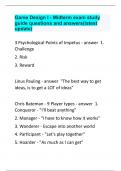
Game Design I - Midterm exam study guide questions and answers(latest update)
3 Psychological Points of Impetus 1. Challenge 2. Risk 3. Reward Linus Pauling "The best way to get ideas, is to get a LOT of ideas" Chris Bateman - 9 Player types 1. Conqueror - "I'll beat anything" 2. Manager - "I have to know how it works" 3. Wanderer - Escape into another world 4. Participant - "Let's play together" 5. Hoarder - "As much as I can get" 6. Zoner - "Time has lost all Meaning" 7. Juggernaut - "Knock 'em down" 8. Monster - "Evil is my middle name" 9. Hotshot - The thrill of the ride Mihalyi Csikszentmihalyi - Stages of Creativity 1. Preparation 2. Incubation 3. Insight 4. Evaluation 5. Elaboration Mihalyi Csikszentmihalyi - FLOW Diagram x-axis: Skill y-axis: Challenge Too much skill, not enough challenge = boredom Tom much challenge, not enough skill = frustration Raph Koster "Learning is fun" Sid Meier "Fun is a series of meaningful choices" - Has noticeable consequences - Has emotional weight - Long term impact - Requires deliberation/cooperation - Changes the state of the game - You have a sense of consequence when making the decision Roger Callois Agon - Challenge Alea - Chance Mimicry - Simulation Ilinx - Vertigo (out of control) Scale: Paidia = Free form Ludus = More structure M.D.A. Mechanics (systems or rules) Dynamics (play of the game) Aesthetics (fun) Marc LeBlanc - 8 kinds of Fun 1. Sensations - Games as sense pleasure 2. Fantasy - Games as make believe 3. Narrative - Games as drama 4. Challenge - Games as an obstacle course 5. Fellowship - Games as a social framework 6. Discovery - Games as uncharted territory 7. Expression - Games as self-discovery 8. Submission - Games as a passtime Game Designers you should know Sigeru Miyamoto - Donkey Kong, Nintendo Will Wright - The Sims Sid Meier - Civilization Warren Spector - Theif, Paper-based RP games Richard Garfield - MTG Peter Molynuex - RTS Gary Gygax - D&D Richard Garriott - Ultima Iterative Design Process 1. Brainstorming 2. Physical Prototype 3. Presentation 4. Software Prototype 5. Design Documentation 6. Production 7. Quality Assurance Dramatic Elements - Challenge - Play - Characters - Premise - Story - World Building - Dramatic Arc Player Interaction Patterns - Single Player vs. Game - Multiple Individual Players vs. Game - Player vs. Player - Unilateral Competition - Multilateral Competition - Cooperative Play - Team Competition Aspects of Flow - The loss of self-consciousness - A challenging activity that requires skill - Clear goals and feedback - The merging of action and awareness - Concentration on the task at hand - The paradox of control - The transformation of time Key Principles of Game Design 1. Simplicity - minimum info needed to succeed 2. Expressibility - playing the way they want 3. Learning curve - how hard is it to learn to play Rule of 3s - Introduce new mechanic - Practice mechanic - Reinforce mechanic later 5 Golden Rules 1. One button, one function 2. Draw from the familiar 3. Be consistent 4. Use the simplest possible interface 5. Structure the learning curve 5 Cautions 1. Document it 2. Icons for speed, text for clarity 3. Shortcuts are only for advanced users 4. Provide options and Save Options 5. Allow skipping of non-interactive cut-scenes Brainstorming Best Practices 1. State a challenge 2. No criticism 3. Vary the method 4. Playful environment 5. Put it on the wall 6. Go for lots of ideas 7. Don't go too long Game Objectives - Capture - Chase - Race - Alignment - Rescue or escape - Forbidden act - Construction - Exploration - Solution - Outwit McGonagal "What is a game?" - Activity with goal - Rules or limitations on how to achieve goal - With some form of feedback - Voluntary participation Formal Elements of Games - Player - Objective - Procedures - Rules - Resources - Conflict - Boundaries - Outcome
Written for
- Institution
- Game Design
- Course
- Game Design
Document information
- Uploaded on
- May 12, 2024
- Number of pages
- 15
- Written in
- 2023/2024
- Type
- Exam (elaborations)
- Contains
- Questions & answers
Subjects
-
game design i midterm exam study guide

Also available in package deal