TCTX 5300: Instructional Structures Questions and Answers 2024
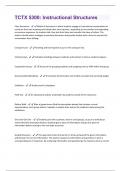
Class Discussion - Model of discussion in which students engage in instructional conversations to construct their own meaning and initiate their own inquiries, responding to one another and expanding on previous responses. As students talk, they test their ideas and consider the ideas of others. The teacher should select strategies to promote discussion and provide studnts with a focus to prevent the conversation from drifting. Computer Lab - Teaching and learning that occurs in the computer lab. Conferencing - Individual meetings between students and teachers to discuss student progress. Cooperative Group - Structure for grouping students and assigning roles to fulfill within the group. Demonstration/Modeling - The teacher demonstrates and models concepts that are being taught. Exhibition - Student work is displayed. Field Trip - An educational activity undertaken by students outside of the classroom. Gallery Walk - After a jigsaw lesson (find the description below) that includes a visual representation, each group selects a speaker to explain their wok as the students rotate among the exhibitions. Give One-Get One - Students pair with a partner, work in small groups, or go on a walk-about review (find the description below). Students give a piece of information and get one piece of information before moving to the next topic or person. Guided Discovery - This approach invites the learner to think, go beyond the given information, and discover the correct information. The teacher sequences information and questions to elicit a corresponding set of responses. By combining information and questioning, the teachers elicits a correctresponse from the learner. This converging process leads the student to discover the sought concept or principle. Inquiry - Students collect data to generate a hypothesis/conjecture given a situation/event. Jigsaw - This is a cooperative learning structure. Students work in learning teams composed of experts who research subtopics. Experts from each team meet to discuss their findings, return home to their original team, and teach their findings to the group. Labs/Experiments - Student-centered hands-on activity using tools to explore scientific principles. Peer Evaluation - A form of collaborative, usually small-group, learning in which students informally discuss the results of their efforts. Small Group Instruction - Teachers create groups for targeted learning. Student Presentations - Students formal present their work to an audience, such as their classmates, parents, teachers, students, or the general public. Ticket Out - Students are offered "tickets" out of class for their answers to reflective questions. A review of key points from the lesson helps students sort through what they have learned. These can be written on a small piece of paper and handed to the teacher at the end of class. Tutorials - Small-group teaching sessions led by a tutor to provide individual assistance. Walk-About Review - Students walk around the room and gather information from others at random. They collect new information to add to their notes. Whole Class Instruction - Teacher-led whole class instruction.
Written for
- Institution
- TCTX 5300 Instructional Structures
- Course
- TCTX 5300 Instructional Structures
Document information
- Uploaded on
- May 10, 2024
- Number of pages
- 2
- Written in
- 2023/2024
- Type
- Exam (elaborations)
- Contains
- Questions & answers
Subjects
-
tctx 5300 instructional structures

Also available in package deal