

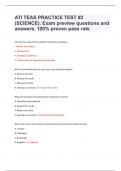
ATI TEAS PRACTICE TEST #2 (SCIENCE). Exam preview questions and answers. 100% proven pass rate
ATI TEAS PRACTICE TEST #2 (SCIENCE). Exam preview questions and answers. 100% proven pass rate The first four steps of the scientific method are as follows: I. Identify the problem II. Ask Questions III. Develop a hypothesis IV. Collect data and experiment on that data Which of the following is the next step in the scientific method? A. Observe the data B. Analyze the results C. Measure the data D. Develop a conclusion - B. Analyze the results What are two types of measurement important in science? A. Quantitive and numerical B. Analyze the results C. Measure the data D. Develop a conclusion - D. Quantitive and Qualitative What is the name of the structure that prevents food from entering the airway? A. Trachea B. Esophagus C. Diaphragm D. Epiglottis - D. EpiglottisWhich substance makes up the pads that provide support between the vertebrae? A.Bone B.Cartilage C.Tendon D. Fat - B. Cartilage The two criteria for classifying epithelial tissue are cell layers and _______. Which of the following completes the sentence above? A. Cell composition B. Cell abosorption C. Cell Shape D. Cell stratification - C. Cell shape Where is the parathyroid gland located? A. Neck B. Back C. Side D. Brain - A. Neck How many organ systems are in the human body? A. 12 B. 15 C. 9 d.11 - D. 11 Which element within the respiratory system is responsible for removing foreign matter from the lungs? A. Bronchial tubes B. CilaC. Trachea D. Alveoli - B. Cilia Organized from high to low, the hierarchy of the human body's structure is as follows: organism, organ system, organs, tissues. Which of the following comes next? A. Molecules B. Atoms C. Cells D. Muscle - C. Cell What is the name of the process in the lungs by which oxygen is transported from the air to the blood? A. Osmosis B. Diffusion C. Dissipation D.Reverse Osmosis - B. Diffusion In human anatomy, an organ is best described as - a group of tissues that together perform a specific function. Vaccines function through which of the following mechanisms? - Vaccine exposure creates dormant B cells for the secondary immune response. After several minutes of strenuous activity, lactic acid can build up in skeletal muscle as a result of - fermentation. Within the pancreas, the structure(s) responsible for production of insulin is/are the - islets of Langerhans. Which of the following is the correct order of the steps immediately before and after an action potential? - Depolarization, threshold, repolarization, refractory period
Document information
- Uploaded on
- May 7, 2024
- Number of pages
- 18
- Written in
- 2023/2024
- Type
- Exam (elaborations)
- Contains
- Questions & answers


