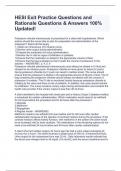
HESI Exit Practice Questions and Rationale Questions & Answers 100% Updated!
Potassium chloride intravenously is prescribed for a client with hypokalemia. Which actions should the nurse take to plan for preparation and administration of the potassium? Select all that apply. 1. Obtain an intravenous (IV) infusion pump. 2.Monitor urine output during administration. 3.Prepare the medication for bolus administration. 4.Monitor the IV site for signs of infiltration or phlebitis. 5.Ensure that the medication is diluted in the appropriate volume of fluid. 6.Ensure that the bag is labeled so that it reads the volume of potassium in the solution. - ANSWERS1, 2, 4, 5, 6 Potassium chloride administered intravenously must always be diluted in IV fluid and infused via an infusion pump. Potassium chloride is never given by bolus (IV push). Giving potassium chloride by IV push can result in cardiac arrest. The nurse should ensure that the potassium is diluted in the appropriate amount of diluent or fluid. The IV bag containing the potassium chloride should always be labeled with the volume of potassium it contains. The IV site is monitored closely because potassium chloride is irritating to the veins and there is risk of phlebitis. In addition, the nurse should monitor for infiltration. The nurse monitors urinary output during administration and contacts the health care provider if the urinary output is less than 30 mL/hour. A client admitted to the hospital with chest pain and a history of type 2 diabetes mellitus is scheduled for cardiac catheterization. Which medication would need to be withheld for 24 hours before the procedure and for 48 hours after the procedure? 1.Glipizide 2.Metformin 3.Repaglinide 4.Regular insulin - ANSWERS2 Metformin needs to be withheld 24 hours before and for 48 hours after cardiac catheterization because of the injection of contrast medium during the procedure. If the contrast medium affects kidney function, with metformin in the system the client would be at increased risk for lactic acidosis. The medications in the remaining options do not need to be withheld 24 hours before and 48 hours after cardiac catheterization. A client who had cardiac surgery 24 hours ago has had a urine output averaging 20 mL/hour for 2 hours. The client received a single bolus of 500 mL of intravenous fluid. Urine output for the subsequent hour was 25 mL. Daily laboratory results indicate that the blood urea nitrogen level is 45 mg/dL (16 mmol/L) and the serum creatinine level is 2.2 mg/dL (194 mcmol/L). On the basis of these findings, the nurse would anticipate that the client is at risk for which problem? 1. Hypovolemia 2.Acute kidney injury 3.Glomerulonephritis 4.Urinary tract infection - ANSWERS2 The client who und
Document information
- Uploaded on
- May 7, 2024
- Number of pages
- 47
- Written in
- 2023/2024
- Type
- Exam (elaborations)
- Contains
- Questions & answers