

SFSU BIO 230 FINAL EXAM QUESTIONS AND ANSWERS ALL CORRECT
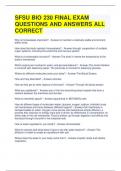
SFSU BIO 230 FINAL EXAM QUESTIONS AND ANSWERS ALL CORRECT Why is homeostasis important? - Answer-to maintain a relatively stable environment, within limits. How does the body maintain homeostasis? - Answer-through cooperation of multiple organ systems, including the endocrine and nervous system What is a homeostatic set point? - Answer-The level in where the temperature of the body is maintained. Which organs are involved in water, and glucose balance? - Answer-The small intestine is involved with balancing water. The pancreas is involved in balancing glucose. Where do different molecules enter your body? - Answer-The Blood Stream. How are they absorbed? - Answer-osmosis How do they get to other regions of the body? - Answer-Through the blood stream What are capillaries? - Answer-any of the fine branching blood vessels that form a network between the arterioles and venules. What is interstitial space? - Answer-space/fluid in BETWEEN cells How do different types of molecules (water, glucose, oxygen, sodium, chloride) cross cell membranes and travel between different organs? - Answer-Cell membrane is semipermeable to water. Oxygen move across cell membranes simple diffusion, a process that requires no energy input and is driven by differences in concentration on either side of the cell membrane. Food is broken up through digestion and diffuse into the blood through microvilli in the intestinal wall. How is water regulated in your body? - Answer-Homeostasis What is osmosis and what does it have to do with water balance? - Answer-The diffusion of water to create an equilibrium with salt. Where does the water in your body come from? - Answer-Liquids, foods and cellular respiration. How does your body eliminate water? - Answer-Through urinating, sweating, and feces. Which organ systems are involved in water balance and what is their role? - Answer- kidney regulates by controlling water concentration in blood plasma What happened to Cynthia Lucero? - Answer-Through the consumption of too much water she flooded her cells to balance the equilibrium of solutes and thus caused swelling of the cells Is Gatorade hypotonic or hypertonic to the blood of a normal person? - Answer- gatorade is hypotonic to the blood (more sodium outside cell) diluted by gatorade How does cholera affect water homeostasis? - Answer-Cholera causes dehydration. If 2 solutions are separated by a semipermeable membrane (permeable to water) and side A is hypertonic to side B, which way will the water molecules be most likely to move? - Answer-To side B to dilute the solutes How is the structure of the small intestine related to its function? - Answer-Absorption by osmosis through the cell walls into the vascular capillaries inside the villi How are glucose levels regulated in your body? - Answer-(homeostasis) Regulated through the liver, pancreas, and muscles What happens when your body cannot control glucose levels? - Answer-Insulin receptor is not functioning, then the insulin will not be able to travel through the cell membrane, pancreas and you develop diabetes. Where does the glucose in your body come from? - Answer-We eat food, the food gets absorbed, excess glycogen is stored in the liver, which later we can use to convert into glucose. Pancreas - responsible for regulating the use of insulin to use glucose as energy. Glut4 transfers glucose from blood - cell membrane - tissues/muscles What is insulin and how does it work? - Answer-Insulin is a hormone produced by your pancreas as the concentration of glucose in your bloodstream rises. Your pancreas senses this increase and is stimulated to release insulin into your bloodstream which plays a role in regulating the concentration of glucose in your blood through a process known as glucose homeostasis. What is glucagon and how does it work? - Answer-When glucagon binds to the glucagon receptors, the liver cells convert the glycogen into individual glucose molecules and release them into the bloodstream. Which organ systems are involved in glucose balance and what is their role? - Answer- Liver, pancreas, muscle What is diabetes? - Answer-A condition whereby the body is not able to regulate levels of glucose (a sugar) in the blood, resulting in too much glucose being present in the blood. In type two this is due to the your cells becoming resistant to insulin and type one you do not produce insulin. What are the warning signs of diabetes? - Answer-1. Excessive thirst/frequent urination, 2. Unexplained weight loss or gain, 3. Weakness and fatigue, 4. Tingling or numbness in hands, legs or feet, 5. Blurred vision, 6. Dry and itchy skin, 7. Frequent infections, 8. Cuts or bruises heal slowly.
Document information
- Uploaded on
- May 6, 2024
- Number of pages
- 7
- Written in
- 2023/2024
- Type
- Exam (elaborations)
- Contains
- Questions & answers


