CALT Exam..docx
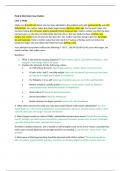
Adolph Kussmaul (1877) - correct answer "word blindness" Dr. Rudolph Berlin (1887) - correct answer Came up with the word "Dyslexia' James Hinschelwood (1897) - correct answer reported cases of "congenital wordblindness", called on schools to screen and treat it Dr. W. Pringle Morgan (1896) - correct answer Wrote 1st medical journal on word blindness Grace Fernald (1920s) - correct answer Developed the VAKT Method (Fernald Method) Samuel T. Orton (1925) - correct answer Neurologist, associated dyslexia as a "language disorder", Coined the term "strephosymbolia" (twisted symbols) Anna Gillingham (1930s) - correct answer Developed multisensory teaching with Orton, Trained 50 teachers with Sally Childs Aylett Cox - correct answer Developed Alphabetic Phonics at Scottish Rite Hospital, Worked with Sally Childs Drs. Sally and Bennett Shaywitz - correct answer Watched the brain read using fMRI, Tracked the prevalence of Dyslexia and whether is was a developmental lag vs. persists over time Chomsky - correct answer Said children are pre-wired to learn oral language but reading and writing are acquired Isabelle Liberman - correct answer Phonological Processes NIH Prior to 1980 dyslexia definition - correct answer Exclusionary- when you couldn't figure out the problem it must be dyslexia Dyslexia Definition - correct answer Deficit of phonological component of language IQ discrepancy - correct answer Research shows this to be an invalid model (IQ decided based on a reading test, unfair for children with dyslexia) Specific Learning Disability - correct answer Disorder with language, may make it difficult to thing, listen, speak, read, write, do math, etc. ADD/ADHD Historically - correct answer minimal brain dysfunction ADD/ADHD Comorbity - correct answer 30-50% Twin Studies - correct answer Concordance rate 70% in identical pairs, 48% in fraternal Purpose of Assessment - correct answer Identify issues, Determine progress, Determine placement or exit from therapy Assessment - correct answer The collection of information to make decisions about learning and instruction Diagnostic Test - correct answer A test to determine more specifically the exact nature a student, or students', learning problems. It con help the teacher identify ways to better assist the the students. Informal Test - correct answer A test that is not standardized, can see if students need further screening or different instruction Formal Test - correct answer Standardized test, uses specific procedures Norm Referenced Test - correct answer Compare a students performance with their peers Criterion Referenced Test - correct answer Performance is measured by how well student has mastered the standard, show knowledge attained and knowledge that needs to be acquired Curriculum Referenced Test - correct answer Variation of Criterion, Questions based on what is taught in the classroom CTOPP-2 - correct answer Measures- phonological awareness, phonological memory, and rapid naming GORT-5 - correct answer Fluency PPVT-4 - correct answer Receptive Vocabulary-Picture Test Formative Data Collection - correct answer Gather information about a child's progress in certain skills of knowledge, short term instructional goals, criterion/curriculum referenced test Summative Data Collection - correct answer Gathers information about a child's accumulation and integration of knowledge, long term, norm-referenced test Profile - correct answer Graphic Representation of Scores Standard Scores - correct answer Represent deviation from mean in age group Standard Deviation - correct answer 15 Grade Equivalent Score - correct answer Compare performance on grade level material against average performance of students at other grade levels Age Equivalent Score - correct answer age at which a given raw score is average, not precise for reporting ADD/ADHD Tests - correct answer Conners and Vanderbilt Phonology - correct answer The study of language sounds and sound patterns Phoneme - correct answer Smallest unit of sound Morphology - correct answer Study of meaningful units of language and word formation Morpheme - correct answer Smallest meaningful unit of language Semantics - correct answer Meaning of words and how they are used Syntax - correct answer Structure of language, grammar Pragmatics - correct answer Rules for communicating effectively in social situations Top Down Theory - correct answer Whole language, analytic Kenneth and Yetta Goodman and Frank Smith - correct answer Whole lanugauge, guessing game
Written for
- Institution
- CALT
- Course
- CALT
Document information
- Uploaded on
- May 5, 2024
- Number of pages
- 8
- Written in
- 2023/2024
- Type
- Exam (elaborations)
- Contains
- Questions & answers
Subjects