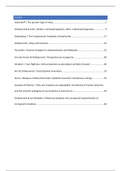
PAPERS
Jackendoff | The peculiar logic of value..................................................................................... 2
Schilperoord & Cohn | Before: unimodal linguistics, After: multimodal linguistics .................. 9
Goldenberg | The Fundamental Templates of Quality Ads ..................................................... 17
Schilperoord | Ways with pictures........................................................................................... 25
Forceville | Pictorial metaphor in advertisements and billboards .......................................... 32
Van den Hoven & Schilperoord | Perspective by incongruity ................................................. 40
Schubert | Your Highness: Vertical positions as perceptual symbols of power ...................... 46
Arts & Schilperoord | Visual Optimal Innovation .................................................................... 53
Giora | Weapons of Mass Distraction: Optimal innovation and pleasure ratings................... 55
Jacobson & Werner | Why cast shadows are expendable: Insensitivity of human observers
and the inherent ambiguity of cast shadows in pictorial art. .................................................. 59
Schilperoord & van Weelden | Rhetorical shadows: the conceptual representation of
incongruent shadows. .............................................................................................................. 64
,JACKENDOFF | THE PECULIAR LOGIC OF VALUE
Value = an abstract valence and quantity that an individual associates with a past, present, or
contemplated object or action in the environment, and is used to help determine what actions to take.
• Affective value How good is the action for someone
• Normative value How good is the action of someone
o moral value, legality, etiquette, and religious value
• Esteem How good a reputation someone has
Value is a conceptualized abstract property attributed to (conceptualized) objects, persons, and
actions. It is not directly perceptible. A value has two dimensions:
• A valence (good/positive of bad/negative)
• A magnitude (better or worse) -> only numerical quantity in case of monetary value.
There are three basic elements to a system of values.
1. For something to have values, there must be principles that assign values to entities on various
grounds. (If such-and-such takes place, then such-and-such a value is assigned = input rules).
2. Just assigning values is of little use unless values have some effect on behavior. So, there must
be principles that favor performing certain actions on the basis of values, i.e. rules in which
value appears in the antecedent of the rule (‘outputs’ of the value system -> if such-and-such
an action has such-and-such a value, then do it).
3. In between input and output there may be inferences that involve values in both the
antecedent and consequent, that is, reasoning internal to the value system.
SIX KINDS OF VALUE
• Affective value
If it has a positive of negative effect on someone, if it yields pleasure or suffering, a benefit or a cost.
It is about the effect on individual participants of the event and not about the event per se.
Eating your dinner will be good for you.
Being overweight is bad (for Max).
Drinking milk is good = objective A-value. (implicit generic individual)
Drinking milk is good for Bill = subjective A-value.
Objective A-value is still not value in the world, independent of observers.
• Resource value
If it is good for someone to have: the object is valuable. Something may be good to have, because it
offers the potential for an event with affective value. Food has R-value, because it offers the potential
of being eaten, which is in turn an action of A-value to the eater. A famous painting and money also
have R-value.
This piece of land is very valuable/worth a lot. = objective
Anyone will value the land highly.
This piece of land is very valuable/worth a lot to Harry = subjective
It leaves the question open if it means anything to anyone else.
2
, • Quality
An object or event can be valued in terms of its quality relative to other objects or events of the same
type. If the for-phrase is absent, there is still an implicit purpose; the default interpretation is that is
has quality for its proper function -> what the object is usually used for. The world ‘excellent’ comes
naturally in expressions of Q-value, in contrast to A-value.
The spatula is good for frosting cakes with.
This is a good/terrible computer.
That was an excellent/miserable back dive.
• Prowess
It rates quality of an individual performance.
Harry is good/excellent (at singing). [Prowess]
Harry is a good/excellent singer. [Prowess]
This is a good/excellent knife [Q-value]
• Normative value
This concerns conformance to social norms: moral/ethical value, religious value, and valuation
according to standards of etiquette. You can now also use good and bad besides right and wrong. The
event must be something that the person does intentionally, it does not just happen or accidentally
happen. There are interactions between N-value and A-value: actions that are good of you are often
good for someone else: acts of charity, or it feels good to do something.
It is good of Harry to wash the dished without being asked. [action-focused]
Taking cookies without asking is bad/wrong of Harry. [action-focused]
Harry is good/right to wash the dished without being asked. [person-focused]
Washing the dishes is good of Harry. [N-value]
Being overweight isn’t good of Harry. [A-value]
The bus should/ought to arrive soon. [predictive, non-value]
You should/ought to take an umbrella in case it rains. [prudential: the A-value of taking an
umbrella is positive, would be good
for you]
You should/ought to wash the dishes. [normative: the N-value of washing
the dished is positive, would be good
of you.]
To Joe, Harry’s a good guy. [subjective]
• Esteem
Composites of person-focused N-value, prowess, status in the dominance hierarchy, wealth
(accumulation of R-value) and perhaps other factors such as simple personal attractiveness. Unlike
prowess, esteem is a socially rooted value.
Harry is prestigious/well-respected. Harry has a good reputation. [objective]
Joe respects Harry. [subjective]
3
, Type of value Applies to: Subjective Objective
Affective (A-)value Events, situations Situation X is good for Y. Situation X is good.
Resource (R-)value Objects Object X is valuable to Y. Object X is valuable.
Quality (Q-)value Events Event X was a good one.
Objects Object Y is good for doing X.
Prowess (P-)value Persons Y is good at doing X.
Normative (N-)value Action-focused, relational To Z, doing X is good of Y. Doing X is food of Y.
Action-focused, absolute To Z, doing X is good. Doing X is good.
Person-focused, relational To Z, Y is good to do X. Person Y is good to do X.
Person-focused, absolute To Z, Y is good. Person Y is good.
Esteem (E-)value Persons X respects Y. Y is prestigious.
SOME INFERENCE RULES: A ROUTE THROUGH THE SYSTEM
• An event E which affects person Y positively/negatively is of positive/negative A-value to Y. (A)
E can just be an event that Y experiences, such as a delicious meal (positive) or the onset of a disease
(negative). However, the more interesting case is when E is an action on someone else’s part, in which
case Y is a beneficiary (positive) or patient (negative) of the action: it’s A-good to be helped and A-bad
to be victimized. This is one input route into the value system.
• If X acts in a way that is A-good/bad for Y, then that action is N-good/bad of X. (B)
It is (N-)good to be nice to people.
• If X has performed some action that is N-good/bad, then X is N-good/bad. (C)
If you do something N-good, you’re an N-good person.
• If X has performed some action that is N-good/bad, then X is N-better/worse for having done
so. (D)
Good acts add to you total ‘goodness’, and bad acts subtract from it.
• X’s E-value (value as a person) is a function of X’s N-value, X’s P-value, X’s wealth (accumulated
R-value), X’s dominance, X’s attractiveness, and… (E)
One of the factors in this rule is commonly expressed by “You’re known by the company you keep”:
people adjust an individual’s esteem in terms of the esteem of the people he or she associates with
(“Oh, my! YOU know Noam Chomsky?” – which may express a positive or negative effect on the
addressee’s esteem, depending on the speaker’s opinion of Chomsky)
• If Y is of high/low E-value (to X), it’s A-good/bad (for X) to associate with Y. (F)
One particular consequence of this rule concerns the esteem derived from group membership: people
prefer to associate with and do business with members of their own group and with members of high-
status groups, all things being equal.
4
Jackendoff | The peculiar logic of value..................................................................................... 2
Schilperoord & Cohn | Before: unimodal linguistics, After: multimodal linguistics .................. 9
Goldenberg | The Fundamental Templates of Quality Ads ..................................................... 17
Schilperoord | Ways with pictures........................................................................................... 25
Forceville | Pictorial metaphor in advertisements and billboards .......................................... 32
Van den Hoven & Schilperoord | Perspective by incongruity ................................................. 40
Schubert | Your Highness: Vertical positions as perceptual symbols of power ...................... 46
Arts & Schilperoord | Visual Optimal Innovation .................................................................... 53
Giora | Weapons of Mass Distraction: Optimal innovation and pleasure ratings................... 55
Jacobson & Werner | Why cast shadows are expendable: Insensitivity of human observers
and the inherent ambiguity of cast shadows in pictorial art. .................................................. 59
Schilperoord & van Weelden | Rhetorical shadows: the conceptual representation of
incongruent shadows. .............................................................................................................. 64
,JACKENDOFF | THE PECULIAR LOGIC OF VALUE
Value = an abstract valence and quantity that an individual associates with a past, present, or
contemplated object or action in the environment, and is used to help determine what actions to take.
• Affective value How good is the action for someone
• Normative value How good is the action of someone
o moral value, legality, etiquette, and religious value
• Esteem How good a reputation someone has
Value is a conceptualized abstract property attributed to (conceptualized) objects, persons, and
actions. It is not directly perceptible. A value has two dimensions:
• A valence (good/positive of bad/negative)
• A magnitude (better or worse) -> only numerical quantity in case of monetary value.
There are three basic elements to a system of values.
1. For something to have values, there must be principles that assign values to entities on various
grounds. (If such-and-such takes place, then such-and-such a value is assigned = input rules).
2. Just assigning values is of little use unless values have some effect on behavior. So, there must
be principles that favor performing certain actions on the basis of values, i.e. rules in which
value appears in the antecedent of the rule (‘outputs’ of the value system -> if such-and-such
an action has such-and-such a value, then do it).
3. In between input and output there may be inferences that involve values in both the
antecedent and consequent, that is, reasoning internal to the value system.
SIX KINDS OF VALUE
• Affective value
If it has a positive of negative effect on someone, if it yields pleasure or suffering, a benefit or a cost.
It is about the effect on individual participants of the event and not about the event per se.
Eating your dinner will be good for you.
Being overweight is bad (for Max).
Drinking milk is good = objective A-value. (implicit generic individual)
Drinking milk is good for Bill = subjective A-value.
Objective A-value is still not value in the world, independent of observers.
• Resource value
If it is good for someone to have: the object is valuable. Something may be good to have, because it
offers the potential for an event with affective value. Food has R-value, because it offers the potential
of being eaten, which is in turn an action of A-value to the eater. A famous painting and money also
have R-value.
This piece of land is very valuable/worth a lot. = objective
Anyone will value the land highly.
This piece of land is very valuable/worth a lot to Harry = subjective
It leaves the question open if it means anything to anyone else.
2
, • Quality
An object or event can be valued in terms of its quality relative to other objects or events of the same
type. If the for-phrase is absent, there is still an implicit purpose; the default interpretation is that is
has quality for its proper function -> what the object is usually used for. The world ‘excellent’ comes
naturally in expressions of Q-value, in contrast to A-value.
The spatula is good for frosting cakes with.
This is a good/terrible computer.
That was an excellent/miserable back dive.
• Prowess
It rates quality of an individual performance.
Harry is good/excellent (at singing). [Prowess]
Harry is a good/excellent singer. [Prowess]
This is a good/excellent knife [Q-value]
• Normative value
This concerns conformance to social norms: moral/ethical value, religious value, and valuation
according to standards of etiquette. You can now also use good and bad besides right and wrong. The
event must be something that the person does intentionally, it does not just happen or accidentally
happen. There are interactions between N-value and A-value: actions that are good of you are often
good for someone else: acts of charity, or it feels good to do something.
It is good of Harry to wash the dished without being asked. [action-focused]
Taking cookies without asking is bad/wrong of Harry. [action-focused]
Harry is good/right to wash the dished without being asked. [person-focused]
Washing the dishes is good of Harry. [N-value]
Being overweight isn’t good of Harry. [A-value]
The bus should/ought to arrive soon. [predictive, non-value]
You should/ought to take an umbrella in case it rains. [prudential: the A-value of taking an
umbrella is positive, would be good
for you]
You should/ought to wash the dishes. [normative: the N-value of washing
the dished is positive, would be good
of you.]
To Joe, Harry’s a good guy. [subjective]
• Esteem
Composites of person-focused N-value, prowess, status in the dominance hierarchy, wealth
(accumulation of R-value) and perhaps other factors such as simple personal attractiveness. Unlike
prowess, esteem is a socially rooted value.
Harry is prestigious/well-respected. Harry has a good reputation. [objective]
Joe respects Harry. [subjective]
3
, Type of value Applies to: Subjective Objective
Affective (A-)value Events, situations Situation X is good for Y. Situation X is good.
Resource (R-)value Objects Object X is valuable to Y. Object X is valuable.
Quality (Q-)value Events Event X was a good one.
Objects Object Y is good for doing X.
Prowess (P-)value Persons Y is good at doing X.
Normative (N-)value Action-focused, relational To Z, doing X is good of Y. Doing X is food of Y.
Action-focused, absolute To Z, doing X is good. Doing X is good.
Person-focused, relational To Z, Y is good to do X. Person Y is good to do X.
Person-focused, absolute To Z, Y is good. Person Y is good.
Esteem (E-)value Persons X respects Y. Y is prestigious.
SOME INFERENCE RULES: A ROUTE THROUGH THE SYSTEM
• An event E which affects person Y positively/negatively is of positive/negative A-value to Y. (A)
E can just be an event that Y experiences, such as a delicious meal (positive) or the onset of a disease
(negative). However, the more interesting case is when E is an action on someone else’s part, in which
case Y is a beneficiary (positive) or patient (negative) of the action: it’s A-good to be helped and A-bad
to be victimized. This is one input route into the value system.
• If X acts in a way that is A-good/bad for Y, then that action is N-good/bad of X. (B)
It is (N-)good to be nice to people.
• If X has performed some action that is N-good/bad, then X is N-good/bad. (C)
If you do something N-good, you’re an N-good person.
• If X has performed some action that is N-good/bad, then X is N-better/worse for having done
so. (D)
Good acts add to you total ‘goodness’, and bad acts subtract from it.
• X’s E-value (value as a person) is a function of X’s N-value, X’s P-value, X’s wealth (accumulated
R-value), X’s dominance, X’s attractiveness, and… (E)
One of the factors in this rule is commonly expressed by “You’re known by the company you keep”:
people adjust an individual’s esteem in terms of the esteem of the people he or she associates with
(“Oh, my! YOU know Noam Chomsky?” – which may express a positive or negative effect on the
addressee’s esteem, depending on the speaker’s opinion of Chomsky)
• If Y is of high/low E-value (to X), it’s A-good/bad (for X) to associate with Y. (F)
One particular consequence of this rule concerns the esteem derived from group membership: people
prefer to associate with and do business with members of their own group and with members of high-
status groups, all things being equal.
4