
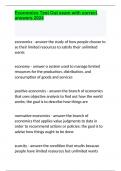
Economics Test Out exam with correct answers 2024
economics - answer-the study of how people choose to se their limited resources to satisfy their unlimited wants economy - answer-a system used to manage limited resources for the production, distribution, and consumption of goods and services positive economics - answer-the branch of economics that uses objective analysis to find out how the world works; the goal is to describe how things are normative economics - answer-the branch of economics that applies value judgments to data in order to recommend actions or policies; the goal is to advise how things ought to be done scarcity - answer-the condition that results because people have limited resources but unlimited wants tradeoff - answer-the exchange of one benefit or advantage for another that is thought to be better cost- benefit analysis - answer-a way to compare the costs of an action with the benefits of that action; if benefits exceed costs, then the action is worth taking incentive - answer-any factor that encourages or motivates a person to do something prices, taxes, and laws create incentives that influence how people behave goods - answer-physical articles that have been produced for sale or use; three examples are food, clothing, and cars services - answer-work done by someone else for which a consumer, business, or government is willing to pay; three examples are teaching, gardening, and childcare factors of production - answer-the resources used to produce goods and services; economists define these resources as land, labor and capital entrepreneurship - answer-the willingness and ability to take the risks involved in starting and managing a business capital - answer-the tools, machines, and buildings used to produce goods and services productivity - answer-a measure of the efficiency with which goods and services are produced; productivity is often stated as the quantity produced per person per hour opportunity cost - answer-the value of the next best alternative that is given up when making a choice; this is the measure of what you must give up to get what you most want production possibilities frontier (PPF) - answer-a simple model of an economy that shows all the combinations of two goods that can be produced with the resources and technology currently available economic equity - answer-the fairness with which an economy distributes its resources and wealth economic stem - answer-a society's way of coordinating the production and consumption of goods and services traditional economy - answer-an economic system in which decisions about production and consumption are based on custom and tradition command economy - answer-an economic system in which decisions about production and consumption are made by a powerful ruler or government market economy - answer-an economic system in which economic decisions are left up to individual producers and consumers factor payment - answer-income earned when an individual sells or rents a factor of production that he or she owns; wages are factor payments made to workers in exchange for their labor mixed economy - answer-an economic system in which both the government and individuals play important roles in production and consumption; most modern economies are mixed economies free enterprise system - answer-an economic system in which the means of production are mostly privately owned and operated for profit specialization - answer-the development of skills or knowledge in one aspect of a job or field of interest; people who specialize become expert in a particular area division of labor - answer-the allocation of separate tasks to different people; division of labor in the production of a good or service is based on the principle of specialization voluntary exchange - answer-the act of willingly trading one item of service for another; both parties in a voluntary exchange expect to gain from it barter - answer-the direct exchange of goods or services without the use of money; barter is typical is traditional economies money - answer-a generally accepted medium of exchange that can be traded for goods and services or used to pay debts; money is critical in a market economy economic interdependence - answer-the characteristic of a society in which people rely on others for most of the goods and services they want; the interdependence results from specialization and trade absolute advantage - answer-the condition that exists when someone can produce a good or service using fewer resources than someone else comparative advantage - answer-the condition that exits when someone can produce a good or service at a lower opportunity cost than someone else demand - answer-the quantity of a good or service that consumers are both willing and able to buy at various prices law of demand - answer-an economic law stating that as the price of a good or service increases, the quantity demanded decreases, and vice versa; generally, consumers are happier to buy goods and services at lower prices than at higher prices substitute good - answer-a product that satisfies the same basic want as another product; substitute goods may be used in place of one another complementary good - answer-a product that is used or consumed jointly with another product; such a good usually has more value when paired its complement than when used separately supply - answer-the quantity of a good or service that producers are willing and able to offer for sale at various prices law of supply - answer-an economic law stating that as the price of a good or service increases, the quantity supplied increases, and vice versa; generally, producers are happier to offer goods and services at higher prices than at lower prices revenue - answer-the amount of money a firm receives in the course of doing business; revenue is calculated by multiplying the quantity sold by the price elasticity - answer-a measure of the degree to which the quantity demanded or supplied of a good or service changes in response to a change in price market equilibrium - answer-the point at which the quantity of a product demanded by consumers in a market equals the quantity supplied by producers equilibrium price - answer-the price at which the quantity of a product demanded by consumers equals the quantity supplied by producers equilibrium quantity - answer-the quantity of a good or service demanded by consumers and supplied by producers when the market is in equilibrium price controls - answer-government-imposed limits on the prices that producers may charge in the market price floor - answer-a maximum price set by the government to prevent prices from going too high; rent control laws set a price ceiling on the amount of rent a land-lord can charge a tenant rationing - answer-the controlled distribution of a limited supply of a good or service black market - answer-an illegal market in which goods are traded at prices or in quantities higher than those set by law market structure - answer-the organization of a market, based mainly on the degree of competition; there a four basic market structures perfect competition - answer-a market structure in which many producers supply and identical product; this is the most efficient structure, with prices set by supply and demand monopoly - answer-a market structure in which a single producer supplies a unique product that has no close substitutes; in an unregulated monopoly, the producer sets prices oligopoly - answer-a market structure in which a few firms dominate the market and produce similar or identical goods; this structure is more competitive than a monopoly monopolistic competition - answer-a market structure in which many producers supply similar but varied products; this structure is the closest to a perfect competition market failure - answer-a situation in which the market fails to allocate resources efficiently externality - answer-a cost or benefit that arises from production or consumption of a good or service that falls on someone other than the producer or consumer public goods - answer-goods and services that are used collectively and that no can be excluded from using; public goods are not priced by markets; examples include national defense and clean air bank - answer-a business whose main purpose is to receive deposits and make loans assets - answer-anything owned to which a market value can be assigned credit card - answer-a card authorizing the user to buy goods and services with funds borrowed from the bank, store, or other business that issued the card debit card - answer-a card authorizing the user to access his r her own funds on deposit in a bank account; a debit card can be used to buy goods and services or to withdraw money directly from an account saving - answer-setting aside a portion of income for use in the future interest - answer-a periodic payment for the use of borrowed funds; when calculated as a simple percentage of the amount borrowed, this payment is also known as simple interest principal - answer-the amount of money burrowed, or the amount of money still owed on a loan, apart from the interest investing - answer-using money with the intention of making a financial gain diversification - answer-a method of lowering risk by investing in a wide variety of financial assets sole partnership - answer-a business owned and managed by one person liability - answer-the legal representation to repay debts and to pay for damages resulting from a lawsuit partnership - answer-a business owned by two or more co-owners who share profits from the business and are legally responsible for the business's debts corporation - answer-a business owned by shareholders who have limited liability for the firm's debts; because it is considered a legal entity, a corporation can conduct business affairs in its name multinational corporation - answer-a corporation that does business in more than one country business franchise - answer-an arrangement in which a parent company, or franchiser, distributes its products or services through independently owned outlets; the outlet owners, or franchisees, pay for the exclusive right to use the parent company's trade name and sell its products or provide its services cooperative - answer-a business organization that is jointly owned and operated by a group of individuals for their mutual benefit nonprofit organization - answer-an organization that functions much like a business but does not appear to make a profit labor force - answer-the portion of the population that has paid work or is seeking work; active members of the military are not considered part of the labor force offshoring - answer-relocating work and jobs to another country equilibrium wage - answer-the rate of pay that results in neither a surplus or shortage of labor; if the wage for a job is set above equilibrium level, too many workers will apply; if it is set below, too few will apply fringe benefits - answer-nonwage compensations offered to workers in addition to pay; examples include health insurance plans and paid vacations wage gap - answer-a difference in the wages earned by various groups in society affirmative action - answer-policies designed to promote the hiring of individuals from groups that have historically faced job discrimination; such groups include minorities, women, and people with disabilities collective bargaining - answer-negotiations between an employer and a group of employees, usually represented by a labor union, to determine the conditions of employment right-to-work law - answer-a law that prohibits employers from making union membership a requirement for getting or keeping a job; twenty two states have right-to-work laws regulation - answer-the establishment, by the government, of rules aimed at influencing the behavior of firms and individuals; regulation can involve setting prices, establishing product and workplace standards, and limiting entry into an industry eminent domain - answer-the power of a government to take an individual's property for public use if the owner is fairly compensated regulatory agency - answer-a unit of government created to set and enforce standards for a particular industry or area of economic activity merger - answer-the combining of two or more separately owned firms into a single firm deregulation - answer-the process of removing government restrictions on firms in order to promote competition or encourage economic activity common resource - answer-a resource that everyone has access to and that can easily be overused or destroyed; examples include the atmosphere and the oceans government failure - answer-inefficient allocation of resources caused by government intervention in the economy poverty rate - answer-the percentage of the population that has a family income below a government-defined threshold, or poverty line tax equity - answer-the idea that a tax system should be fair; although people agree with tax equity in principle, they often disagree on how to achieve it tax incidence - answer-the allocation of the burden of a tax between consumers and producers; tax incidence is said to fall on the group that bears the burden of tax, no matter from whom the tax is collected deadweight loss - answer-a loss of productivity or economic well-being for which there is no corresponding gain; a tax causes deadweight loss when the costs to taxpayers of paying the tax exceed the revenues gained by the government tax rate - answer-the percentage that is levied on the value of whatever is being taxed, such as income or property proportional tax - answer-a tax that takes the same share of income at all income levels; a proportional income tax applies the same tax rate to all taxpayers, regardless of income progressive tax - answer-a tax that takes a larger share of income as income increases; a progressive income tax applies a higher tax rate to high incomes than to low incomes regressive tax - answer-a tax that takes a smaller share of income as income increases a regressive tax applies the same tax rate to everyone; but the tax paid represents a larger share of a poorer taxpayer's income than of a wealthier taxpayer's income inflation - answer-an increase in the overall price level of goods and services produced in an economy economic indicators - answer-statistics that help economists judge the health of an economy gross domestic product (GDP) - answer-the market value of all final goods and services producer within a country during a given period of time; in the United States, GDP is the standard measure of the nation's total production unemployment rate - answer-the percentage of the labor force that is not employed but is actively seeking work inflation rate - answer-the percentage increase in the average price level of goods and services from one month or year to the next consumer price index (CPI) - answer-a measure of price changes in consumer goods and services; the CPI shows changes in the cost of living over time business cycle - answer-a recurring pattern of growth and decline in economic activity over time recession - answer-a period of declining national economic activity, usually measured as a decrease in GDP for at least two consecutive quarters (six months) fiscal policy - answer-government policy regarding taxing and spending; fiscal here means "relating to public revenues" monetary policy - answer-central bank policy aimed at regulating the amount of money in circulation; monetary means "relating to money" deficit spending - answer-government spending in excess of what is collected in revenues stagflation - answer-a combination of economic stagnation- or slowdown- and high inflation; during a period of stagflation, gross domestic product growth is slow or zero, unemployment is high, and prices are rising multiplier effect - answer-a ripple effect in which a change in spending by one person or business leads to additional changes in spending by another person or business easy-money policy - answer-a monetary policy designed to accelerate the rate of growth of the money supply-a monetary policy designed to accelerate the rate of growth of the money supply in order to stimulate economic growth tght-money policy - answer-a monetary policy designed to slow the rate of the money supply in order to reduce inflation crowding-out effect - answer-the possible effect of increased government borrowing on businesses and consumers; by driving interest rates up, high levels of government borrowing may crowd private borrowers out of the lending market
Document information
- Uploaded on
- May 3, 2024
- Number of pages
- 26
- Written in
- 2023/2024
- Type
- Exam (elaborations)
- Contains
- Questions & answers


