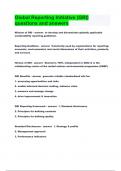
GRI, 2024 Update questions and answers
internal benefits of gri standards - Set vision and strategy - Measure performance - Manage risks - Motivate employees external benefits of gri standards - Build reputation and trust - Attract capital - Engage with stakeholders - Comply with regulatory requirements Key features of gri standards - designed to be used by any org. - comprehensive range of topics - flexible framework for reporting - aligned with best practice in managing and reporting on impacts - regularly updated - free public good available in several languages Who issues the gri standards? global sustainability standards board (GSSB), an independent authority operating under the auspices of GRI what are the universal standards? they apply to all organizations: - GRI 1: Foundation 2021 - GRI 2: General Disclosures 2021 -GRI 3: Material Topics 2021 what is in gri 1 foundation? - purpose of the standards - clarifies critical concepts that provide a common language for reporting with the Standards - explains how to use/ reference the standards - lists requirements that orgs must comply with to report in accordance with the standards - specifies the principles (accuracy, balance, and verifiability) that are fundamental to high quality reporting. - provides additional reporting recommendations. - two appendices and a glossary what is in gri 2 general disclosures? - disclosures detailing org structure and reporting practices, activities and workers, governance, strategy, policies, practices, and stakeholder engagement (for reporting context) what is in gri 3 material topics? - explains and reports on steps by which an org determines and manages its material topics and how the sector standards are used in the process. Impacts are grouped into topics for cohesive reporting. What is in each sector standard? lists topics that are likely to be material for an organization given a specific sector based on the sector's most significant impacts. It also lists disclosures from the GRI Topic Standards for an organization to report. Any organization that wishes to state that its report has been prepared in accordance with the Standards is required to use _________________________ when determining its material topics. the applicable sector standards What are the topic standards? final series in system of GRI standards, each topic standard is dedicated to a particular topic and contains disclosures relevant to that topic. What does each topic standard contain? - overview of the topic - disclosures for an org. to report about its impacts in relation to the topic - how it manages its impacts. An organization uses the ___________ _________ that correspond to the topics it has determined to be material for reporting. Topic Standards What is the GRI Standards Glossary? a separate doc that contains defined terms with specific meaning when used in the context of the Standards. Orgs are required to use the definitions of terms in the GRI standards glossary when reporting in accordance with the GRI standards. What is an effective date? The date from which the use of the Standard is required when reporting in accordance with the Standards. Adoption before the effective date is not required, it is strongly recommended. Each GRI Sector and Topic Standard has its own _____________ ______ effective date Disclosures provide: A structured means for an organization to report information about itself and its impacts. All GRI Standards, except for ___________________________ contain disclosures. GRI 1: Foundation All disclosures included in the GRI standards contain _____________________ requirements. Requirements are presented in _____________ and indicated with the word "_______" bold font; shall To prepare a report in accordance with the Standards, the organization is required to comply with _____________________________ in the reported disclosures all requirements Each disclosure also contains guidance... which the organization is not required to comply with. Standards may include recommendations... where a particular course of action is recommended but not required. The word "should" indicates a recommendation. The word "can" indicates a possibility or option. what are the four key concepts that are at the heart of reporting with the Standards? stakeholder, impact, material topic, and due diligence. what is "impact"? the effect an organization has or could have on the economy, the environment, or people, including on their human rights, as a result of its activities or business relationships. Can be: actual/potential; negative/positive; short-term/long-term; intended/unintended. what is a "material topic" those that represent the organizations most significant impacts on the economy, the environment, and people, including on their human rights. due diligence the process through which an organization identifies, prevents, mitigates, and accounts for how it addresses its actual and potential negative impacts on the economy, environment, and people, including on their human rights. stakeholder individuals or groups that have interests that are or could be affected by an organization's activities. Engaging with ______________(s) is an important part of the process of identifying impacts and assessing their significance which helps an org determine its material topics. what disclosures are required to report in accordance with the GRI standards? GRI 2: General Disclosures 2021, GRI 3: material topics 2021, and disclosures from GRI topic standards for each material topic what are the reporting principles? accuracy, balance, clarity, comparability, completeness, sustainability context, timeliness,
Written for
- Institution
- GRI
- Course
- GRI
Document information
- Uploaded on
- April 30, 2024
- Number of pages
- 13
- Written in
- 2023/2024
- Type
- Exam (elaborations)
- Contains
- Questions & answers
Subjects

Also available in package deal