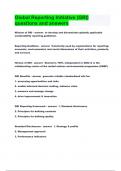
Global Reporting Initiative (GRI) questions and answers
Mission of GRI to develop and disseminate globally applicable sustainability reporting guidelines Reporting Guidlines Voluntarily used by organizations for reporting; economic, environmental, and social dimensions of their activities, products, and services History of GRI Started in 1997, independent in 2002 & is the collaborating centre of the united nations environmental programme (UNEP) GRI Benefits generate reliable standardized info for: 1. assessing opportunities and risks 2. enable informed decision making, enhance value 3. measure and manage change 4. drive improvement & innovation GRI Reporting framework 1. Standard disclosures 2. Principles for defining contents 3. Principles for defining quality Standard Disclosures 1. Strategy & profile 2. Management approach 3. Performance indicators Principles for defining contents 1. Materiality 2. Stakeholder inclusiveness 3. Sustainability content 4. Completeness Principles for defining quality 1. Balance 2. Clarity 3. Accuracy 4. Timeliness 5. Comparability 6. Reliability Core option Contains essential elements of a sustainability report, communicating the economic, environmental, social and government impacts. Comprehensive builds on core option, requires additional standard disclosures of strategy and analysis, governance, ethics and integrity. As well communicate its performance and report indicators to material aspects. GRI Guidelines Structure 1. Principles and Standard Disclosures; criteria that guide choices towards effective GRI reporting. 2. Implementation Manual: the 'how to' section providing G4 advice and recommendations Reporting Principles 1. Stakeholder inclusiveness 2. Sustainable context 3. Materiality 4. Completeness 1. Stakeholder inclusiveness The organization should identify its stakeholders and explain how it has responded to their expectations and wishes 2. Sustainability context Reporting organization should seek to place its performance in the larger context of ecological, social or other limits. This context should add meaning to reported information 3. Materiality The report should cover aspects that: 1. reflect the organizations important economic, environmental and social impacts. 2. Influence the assessments and decisions of stakeholders 4. Completeness Report should include coverage of material aspects & their boundaries, environmental social and economic impacts, enable stakeholders to assess the organizations performance. Materiality is central to GRI reporting determines what an organization should be reporting and communicating to stakeholders should cover topics that reflect the organizations significant economic, environmental and social impacts or what influences the assessments and decisions of stakeholders Standard Disclosures Two types: 1. General standard disclosures 2. Specific standard disclosures
Written for
- Institution
- GRI
- Course
- GRI
Document information
- Uploaded on
- April 30, 2024
- Number of pages
- 4
- Written in
- 2023/2024
- Type
- Exam (elaborations)
- Contains
- Questions & answers
Subjects
-
global reporting initiative gri

Also available in package deal