

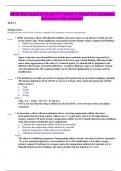
HESI Med Surg Exit Exam (V1 Version 1) Brand New Questions &Answers with rationales
HESI Med Surg Exit Exam (V1 Version 1) Brand New Questions &Answers with rationales TEST 1 Multiple Choice Identify the letter of the choice that best completes the statement or answers the question. 1. While assessing a client with diabetes mellitus, the nurse observes an absence of hair growth on the client's legs. What additional assessment provides further data to support this finding? a. Palpate for the presence of femoral pulses bilaterally. b. Assess for the presence of a positive Homan's sign. c. Observe the appearance of the skin on the client's legs. d. Watch the client's posture and balance during ambulation. ANS: C Signs of chronic arterial insufficiency include decreased hair growth in the legs and feet, absent or decreased pedal pulses, infection in the foot, poor wound healing, thickened nails, and a shiny appearance of the skin (C). Femoral pulses (A) should still be palpable in the diabetic with chronic arterial insufficiency. A positive Homan's sign is an indicator of deep vein thrombosis (B). (D) would probably not be affected significantly by chronic arterial insufficiency. 2. The healthcare provider prescribes 15 mg/kg of Streptomycin for an infant weighing 4 pounds. The drug is diluted in 25 ml of D5W to run over 8 hours. How much Streptomycin will the infant receive? a. 9 mg. b. 18 mg. c. 27 mg. d. 36 mg. ANS: C 4 lbs / 2.2 = 1.8 kg. 1.8 x 15 = 27 mg (C). NOTE, the fact that the drug is diluted in 25 ml of D5W, is not relevant to the calculation requested. 3. In assessing a client with preeclampsia who is receiving magnesium sulfate, the nurse determines that her deep tendon reflexes are 1+; respiratory rate is 12 breaths/minute; urinary output is 90 ml in 4 hours; magnesium sulfate level is 9 mg/dl. Based on these findings, what intervention should the nurse implement? a. Continue the magnesium sulfate infusion as prescribed. b. Decrease the magnesium sulfate infusion by one-half. c. Stop the magnesium sulfate infusion immediately. d. Administer calcium gluconate immediately. ANS: C The client is exhibiting symptoms of magnesium sulfate toxicity--decreased reflexes (normal is +2), a low normal respiratory rate (normal is 12 to 20 breaths/min), a less than average urinary output (30 ml/hour is average), and a low magnesium sulfate level (normal is 4 to 8mg/dl). Based on these findings, the nurse should stop the infusion (C). (A) is
Document information
- Uploaded on
- April 29, 2024
- Number of pages
- 67
- Written in
- 2023/2024
- Type
- Exam (elaborations)
- Contains
- Questions & answers


