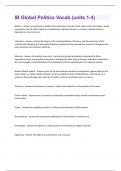
IB Global Politics Vocab (units 1-4) Questions and Answers
Realism - Answer-an approach to politics that emphasizes the role of the nation-state and makes a broad assumption that all nation-states are motivated by national interests, or, at best, national interests disguised as moral concerns. Liberalism - Answer-a theory founded on the natural goodness of humans and the autonomy of the individual and favoring civil and political liberties, government by law with the consent of the governed, and protection from arbitrary authority Marxism - Answer-the political, economic, and social principles and policies advocated by Marx; especially a theory and practice of socialism, including the labor theory of value, dialectical materialism, the class struggle, and dictatorship of the proletariat until the establishment of a classless society Bretton Woods System - Answer-refers to the international monetary arrangement, agreed upon by the allied nations in 1944 in Bretton Woods, US, that created the IMF and World Bank, and that set up a system of fixed exchange rates with the US dollar as the international reserve currency Feminism - Answer-the advocacy of women's rights with emphasis on the equality of the sexes Green Politics - Answer-aims to create an ecologically sustainable society rooted in nonviolence and social justice Power - Answer-the capability to direct or influence the behavior of other parties Rome Statute - Answer-the treaty that established the International Criminal Court Sovereignty - Answer-the ability of a state to govern itself without a higher authority legitimacy - Answer-the right of an authority to rule a countryinterdependence - Answer-the reliance of two or more groups on each other for economic growth or security trade unions - Answer-an organization of workers usually used to increase the power of workers against their employers Hard Power - Answer-a persuasive approach to international relations, typically involving the use of economic or cultural influence Smart Power - Answer-`refers to the combination of hard power and soft power strategies, typically comprising of soft power backed by hard power treaty - Answer-a formally concluded and ratified agreement between countries unilateral - Answer-when one country does something or takes action by itself multilateral - Answer-when more than one country does something or takes action together - for example - if a NATO country was attacked, all of the member nations would retaliate together compellence - Answer-a set of actions or positions that force an opponent to take some action desired by the initial actor collective security - Answer-a security arrangement, political, regional, or global, in which each state in the system accepts that the security of one is the concern of all, and therefore commits to a collective response to threats to, and breaches to peace deterrence - Answer-a strategy intended to dissuade an adversary from taking an action not yet started, or to prevent them from doing something that another state desires hegemony - Answer-the dominance of one group over another, often supported by legitimating norms and ideasstatehood - Answer-the following qualifications - (a) a permanent population (b) a defined territory, (c) state, and (d) ability in relations with other states in force strategic alliance - Answer-an agreement between two or more parties to pursue a set of agreed upon objectives needed while remaining independent organizations. pooled sovereignty - Answer-the strengthening of a country's resources by combining them with those of partner countries internal sovereignty - Answer-legitimacy given to a government from within external sovereignty - Answer-legitimacy of a government given from foreign states informal cooperation - Answer-collaboration between competition authorities aimed at creating synergies as well as partnerships for mutual assistance governance - Answer-action of governing, establishment of policies and monitoring their implementation supra-territoriality - Answer-submissive to others coming into your territory unitary state - Answer-a state governed as a single power in which central government is supreme and any branches of power only delegate what the central government chooses for them interstate war - Answer-a conflict fought between two or more states federal state - Answer-a political entity characterized by a union of partially self-governing states or regions under a central, federal government confederation - Answer-a union of sovereign states, united for purposes of common action often in relation to other states. Usually created by a treaty, tend to be established for dealing with critical issues,such as defense, foreign relations, internal trade or currency, with the general government being required to provide support for all of its members militarized state - Answer-the process by which a society organizes itself for military conflict and violence intrastate war - Answer-sustained political violence that takes place between armed groups representing the state, and one or more non-state groups pariah/rogue state - Answer-a nation considered to be an outcast in the international community, or a state that threatens world peace
Written for
- Institution
- IB Global Politics Vocab
- Course
- IB Global Politics Vocab
Document information
- Uploaded on
- April 27, 2024
- Number of pages
- 14
- Written in
- 2023/2024
- Type
- Exam (elaborations)
- Contains
- Questions & answers
Subjects
-
ib global politics vocab units 1 4

Also available in package deal