AAOS EMT Chapter 7: Life Span Development Complete Assignment Questions Fully Solved.
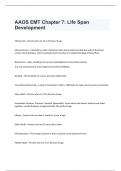
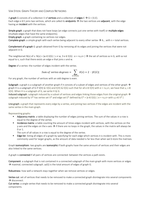
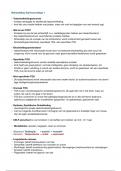
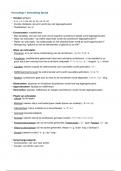
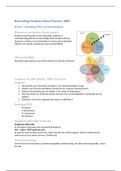
Adolescents - Persons who are 12 to 18 years of age. Atherosclerosis - A disorder in which cholesterol and calcium build up inside the walls of the blood vessels, forming plaque, which eventually leads to partial or complete blockage of blood flow. Barotrauma - Injury resulting from pressure disequilibrium across body surfaces, E.g. too much pressure in the lungs from forceful ventilation. Bonding - The formation of a close, personal relationship. Conventional Reasoning - A type of reasoning in which a child looks for approval from peers and society. Early Adults - Persons who are 19 to 40 years of age. Fontanelles (Anterior, Posterior, Mastoid, Sphenoidal) - Areas where the infant's skull has not fused together; usually disappear at approximately 18 months of age. Infants - Persons who are from 1 month to 1 year of age. Older Adults - Persons who are 61 years old or older. Life Expectancy - The average amount of years a person can be expected to live. Middle Adults - Persons who are 41 to 60 years of age. Moro Reflex - An infant reflex in which, when an infant is caught off guard, the infant opens his or her arms wide, spreads the fingers, and seems to grab at things. Neonate - Persons who are birth to 1 month of age. Nephrons - The basic filtering units in the kidneys. Palmar Grasp - An infant reflex that occurs when something is placed in the infant's palm; the infant grasps the object. Postconventional Reasoning - A type of reasoning in which a child bases decisions on his or her conscience. Preconventional Reasoning - A type of reasoning in which a child acts almost purely to avoid punishment to get what he or she wants. Preschoolers - Persons who are 3 to 6 years of age. Rooting Reflex - An infant reflex that occurs when something touches an infant's cheek, and the infant instinctively turns his or her head toward the touch. School Age - A person who is 6 to 12 years of age. Sucking Reflex - An infant reflex in which the infant starts sucking when his or her lips are stroked. Terminal Drop Hypothesis - The theory that a person's mental function declines in the last 5 years of life. Toddlers - Persons who are 1 to 3 years of age. Trust and Mistrust - A phrase that refers to a stage of development from birth to approximately 18 months of age, during which infants gain trust of their parents or caregivers if their world is planned, organized, and routine. Vital Signs Neonate (0 to 1 month) - 90 to 180 Pulse bpm; 30 to 60 Respiration bmp; 50 to 70 Systolic B/P mm Hg; 98 to 100 (37 to 38°C) Vital Signs Infant (1 month - 1 year) - 100 to 160 Pulse bpm; 25 to 50 Respirations bpm; 70 to 95 Systolic B/P mm Hg; 96.8 to 99.6 (36 to 37.5°C) Vital Signs Toddler (1 to 3 years) - 90 to 150 Pulse bmp; 20 to 30 Respiration pbm; 80 to 100 Systolic BP mm Hg; 96.8 to 99.6 (36 to 37.5°C) Vital Signs Preschool age (3 to 6 Yrs) - 80 to 140 Pulse bpm; 20 to 25 Respirations bpm; 80 to 100 Systolic BP mm Hg; 98.6 (37°C) Vital Signs: School age (6-12 years) - 70 to 120 Pulse bpm; 15 to 20 Respirations bpm; 80 to 110 Systolic BP mm Hg; 98.6 (37°C) Vital Signs Adolescent (12 to 18) - 60 to 100 Pulse bpm; 12 to 20 Respirations bpm; 90 to 110 Systolic BP mm Hg; 98.6 (37°C) Vital Signs Early-Middle-Older Adult (19 + older) - 60 to 100 Pulse bpm; 12 to 20 Respiration bpm; 90 to 140 Systolic BP mm Hg; 98.6 (37°C) Anxious-Avoidant Attachment - Observed in infants who are repeatly rejected Separation Anxiety - Common in older infants can peak between 10 to 18 months old Self-concept - It is one's perception of oneself. Eg. individual knowledge of who he/she is. Self-esteem - Is how we feel about ourselves and how we "fit in" with our peers Older Adult Respiratory System - Size of airway increases and surface area of alveoli decreases. Increased usage of intercostal muscles to breathe
Written for
- Institution
- AAOS
- Course
- AAOS
Document information
- Uploaded on
- April 24, 2024
- Number of pages
- 4
- Written in
- 2023/2024
- Type
- Exam (elaborations)
- Contains
- Questions & answers
Subjects
-
aaos emt chapter 7 life span development

Also available in package deal