

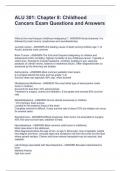
ALU 301: Chapter 8: Childhood Cancers Exam Questions and Answers
Juvenile cancer - ANSWER-2nd leading cause of death among children age 1-14 Acute Leukemia most common Brain Tumors - ANSWER-The 2nd most frequent malignancy in children and adolescents (45% mortality). highest morbidity of any childhood cancer. Typically a solid tumor. Symptoms include headache, vomiting, swelling in eye, seizures, paralysis of cranial nerves, balance or weakness issues. Often diagnosed later so advanced by the time they are treated. Astrocytoma - ANSWER-Most common pediatric brain lesion. It is located behind the brain and low grade (1-2) Survival rates can approach 90% esp. when excised Glioblastoma Multiforme - ANSWER-The most lethal type of astrocytoma -brain tumor in children. Accounts for less than 10% astrocytomas Treatment is surgery, chemo and radiation. If low grade and excised 90% survival rate. Medulloblastoma - ANSWER-Occurs almost exclusively in children 1/5 of primary brain tumors. Located in the posterior fossa of the brain. Complete removal is difficult. 5 year survival rate of about 70% but relapse can occur for several years. Ependymoma - ANSWER-Difficult prognosis; brain tumor not amenable to surgery; 40% five-year survival rate, radiation to treat. Neuroblastoma - ANSWER-Most common solid tumor in childhood. Most case arise in the abdomen. Most diagnosed before the age of two -to age 5. Bone pain, loss of appetite, weight loss fatigue and fever. Unusual signs and symptoms not from the tumor but the spot where growth resides. Chemo and bone marrow transplant may be required, also radiation. Lab findings associated with Neuroblastoma - ANSWER-Elevated catecholamine level Marked Anemia high iron count High platelet count Nephroblastoma -Wilm's tumor - ANSWER-Arises from the kidney 3 separate elements: blatema, epithelia and stroma. Most common in preschool children. 5 year survival rate of about 90%, worse for older Surgery followed by chemo and radiation to treat Most common sign is asymptomatic mass or swelling
Document information
- Uploaded on
- April 19, 2024
- Number of pages
- 3
- Written in
- 2023/2024
- Type
- Exam (elaborations)
- Contains
- Questions & answers


