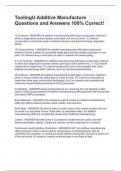
ToolingU Additive Manufacture Questions and Answers 100% Correct!
1D Channel - ANSWER-An additive manufacturing (AM) layer construction method in which a single-point source creates a part layer one line at a time. 1D channel construction is commonly used in material extrusion and directed energy deposition (DED). 1D Channel Array - ANSWER-An additive manufacturing (AM) layer construction method in which a series of connected single-point sources create a part layer in one pass. 1D channel array construction is used in material and binder jetting. 2 X 1D Channel - ANSWER-An additive manufacturing (AM) layer construction method in which two single-point sources create a part layer at the same time. 2 x 1D channel construction is faster than 1D channel construction but is only available with some additive manufacturing (AM) methods, such as vat photopolymerization. 2D Channel - ANSWER-An additive manufacturing (AM) layer construction method in which a source creates an entire layer of a part at once. 2D channel construction is faster than other layer construction techniques, but it is currently only available with continuous liquid interface production (CLIP) processes. Air Blasting - ANSWER-Using compressed air as a cleaning tool. Air blasting is often used to clean excess powder off additive manufacturing (AM) parts built with the powder bed fusion (PBF) processes. Build Materials - ANSWER-The substance used to create an additive manufacturing (AM) part. Build material includes metal, plastic, and ceramics. Build Rate - ANSWER-The time it takes to build a part or the number of parts that can be made in a set period of time. Build rates, or production rates, for additive manufacturing (AM) are considerably slower than traditional manufacturing. Cables - ANSWER-Bundled wires in a protective sheath that are used to transfer telecommunication signals. Cables are used to connect computers in a network. Continuous Liquid Interface Production - ANSWER-CLIP. An additive manufacturing (AM) process in which a part is built by curing layers of a photopolymer with an ultraviolet (UV) projector. In continuous liquid interface production, the part is drawn out of the vat as the UV projector creates an entire layer in one flash of light. Cures - ANSWER-Causes a material to bond and solidify through heat, time, or chemical means. A laser cures photopolymers in vat photopolymerization processes. G-Code - ANSWER-An additive-manufacturing (AM) compatible file that provides detailed instructions to an AM machine. G-code includes information about the exact shape and size of each layer. Hi
Written for
- Institution
- ToolingU Additive
- Course
- ToolingU Additive
Document information
- Uploaded on
- April 18, 2024
- Number of pages
- 75
- Written in
- 2023/2024
- Type
- Exam (elaborations)
- Contains
- Questions & answers
Subjects
-
toolingu additive manufacture questions and answer
-
toolingu additive manufacturestuvia
-
1d channel answer an additive manufacturing am
-
1d channel array answer an additive manufacturin

Also available in package deal