

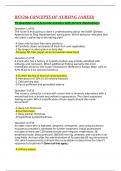
BSN266 CONCEPTS OF NURSING 11(HESI) 55 Questions and Accurate answers with picture illustrations.
BSN266 CONCEPTS OF NURSING 11(HESI) 55 Questions and Accurate answers with picture illustrations. Question 1 of 55 The nurse is evaluating a client’s understanding about the DASH (Dietary Approaches to Stop Hypertension) eating plan. Which behavior indicates that the client is adhering to the eating plan? - A Uses only lactose-free dairy products. - B Carefully cleans and peels all fresh fruit and vegetables. - C No longer incudes grains in daily diet. - D Enjoys fat-free yogurt as an occasional snack food. Question 2 of 55 A client who has a history of hypothyroidism was initially admitted with lethargy and confusion. Which additional finding warrants the most immediate action by the nurse? Hematocrit (Reference Range: Male: 42% to 52% (0.42 to 0.52 volume fraction)] - A Further decline in level of consciousness. - B Hematocrit of 30% (0.30 volume fraction) - C Cold and dry skin. - D Facial puffiness and periorbital edema Question 3 of 55 The nurse is caring for a client with a burn that is severely edematous with a wound bed that is brown and yellow in appearance. The client expresses feeling no pain. Which classification of burn depth should the nurse document? - A Deep full-thickness. - B Full thickness. - C Deep partial-thickness. - D Superficial partial-thickness. Question 4 of 55 An older client who is agitated, dyspneic, orthopneic, and using accessory muscles to breathe is admitted for further treatment. Initial assessment includes a heart rate 128 beats/minute and irregular, respirations 38 breaths/minute, blood pressure 168/100 mm Hg, wheezes and crackles in all lung fields. An hour after the administration of furosemide 60 mg intravenous (IV), which assessment(s) should the nurse obtain to determine the client's response to treatment? (Select all that apply.) - A Urinary output. - B Oxygen saturation. - C Pain scale. - D Lung sounds. - E Skin elasticity. Question 5 of 55 A client is diagnosed with chronic kidney disease and needs to begin dialysis. Which condition entered on the client's medical record should the nurse recognize as a contraindication for peritoneal dialysis? - A Nephrotic syndrome history. - B Crohn's disease with colectomy. - C Type 2 diabetes mellitus. - D Latent hepatitis C. Question # 5 Rationale - B Crohn's disease with colectomy. The nurse should recognize that clients with extensive intra-abdominal surgical history are not candidates for peritoneal dialysis, as these clients may have decreased peritoneal membrane surface areas and scar tissue formation, which would make it insufficient for adequate dialysis exchange. Question 6 of 55 The nurse assesses a client with cirrhosis and finds 4+ pitting edema of the feet and legs, and massive ascites. Which mechanism contributes to edema and ascites in clients with cirrhosis? - A Decreased portacaval pressure with greater collateral circulation. - B Hyperaldosteronism causing an increased sodium reabsorption in renal tubules. - C Decreased renin-angiotensin response related to an increase in renal blood flow. - D Hypoalbuminemia that results in a decreased colloidal oncotic pressure. Question 7 of 55 While assessing a client with degenerative joint disease, the nurse

Document information
- Uploaded on
- April 17, 2024
- Number of pages
- 19
- Written in
- 2023/2024
- Type
- Exam (elaborations)
- Contains
- Questions & answers


