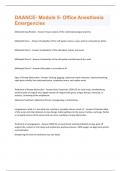
DAANCE- Module 5- Office Anesthesia Emergencies All Possible Questions and Answers with complete solution
Mallampti Classification - Answer-Visual analysis of the oral/oropharyngeal anatomy Mallampti Class I - Answer-Visualization of the soft palate, fauces, uvula, anterior and posterior pillars Mallampti Class II - Answer-Visualization of the soft palate, fauces, and uvula Mallampti Class III - Answer-Visualization of the soft palate and the base of the uvula Mallampti Class IV - Answer-Soft palate is not visible at all. Signs of Airway Obstruction - Answer-Choking, gagging, substernal notch retraction, labored breathing, rapid pulse initially, then decreased pulse, respiratory arrest, and cardiac arrest Treatment of Airway Obstruction - Answer-Early Treatment: 100% O2 via nasal mask, trendelenburg position (pack of surgical site), digital traction of tongue (with gauze, tongue forceps, hemostat, or sutures), suctioning of the oropharynx. Advanced Treatment: Abdominal thrusts, laryngoscopy, cricothrotomy. Larygospasm- what is it, and what can a partial or complete closure result in? - Answer-Protective reflex of the vocal cords that attempts to stop foreign matter getting into the larynx, trachea, and lungs. Partial or complete closure of the vocal cords can occur resulting in airway obstruction. Treatment of Laryngospasm - Answer-100% O2 via nasal hood, maintain/establish airway, pack off surgical site, suction of oral cavity and oropharynx, positive pressure, 100% oxygen via bag/mask system, succinylcholine (Deepening the level of anesthesia may also help)Bronchospasm - Answer-Generalized contraction of the smooth muscles of the small bronchi and bronchioles of the lungs, resulting in restriction of airflow to and from the lungs. Patient will have more difficulty with expiration than inspiration. Patients more susceptible to bronchospasm - Answer-Patients with history of allergies, asthma, COPD, and bronchitis Diagnosis of Bronchospasm - Answer-Labored breathing, aspirational difficulty, signs of diminishing respiratory status (cyanosis or decreased ventilation patterns on capnograph) Treatment of Bronchospasm - Answer-100% Oxygen via bag/mask, albuterol, atrovent, epinephrine injection, intubation/ventilation, steroid injection, diphenhydramine, aminophylline. (Activate EMS after steroid injection if it has not been resolved) Aspiration - Answer-Occurs when the contents of the stomach enter the lungs secondary to emesis, or when a foreign body or fluid inadvertently enters the lungs from the oral pharyngeal cavity through the larynx. Treatment of Emesis with Aspiration - Answer-Activate EMS, 100% O2 via bag/mask, turn patient on right side with head down (trendelenburg position), tonsil suction, removal of visible foreign bodies, intubation, transport to acute care facility Hyperventilation - Answer-Occurs when the patient is breathing at a rate faster than his/her normal breathing pattern or breathing more deeply than the body requires. Triggered by a change in body's natural balance of oxygen and carbon dioxide. Patient exhales too much carbon dioxide and will begin to feel light headed. Treatment of Hyperventilation - Answer-Early: terminate treatment and remove foreign bodies from mouth and remove surgical instruments from view, maintain airway, verbally try to calm the patient, monitor vitals, DO NOT GIVE OXYGEN, have patient breathe into a bag to recapture exhaled CO2 Advanced: If patient is not sedated try IV midazolam, diazepam, propofol, etc., continue to monitor vitals, discontinue breathing bag as breathing returns to normal, activate EMS if condition deterioratesRespiratory Depression and Apnea - Answer-Can be the result of many different causes and can result in increased heart rate and the development of hypoxia and cyanosis. Many of the drugs administered for sedation can depress or stop the patient's ability to breathe Acute Coronary Syndrome - Answer-Two components: 1. Angina: damage to myocardium from dimished blood flow through coronary arteries. 2. Myocardial infarction: death of myocardial tissue when coronary arteries become occlueded. Treatment of Angina Attack- what are the steps, and what can we assume after a certain amount of treatment? - Answer-Stop surgery, give Nitroglycerine and 100% oxygen, make patient comfortable. If 3 doses of nitroglycerin does not provide relief, it should be assumed the patient is having a myocardial infarction Treatment of Miocardial infarction - Answer-Stop surgery, remove foreign bodies from mouth, place in comfy position, oxygen, activate EMS when surgeon tells you too Treatment of Acute Coronary Syndrome - Answer-Activate EMS and closely observe vitals, 100% O2 via mask, make patient comfy/reassure, attach AED defibrillator, Aspirin 325 mg, establish IV access with normal saline slow drip, morphine for pain MONA - Answer-Morphine (helps with pain, decreases BP, and workload of heart) Oxygen (heart needs oxygen) Nitroglycerin (dilates blood vessels) Aspirin (thins blood) Treatment of Symptomatic Bradycardia - Answer-Terminate the procedure, 100% O2, establish IV, Atropine, May need to be transported to the ER for transcutaneous pacing Treatment of Supraventricular Tachycardia - Answer-Place patient in supine position, give adenosine, rapidly flush after with saline, repeat up to three times. Treatment of Premature Ventricular Contractions (PVCs) - Answer-Try to determine cause and correct, lidocaine .5-1.5mg, repeat every 5 to 10 minutes up to 3mgTreatment of Ventricular Tachycardia - Answer-If unstable treat as V. Fib. If stable: 100% O2, Amiodarone 150mg over 10 minutes, prepare for synchronous cardioversion Treatment of Ventricular Fibrillation - Answer-Activate EMS immediately, CPR/mechanical defibrillation Continue CPR, establish IV and give epi 1mg, CPR/repeat shock as above, may give a single dose of vasopressin to replace 1 and 2 doses of epi. Amiodarone, lidocaine and magnesium may be considered as well. Continue CPR and recheck rhythm after 5 cycles Treatment of Asystole - Answer-Administer CPR, epinephrine 1mg. IV. May repeat every 3-5 minutes. May give one does of vasopressin to replace 1st or 2nd dose of epi Treatment of Hypertension (200/100) - Answer-Terminate procedure, check for monitor malfunction, attempt to determine cause and manage the cause appropriately, record vitals every 5 minutes, consider EMS activation, establish IV access, Beta-blockers (labetalol, esmolol, atenolol) Causes of Hypotension - Answer-Medications, syncope, shock, blood loss, drug overdose, dehydration, allergy, infection, arrhythmias, and postural changes Symptoms of Hypotension (5 things) - Answer-Weakness, nausea, impending loss of consciousness, tachycardia, or possibly bradycardia Treatment of Hypotension - Answer-Trendlenburg position, support airway, 100% O2, monitor vitals, consider activating EMS if condition deteriorates, IV access, Fluid bolus of NS, ephedrine or phenylephrine Venipuncture Complications - Answer-1. Infiltration: leakage of fluid into surrounding tissues resultin in edema and pain. Stop infusion and start IV at another site. 2. Hematoma: Blood leakage into surrounding tissues resulting in firm tender swelling. Initial treatment with firm pressure, later moist heat. 3. Phlebitis: Irritation/Inflammation of the vein resulting in pain, erythema (redness), edema, warmth and cord-like feel to vein. Treat with elevation of limb, moist heat, NSAIDS.Treatment of Intra-arterial Injection - Answer-Activate EMS, secure catheter DO NOT REMOVE, 10cc of 1% lidocaine w/o epi injected into catheter, ice pack to limb Hypoglycemia - Answer-Low blood glucose levels. Blood glucose levels fall below 60-65 mg/dL. Mild symptoms: nausea, hunger, tachycardia. Moderate symptoms can occur below 50mg/dL: irritability, lack of energy, anxiety and restlessness. Severe symptoms below 30mg/dL: loss of consciousness, seizures, coma, hypothermia. Treatment of Mild Symptoms of Hypoglycemia - Answer-Oral glucose or juice, confirm blood sugar with glucometer Treatment of Severe Hypoglycemia - Answer-Activate EMS, establish IV access, take blood sugar with glucometer, 1 amp of IV glucose, IV infusion of dextrose, if no IV access then 1mg glucagon IM. Acute Adrenal Insufficiency- what is it, how does it hurt a patient during a procedure, and what are the symptoms? - Answer--Inadequate production of cortisol (hormone produced and released by adrenal gland) -insufficient control to support homeostatic needs of patient under stress. - Symptoms: hypotension, pallor (pale) , diaphoresis (sweating) , nausea, tachycardia, headache, extreme fatigue, high fever, shaking, abdominal pain and confusion. Treatment of Adrenal Insufficiency - Answer-Terminate procedure, monitor vitals, trendelenburg if hypotensive, activate EMS, IV accesss, steroid administration (dexamethasone or hydrocortisone), fluid bolus of NS, transport to hospital
Written for
- Institution
- DAANCE- Module 5- Office Anesthesia Emergencies
- Course
- DAANCE- Module 5- Office Anesthesia Emergencies
Document information
- Uploaded on
- April 17, 2024
- Number of pages
- 6
- Written in
- 2023/2024
- Type
- Exam (elaborations)
- Contains
- Questions & answers
Subjects
-
daance module 5 office anesthesia emergencies

Also available in package deal