Research Methods
Research Methods
Scienti c processes
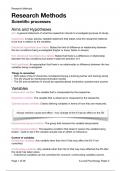
Aims and Hypotheses
Aim: A general statement of what the researcher intends to investigate (purpose of study).
Hypothesis: A clear, precise, testable statement that states what the researcher believes
to be true in relation to the variables.
Directional hypothesis (one-tailed): States the kind of di erence or relationship between
the two conditions being investigated (higher or lower, faster or slower).
Non-directional hypothesis (two-tailed): States that there is a di erence or relationship
between the two conditions but doesn’t state the direction of it
Null hypothesis: An assumption that there is no relationship or di erence between the two
variables being investigated
Things to remember
‣ Both sides of the IV should be considered (having a training partner and training alone)
‣ The DV should be mentioned (motivation levels)
‣ The DV and sometimes IV should be operationalised (motivation questionnaire scores)
Variables
Independent variable: The variable that is manipulated by the researcher.
Dependant variable: The variable that is observed or measured by the researcher.
Operationalised variables: Clearly de ning variables in terms of how they are measured.
Always mention cause and e ect - how change of the IV had an e ect on the DV
Experimental group/condition: The group that receives the variable being tested.
Control group/condition: The baseline condition that doesn’t receive the variable being
tested - used to see if the variable actually has an a ect on behaviour.
Control of variables
Extraneous variables: Any variable other than the IV that may a ect the DV if not
controlled.
Confounding variables: Any variable other than the IV that may have a ected the DV after
the study has taken place.
‣ Extraneous variables can be controlled for, however, confounding variables cannot.
Page 1 of 28 A Level Psychology Paper 2
fi ff fi ff ff ffff ffff ff
, Research Methods
There are 3 key variables that you should control when doing an experiment:
Participant variables – minimising di erences between participants (e.g. their stage of
development such as age, or ability such as IQ).
Researcher variables – factors such as researcher behaviour, appearance or gender could
a ect participant responses, so should be made consistent throughout the experiment.
Situational variables – control of the setting where the experiment takes place, such as
keeping light, sound and temperature levels consistent.
Extraneous Variables
Demand characteristics: Any cue from the researcher that may be interpreted by the
participant as revealing the purpose of the investigation. Leading to a participant
changing their behaviour within the research situation.
Please-U e ect
‣ People may act in a way they think is expected or over perform to please the
experimenter.
Screw-U e ect
‣ People may deliberately under perform to sabotage results of the study.
Investigator e ects: Unwanted in uence (conscious or unconscious) of the investigator on
the research outcome
Dealing with Extraneous Variables
Single blind method: Where the participant doesn’t know the true aim of the experiment
or doesn’t know they’re part of the experiment (raises ethical implications).
Double blind method: Both the participant and the investigator are blind to the aims - the
investigator cannot give cues.
Standardisation: Using exactly the same formalised procedures and environment for the
study so that extraneous variables are reduced
Randomisation: The use of chance when deciding the conditions and participants of the
study to control e ects of bias.
Pilot studies
De nition: Small scale trial of methods.
Aim
‣ To identify and modify issues in aspects of design before the real go such as ambiguity
in instructions, questions, behavioural categories
‣ To save time and money
‣ Used to train investigators or observers
Page 2 of 28 A Level Psychology Paper 2
ff fi ffff ff ff fl ff
, Research Methods
Experimental Designs
Experimental design: The different ways in which the testing or participants can be
organised in relation to the experimental conditions.
Independent Groups Design
Where participants are allocated to di erent groups where each group
represents one experimental condition.
Strengths Weaknesses
‣ No order e ects ‣ Larger sample size needed as each participant only does one condition
‣ Prepare to spend time and money
‣ Reduction in demand ‣ Participant variables might a ect the DV
characteristics ‣ Random allocation
Repeated Measures Design
Where the same participants are allocated to all groups (i.e. take part in all
conditions) of an experiment.
Strengths Weaknesses
‣ Smaller sample size ‣ Order e ects (practice/boredom/fatigue e ect) might in uence the DV -
needed as each confounding variable
participant completes 1. Counterbalancing
both condition 2. Appropriate interval
3. Ensure the tasks set are of equal di culty
‣ Participant variables ‣ Greater chance of demand characteristics
are controlled ‣ Use the single-blind method
‣ The conditions will di er slightly due to the 2 di erent levels of the IV
‣ Standardisation
Matched Pairs Design
Where pairs of participants are rst matched on key variables that may a ect the DV.
Then one member of the pair is assigned to Condition A and the other to Condition B.
Strengths Weaknesses
‣ No order e ects ‣ Its never fully possible to eliminate all participant variables and not
always clear which are the important ones
‣ Reduction in demand ‣ Conduct a pilot study (a mini-trial study) to condor what the key
characteristics variables might be
‣ Participant variables are reduced ‣ Its time consuming and expensive to match key variables as pre-
(more than with independant assessments are required
groups) ‣ Restrict the number of matching variables to make it easier
Random allocation: Controlling for participant variables to ensure that each participant
has the same chance of being in any condition.
Order e ects (practice/boredom/fatigue e ect): A confounding variable arising from the
order in which conditions are presented.
Page 3 of 28 A Level Psychology Paper 2
ff ffff ff ff ffi fi ff ff ff ff fl ff
Research Methods
Scienti c processes
Aims and Hypotheses
Aim: A general statement of what the researcher intends to investigate (purpose of study).
Hypothesis: A clear, precise, testable statement that states what the researcher believes
to be true in relation to the variables.
Directional hypothesis (one-tailed): States the kind of di erence or relationship between
the two conditions being investigated (higher or lower, faster or slower).
Non-directional hypothesis (two-tailed): States that there is a di erence or relationship
between the two conditions but doesn’t state the direction of it
Null hypothesis: An assumption that there is no relationship or di erence between the two
variables being investigated
Things to remember
‣ Both sides of the IV should be considered (having a training partner and training alone)
‣ The DV should be mentioned (motivation levels)
‣ The DV and sometimes IV should be operationalised (motivation questionnaire scores)
Variables
Independent variable: The variable that is manipulated by the researcher.
Dependant variable: The variable that is observed or measured by the researcher.
Operationalised variables: Clearly de ning variables in terms of how they are measured.
Always mention cause and e ect - how change of the IV had an e ect on the DV
Experimental group/condition: The group that receives the variable being tested.
Control group/condition: The baseline condition that doesn’t receive the variable being
tested - used to see if the variable actually has an a ect on behaviour.
Control of variables
Extraneous variables: Any variable other than the IV that may a ect the DV if not
controlled.
Confounding variables: Any variable other than the IV that may have a ected the DV after
the study has taken place.
‣ Extraneous variables can be controlled for, however, confounding variables cannot.
Page 1 of 28 A Level Psychology Paper 2
fi ff fi ff ff ffff ffff ff
, Research Methods
There are 3 key variables that you should control when doing an experiment:
Participant variables – minimising di erences between participants (e.g. their stage of
development such as age, or ability such as IQ).
Researcher variables – factors such as researcher behaviour, appearance or gender could
a ect participant responses, so should be made consistent throughout the experiment.
Situational variables – control of the setting where the experiment takes place, such as
keeping light, sound and temperature levels consistent.
Extraneous Variables
Demand characteristics: Any cue from the researcher that may be interpreted by the
participant as revealing the purpose of the investigation. Leading to a participant
changing their behaviour within the research situation.
Please-U e ect
‣ People may act in a way they think is expected or over perform to please the
experimenter.
Screw-U e ect
‣ People may deliberately under perform to sabotage results of the study.
Investigator e ects: Unwanted in uence (conscious or unconscious) of the investigator on
the research outcome
Dealing with Extraneous Variables
Single blind method: Where the participant doesn’t know the true aim of the experiment
or doesn’t know they’re part of the experiment (raises ethical implications).
Double blind method: Both the participant and the investigator are blind to the aims - the
investigator cannot give cues.
Standardisation: Using exactly the same formalised procedures and environment for the
study so that extraneous variables are reduced
Randomisation: The use of chance when deciding the conditions and participants of the
study to control e ects of bias.
Pilot studies
De nition: Small scale trial of methods.
Aim
‣ To identify and modify issues in aspects of design before the real go such as ambiguity
in instructions, questions, behavioural categories
‣ To save time and money
‣ Used to train investigators or observers
Page 2 of 28 A Level Psychology Paper 2
ff fi ffff ff ff fl ff
, Research Methods
Experimental Designs
Experimental design: The different ways in which the testing or participants can be
organised in relation to the experimental conditions.
Independent Groups Design
Where participants are allocated to di erent groups where each group
represents one experimental condition.
Strengths Weaknesses
‣ No order e ects ‣ Larger sample size needed as each participant only does one condition
‣ Prepare to spend time and money
‣ Reduction in demand ‣ Participant variables might a ect the DV
characteristics ‣ Random allocation
Repeated Measures Design
Where the same participants are allocated to all groups (i.e. take part in all
conditions) of an experiment.
Strengths Weaknesses
‣ Smaller sample size ‣ Order e ects (practice/boredom/fatigue e ect) might in uence the DV -
needed as each confounding variable
participant completes 1. Counterbalancing
both condition 2. Appropriate interval
3. Ensure the tasks set are of equal di culty
‣ Participant variables ‣ Greater chance of demand characteristics
are controlled ‣ Use the single-blind method
‣ The conditions will di er slightly due to the 2 di erent levels of the IV
‣ Standardisation
Matched Pairs Design
Where pairs of participants are rst matched on key variables that may a ect the DV.
Then one member of the pair is assigned to Condition A and the other to Condition B.
Strengths Weaknesses
‣ No order e ects ‣ Its never fully possible to eliminate all participant variables and not
always clear which are the important ones
‣ Reduction in demand ‣ Conduct a pilot study (a mini-trial study) to condor what the key
characteristics variables might be
‣ Participant variables are reduced ‣ Its time consuming and expensive to match key variables as pre-
(more than with independant assessments are required
groups) ‣ Restrict the number of matching variables to make it easier
Random allocation: Controlling for participant variables to ensure that each participant
has the same chance of being in any condition.
Order e ects (practice/boredom/fatigue e ect): A confounding variable arising from the
order in which conditions are presented.
Page 3 of 28 A Level Psychology Paper 2
ff ffff ff ff ffi fi ff ff ff ff fl ff