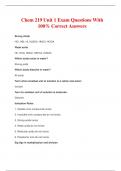
Chem 219 Unit 5 Exam Questions With 100% Correct Answers
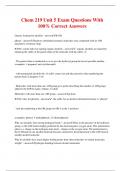
Chem 219 Unit 5 Exam Questions With 100% Correct Answers Generic formula for alcohols - answerR-OH phenol - answerhydroxy-substituted aromatic molecules (any compound with an -OH attached to a benzene ring) IUPAC system rules for naming organic alcohols - answer- organic alcohols are named by replacing the suffix of the parent chain of the molecule with the suffix -ol - The parent chain is numbered so as to give the hydroxyl group the lowest possible number. (examples: 1-propanol, and cyclohexanol) - with unsaturated alcohols the -ol suffix comes last and takes priority when numbering the parent chain (2-propene-1-ol) - Molecules with more than one -OH group get a prefix describing the number of -OH groups added to the IUPAC name. (ethane-1,2-diol) Molecules with more than one -OH group - answerpolyols IUPAC rules for phenols - answer- the suffix for an alcohol substituted benzene is "phenol" - start the numbering at the OH group (so OH is at the 1 position) (examples: phenol, 3-methylphenol, 2,4-dinitrophenol) Why can alcohols form strong hydrogen bonds? - answerDue to the presence of the hydroxyl group, as the O-H bond is highly polarized by the electronegative oxygen atom. This polarization places a + charge on the hydrogen atom and a - charge on the oxygen atom. The polarization in the O-H bond on one alcohol molecule becomes attracted to the polarization in the O-H bond of another alcohol molecule. Why do alcohols have much higher boiling points than other molecules of similar molecular weight? - answerhydrogen bonding between alcohol molecules These attractions raise the amount of energy required to vaporize the liquid-phase molecules (boil), which translates into increased boiling point temperatures. Alcohol molecules can freely hydrogen bond to other molecules possessing what groups? - answerO-H, N-H, or S-H functional groupings How does the water solubility of alcohol molecules change as the molecular weight changes? - answerAlcohol molecules of lower molecular weight are mostly soluble in water as a result of the ability to hydrogen bond to OH, NH, or SH groups. As the molecular weight or carbon- chain length increases, the alcohol molecules become correspondingly less soluble in water. How do alcohols and phenols act as weak acids and weak bases? - answer- acts as an acid by donating the O-H proton as H - acts as a base by accepting H+ using a lone pair on the O atom amphoteric substances - answerSubstances that can act as both acids and bases (alcohols and phenols) Why is acid dissociation for most alcohols unfavorable (lies towards the left)? - answerDissociation produces an alkoxide ion (the conjugate base of an alcohol), which is a very strong base. How can you conduct acid-base reactions that favor the formation of weaker conjugate acids/bases? - answerTo promote (favor) the formation of the alkoxide ion, the alcohol can be treated with sodium or potassium metal (Na or K) or a base that is stronger than the RO- ion produced. protonation of an alcohol - answerWhen alcohols act as weak bases by using a lone pair on the oxygen atom of the hydroxyl group, alcohols can accept a proton when they are placed in an acidic environment. What is the product of the protonation of an alcohol called? - answeralkyloxonium ion What is a Dehydration reaction for alcohols? What happens during a dehydration reaction for alcohols? - answer- A specific type of elimination reaction. In a dehydration reaction, an alcohol molecule will lose H2O to form an alkene. Alcohols undergo a reaction known as dehydration when they are heated with strong mineral acids (like sulfuric or phosphoric). - the alcohol molecule loses the hydroxyl (OH) from one carbon (the α-carbon) and a hydrogen atom (H) from an adjacent (β) carbon. What is the function of an acid during a dehydration reactions? Why does it do what it does? - answerTo protonate the the O
Written for
- Institution
- CHEM 219
- Course
- CHEM 219
Document information
- Uploaded on
- April 16, 2024
- Number of pages
- 10
- Written in
- 2023/2024
- Type
- Exam (elaborations)
- Contains
- Questions & answers
Subjects
-
chem 219 unit 5 exam questions with 100 correct a

Also available in package deal