JBL module 3 Practice Exam Questions with correct Answers
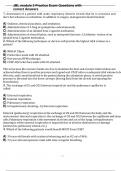
JBL module 3 Practice Exam Questions with correct Answers 1. Assessment of a patient with acute respiratory distress reveals that he is conscious and alert, but wheezes on exhalation. In addition to oxygen, management should include: A) Sedation, chemical paralysis, and intubation. B) Administration of 3-5mg of epinephrine subcutaneously. C) Administration of an inhaled beta-2 agonist medication. D) Administration of a beta-blocker, such as metoprolol tartrate.: C) Adminis- tration of an inhaled beta-2 agonist medication. 2. Which of the following techniques or devices will provide the highest tidal volume to a patient? A) NRB @ 15lpm B) Pocket face mask with O2 attached. C) One-person BVM technique. D) CPAP: B) Pocket face mask with O2 attached. This is because the rescuers hands are free to maintain the best seal. Greater tidal volumes are achieved when there is positive pressure and a good seal. CPAP relies on adequate tidal volume to be effective, and is most beneficial to the patient during the exhalation phase, in which positive pressure is directed into the lower airways (forcing fluid from the alveoli and opening the bronchioles). 3. The exchange of O2 and CO2 between inspired air and the pulmonary capillaries is called: A) External respiration. B) Internal respiration. C) Pulmonary respiration. D) Intrapulmonary shunting.: A) External respiration. External (pulmonary) respiration is the exchange of O2 and CO2 between the body and the environment. Internal respiration is the exchange of O2 and CO2 between the capillaries and tissue cells. Pulmonary respiration is the movement of air into and out of the lungs. Intrapulmonary shunting is when external respiration is impaired due to alveolar dysfunction or damage (atelectasis, pulmonary edema, etc.). 4. Which of the following patients would benefit MOST from CPAP? A) 39-year-old female with scattered wheezing and an O2 sat of 96%. B) 72-year-old unresponsive male with slow, irregular breathing. C) 45-year-old male with anaphylaxis and severe upper airway swelling. D) 61-year-old male with severe respiratory distress and diffuse crackles.: D) 61-year-old male with severe respiratory distress and diffuse crackles. CPAP is used on patients with CHF with pulmonary edema (evident with rhonchi and crackles) and asthma (bronchospasm). 5. In which of the following conditions would you MOST likely detect a drop in systolic blood pressure during inhalation? A) Severe asthma B) Chronic bronchitis C) Pulmonary edema D) Simple pneumothorax: A) Severe asthma Pulsus paradoxus (marked weakening of pulse during inhalation) can be observed in patients experiencing a severe asthma attack, an exacerbation of emphysema, or pericardial tamponade. 6. A 70-year-old man complains of dyspnea that began 2 days ago. He cannot speak more than three words at a time without stopping to catch his breath. Which of the following assessments would give the paramedic the MOST information regarding the possible cause of dyspnea? A) Lung sounds B) Mental status C) O2 sat D) Pulse rate and quality: A) Lung sounds 7. Ventilation of an adult patient with a stoma and no trach tube is MOST effectively achieved by: A) Hyperextending the patient's head and ventilating with a pocket face mask. B) Using a child-size BVM and sealing the patient's mouth and nose. C) Ventilating with a manually triggered ventilator attached to an adult-size mask. D) Using an infant- or child-size mask attached to an adult-size BVM.: D) Using an infant- or child-size mask attached to an adult-size BVM. 8. A 44-year-old male was found unresponsive by his wife. According to the wife, he had been drinking bourbon whiskey all day. He is unresponsive; has slow, shallow respirations; and a slow, weak pulse. You should: A) Promptly intubate him right in the trachea and support those ventilations. B) Throw an OPA in his malodorous mouth and give fresh breaths with an NRB. C) BVM that fool with 24 breaths/min. D) Stick a LMA down his throat to make sure he doesn't inhale his throw-up.: A) Promptly intubate him right in the trachea and support those ventilations. Best way to protect his airway from aspiration is to throw a tube into his trachea and give him that good air. OPA + NRB ain't gonna cut it, not with those shallow respirations and unmaintainable airway, no way. BVM is on the right track, but not at those reckless speeds. An LMA will literally force regurgitated whiskey (which will surely come sooner rather than later) down his freaking trachea. 9. Which of the following airway devices is MOST appropriate to use in a deeply unresponsive intoxicated patient? A) King LT B) NPA C) ET tube D) LMA: C) ET tube ET tubes secure the airway from aspiration better than any other option. 10. After intubating a cardiac arrest patient, you observe a capnography reading that is steadily decreasing. During each ventilation, you see obvious bilateral chest rise and ventilatory compliance is good. You should: A) Give 1mEq/kg of sodium bicarbonate. B) Reevaluate the effectiveness of your CPR. C) Hyperventilate the patient at 24 breaths/min. D) Perform tracheobronchial suctioning at once.: B) Reevaluate the effective- ness of your CPR. A decrease in ETCO2 indicates decreased CO2 return to the lungs. 11. You are ventilating a severely dehydrated apneic 70-year-old male with a history of end-stage emphysema. In order to minimalize the risk of lowering his cardiac output and BP, you should: A) Use a manually triggered ventilation device. B) Hyperventilate the patient at 20-24 breaths/min. C) Adjust the ventilation rate to allow complete exhalation. D) Use a device that provides positive-end expiratory pressure.: C) Adjust the
Written for
- Institution
- JBL
- Course
- JBL
Document information
- Uploaded on
- April 16, 2024
- Number of pages
- 10
- Written in
- 2023/2024
- Type
- Exam (elaborations)
- Contains
- Questions & answers
Subjects
- anrb 15lpm
-
jbl module 3 practice exam questions with correct
-
1assessment of a patient with acute respiratory
-
pocket face mask with o2 attached
-
3the exchange of o2 and co2 between inspired air

Also available in package deal