

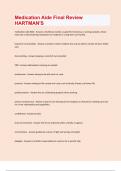
Medication Aide Final Review HARTMAN'S medication aide (MA) - Answer -a healthcare worker, usually first trained as a nursing assistant, whose main task is administering medications to residents in a long -term care facility. long -term care facilities - Answer -a facility in which residents live and are able to receive 24 -hour skilled care. documenting - Answer -keeping a record of care provided. PRN - Answer -abbreviation meaning as needed. professional - Answer -having to do with work or a job. personal - Answer -relating to life outside one's job, such as family, friends, and home life. professionalism - Answer -the act of behaving properly when working. person -centered care - Answer -a type of care that places the emphasis on the person needing care and his or her individuality and capabilities. confidential - Answer -private. chain -of-command - Answer -the line of authority within a facility or agency. conscientious - Answer -guided by a sense of right and wrong; principled. delegate - Answer -to transfer responsibility to a person for a specific task. liability - Answer -a legal term that means someone can be held responsible for harming someone else. scope of practice - Answer -defines the tasks that healthcare providers are legally allowed to do as permitted by state or federal law. nursing process - Answer -an approach to providing effective care for a resident on an ongoing basis; involves assessment, diagnosis, planning, implementation, and evaluation. verbal communication - Answer -communication involving the use of spoken or written words or sounds. nonverbal communication - Answer -communication without using words. clichés - Answer -phrases that are used over and over again and do not really mean anything. policy - Answer -a course of action that should be taken every time a certain situation occurs. procedure - Answer -a method or way of doing something. ethics - Answer -a knowledge of right and wrong. law - Answer -a rule set by the government to help people live peacefully and to ensure safety. controlled substance - Answer -a drug that is more likely than others to be abused or to cause addiction. assessing - Answer -in medication administration, to make a medical determination about a resident's response to a drug; this is a nurse's or doctor's role. glucose - Answer -natural sugar. subcutaneous - Answer -a type of injection given under the skin, in the fat layer above the muscle. insulin - Answer -a hormone that works to move glucose from the blood and into the cells for energy for the body. Residents' Rights - Answer -rights related to how residents must be treated while living in a facility; they provide an ethical code of conduct for healthcare workers. Health Insurance Portability and Accountability Act (HIPAA) - Answer -a federal law that requires that health information be kept private and secure and that organizations take special steps to protect this information. protected health information (PHI) - Answer -a person's private health information, which includes name, address, telephone number, social security number, email address, and medical record number. abuse - Answer -purposeful mistreatment that causes physical, mental, or emotional pain or injury to someone. neglect - Answer -the failure to provide needed care that results in physical, mental, or emotional harm to a person. mandated reporters - Answer -a person who is legally required to report suspected or observed abuse or neglect because they have regular contact with vulnerable populations, such as the elderly in care facilities. negligence - Answer -an action, or the failure to act or provide the proper care, that results in unintended injury to a person. malpractice - Answer -injury to a person due to professional misconduct through negligence, carelessness, or lack of skill. diversion - Answer -removing medications prescribed for a resident for the purpose of personal use or sale to another person.
Preview 3 out of 26 pages
Exam (elaborations)
Medication Aide Final Review HARTMAN'S Questions and Answers with complete solution
Preview 3 out of 26 pages
medication aide (MA) - Answer-a healthcare worker, usually first trained as a nursing assistant, whose main task is administering medications to residents in a long-term care facility. long-term care facilities - Answer-a facility in which residents live and are able to receive 24-hour skilled care. documenting - Answer-keeping a record of care provided. PRN - Answer-abbreviation meaning as needed. professional - Answer-having to do with work or a job. personal - Answer-relating to life outside one's job, such as family, friends, and home life. professionalism - Answer-the act of behaving properly when working. person-centered care - Answer-a type of care that places the emphasis on the person needing care and his or her individuality and capabilities. confidential - Answer-private. chain-of-command - Answer-the line of authority within a facility or agency. conscientious - Answer-guided by a sense of right and wrong; principled. delegate - Answer-to transfer responsibility to a person for a specific lity - Answer-a legal term that means someone can be held responsible for harming someone else. scope of practice - Answer-defines the tasks that healthcare providers are legally allowed to do as permitted by state or federal law. nursing process - Answer-an approach to providing effective care for a resident on an ongoing basis; involves assessment, diagnosis, planning, implementation, and evaluation. verbal communication - Answer-communication involving the use of spoken or written words or sounds. nonverbal communication - Answer-communication without using words. clichés - Answer-phrases that are used over and over again and do not really mean anything. policy - Answer-a course of action that should be taken every time a certain situation occurs. procedure - Answer-a method or way of doing something. ethics - Answer-a knowledge of right and wrong. law - Answer-a rule set by the government to help people live peacefully and to ensure safety. controlled substance - Answer-a drug that is more likely than others to be abused or to cause addiction. assessing - Answer-in medication administration, to make a medical determination about a resident's response to a drug; this is a nurse's or doctor's role. glucose - Answer-natural taneous - Answer-a type of injection given under the skin, in the fat layer above the muscle. insulin - Answer-a hormone that works to move glucose from the blood and into the cells for energy for the body. Residents' Rights - Answer-rights related to how residents must be treated while living in a facility; they provide an ethical code of conduct for healthcare workers. Health Insurance Portability and Accountability Act (HIPAA) - Answer-a federal law that requires that health information be kept private and secure and that organizations take special steps to protect this information. protected health information (PHI) - Answer-a person's private health information, which includes name, address, telephone number, social security number, email address, and medical record number. abuse - Answer-purposeful mistreatment that causes physical, mental, or emotional pain or injury to someone. neglect - Answer-the failure to provide needed care that results in physical, mental, or emotional harm to a person. mandated reporters - Answer-a person who is legally required to report suspected or observed abuse or neglect because they have regular contact with vulnerable populations, such as the elderly in care facilities. negligence - Answer-an action, or the failure to act or provide the proper care, that results in unintended injury to a person. malpractice - Answer-injury to a person due to professional misconduct through negligence, carelessness, or lack of skill. diversion - Answer-removing medications prescribed for a resident for the purpose of personal use or sale to another - Answer-deception or misrepresentation of truth; in health care this can involve falsely documenting care. Controlled Substances Act (CSA) - Answer-a law defining drugs that pose a risk for addiction or abuse. ethics - Answer-a knowledge of right and wrong. law - Answer-a rule set by the government to help people live peacefully and to ensure safety. controlled substance - Answer-a drug that is more likely than others to be abused or to cause addiction.
Content preview
Document information
- Uploaded on
- April 14, 2024
- Number of pages
- 26
- Written in
- 2023/2024
- Type
- Exam (elaborations)
- Contains
- Questions & answers
$8.49
Wrong document? Swap it for free
Within 14 days of purchase and before downloading, you can choose a different document. You can simply spend the amount again.
Written by students who passed
Immediately available after payment
Read online or as PDF

Reputation scores are based on the amount of documents a seller has sold for a fee and the reviews they have received for those documents. There are three levels: Bronze, Silver and Gold. The better the reputation, the more your can rely on the quality of the sellers work.
Available in package deal
Package deal
Hartman's Nursing Exam Bundle (Graded A+)

