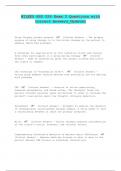
ACSM Clinical Exercise Physiologist Exam Questions With 100% Correct Answers
ACSM Clinical Exercise Physiologist Exam Questions With 100% Correct Answers Factors for a valid VO2 Max? - answerRER 1.1 Lactate 8mmol/L RPE18 Plateu in VO2 HR @ age predicted max Drug has half life of 4 hours. IF given 1000mg, what concentration is left after 12 hours. - answer125mg Can HR max be changed with training? - answerNO How many factors must we see for Valid Vo2 max test? - answer3 RER vs RQ - answerRER: co2 expired/ o2 consumed at mouth RQ: Co2 produced by cell metabolism/ o2 used by tissues What variable caueses VO2 max to increase with training? - answerStroke volume because heart gets bigger (NOT MAX HR) Lactates main job is to _______________ and does not cause - answerbuffer Ph, muscle fatigue Client DOES NOT regularly exercise, when do they need clearance? - answer- Have a chronic disease - Have a chronic disease and S/S Client DOES regularly exercise, when do they need clearance? - answerOnly if they have S/S Acute EXSC affect on leukocytes? - answerINC concentration Gold std for diagnosing cardiac issues - answerCardiac catheterization ST segment elevation vs depression - answerElevation: Myocardial infarction Depression: ischemia 2 cases when you should not do a regular exsc stress test: - answer- Client uses Beta Agonist - Client uses dipyridamole (a vasodilator) What BP level contraindicated during exsc test - answer250/115 Patient w/ CAD will exhibit what symptom relating to HR and BP after EXSC? - answerVERY slow to return to resting levels Primary cause of type 2! diabetes? - answerInflammation S/S of diabetes mellitus: - answerPolydipsia (thirst) Polyuria (urination) Polyphagia (hunger) Which diabetic medications is contraindicated for exercise? - answerInsulin (if exercising at peak insulin effect) When programming EXSC for clinical population, what variables should be progressed first? - answerFrequency, then duration, then intensity *When adjusting intensity, duration should be dropped back to baseline Primary cause of obesity - answerHypercaloric Diet Obesity BMI classifications - answer30 = OBESE 30-34=mild 34-39=moderate 40=morbid waist circumference - answer 40 Males 35 Females INCREASED RISK What type of adiposity is most inflammatory? - answerCentral (visceral) adiposity Most effective method for losing weight? - answerSurgical intervention NIH's weight loss goal for obese individuals (what is clinically significant) - answer5-10% What is exercises effect on weight loss? - answerLITTLE TO NONE! BMI qualifications for pharmacotherapy/surgery - answerPharma: BMI 27 w/comorbidities BMI 30 Surgery: BMI35-39 w/comorbidities BMI40 Average weight loss with bariatric surgery? - answer25% BP classifications - answerNormal: 120/80 Elevated: 120-129/80 St 1 Hypertension: 130-139/80-89 St 2 Hypertension: 140/90 Which physiological variable has greatest impact on BP? - answerBlood vessel radius Atherosclerosis vs. Arteriosclerosis - answerAthero: Thickening (Via damage to media of BV being patched by LDL cholesterol) Arterio: Stiffening (vascular remodeling due to high BP, inflammation and hyperglycemia) What does a higher DBP mean? - answerPt has a better elastic recoil What is the best predictor of future cardiovascular events? - answerArterial stiffness score (PP/Pulse wave velocity)
Written for
- Institution
- ACSM
- Course
- ACSM
Document information
- Uploaded on
- April 14, 2024
- Number of pages
- 24
- Written in
- 2023/2024
- Type
- Exam (elaborations)
- Contains
- Questions & answers
Subjects
-
acsm clinical exercise physiologist exam questions

Also available in package deal