

Bioethics Final Exam Review Questions and answers | Latest updated | Rated A+
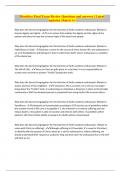
Bioethics Final Exam Review Questions and answers | Latest updated | Rated A+ Why does the Sacred Congregation for the Doctrine of Faith condemn euthanasia? (Relate to Human dignity and rights) - It is an action that violates the dignity and the rights of the patient and takes the way the universal right of life away from people Why does the Sacred Congregation for the Doctrine of Faith condemn euthanasia? (Relate to Faithfulness in God) - God has a vision for the course of every human life, and euthanasia is an at of disobedience and betrayal in that it undermines God's vision; euthanasia is a violation of the divine law Why does the Sacred Congregation for the Doctrine of Faith condemn euthanasia? (Relate to The Gift of Life) - Since our lives are gifts given to us by God, it is our responsibility to sustain and use them to achieve "fruitful"/productive ends Why does the Sacred Congregation for the Doctrine of Faith condemn euthanasia? (Relate to Justice and love of the neighbor) - If someone's life is cut short, he or she can no longer bring about the "fruitful" ends. In euthanizing an individual, a disservice is done to the broader community in that the deceased person is prevented from using his/her life to serve others. Why does the Sacred Congregation for the Doctrine of Faith condemn euthanasia? (Relate to Painkillers) - Euthanasia isn't permissible according to CDF but the use of painkillers within the context of end of life care is acceptable if 1. the intention is to relieve suffering and not induce death 2. the patient is able to function and interact with others. If painkillers affect patient's LOC then his/her ability to prepare for death will be compromised Why does the Sacred Congregation for the Doctrine of Faith condemn euthanasia? ( Relate to union with Christ in suffering) - Although suffering isn't favorable, it's a way for Christian's to identify with the passion of Christ; when pt.'s ask for euthanasia to relieve suffering, we should understand their request as a plea for help and love; don't do euthanasia tho or the CDF will beat yo ass How does the Congregation outline ordinary v. extraordinary or proportionate v. disproportionate means and hastening death? - 1. Ordinary v. Extraordinary: It is permissible to stick with normal medicine, so one can't make another obligated to use a technique that is already in use but is risky or burdensome. Use judgement on ordinary v extraordinary bc every situation is different 2. Proportionate v. Disproportionate: A patient can interrupt ordinary or extraordinary means to preserve life it is disproportionate to what they expected (the treatment falls short of their expectations). It's ok to avoid these procedures so there is no excessive expenditure for the family or community. EUTHANASIA IS EXTRAORDINARY AND DISPROPORTIONATE Explain the "Paradigm Case" for Euthanasia (Meilaender) - It is a case that determines who would be the perfect candidate for euthanasia if permissible. 1. The person deliberately wants to be killed. 2. The person would have died soon anyway 3. The person was suffering terrible pain 4. The person asked to be killed 5. The motive of killing was mercy (good death under circumstances) How does Meilaender's position differ from what he calls well meaning humanitarianism? - Well meaning humanitarianism-- compassion as cure; there's limits to motivations and compassions; he's against it bc compassion isn't a motive for killing (good intentions can't justify a bad motive) Aim versus Result - See adequately favorable results for justification for any aim; if you have a good aim then the result is justified Aim versus Motive - You can't redefine an act in terms of motivation. Killing is killing whether done for good or bad. Nafs - the entity that infuses the human body with life; it signifies personhood and not merely the soul How is death defined in the Qur'an? - When the entity (nafs) departs, the body dies How is death defined by Sachedina? - Traditional view of death is focused upon the cessation of the circulatory and respiratory functions as the criteria of the departed spirit What are the four ways science defines death? - 1. Higher Brain Death 2. Lower Brain Death 3. Whole Brain Death 4. Damage of personhood
Document information
- Uploaded on
- April 10, 2024
- Number of pages
- 21
- Written in
- 2023/2024
- Type
- Exam (elaborations)
- Contains
- Questions & answers


