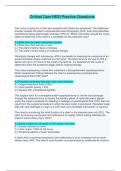
Critical Care HESI Practice Questions - Questions, Answers and Rationales
Critical Care HESI Practice Questions - Questions, Answers and Rationales The nurse is caring for a client who presents with stroke-like symptoms. The healthcare provider reviews the client's computerized axial tomography (CAT) scan and prescribes recombinant tissue plasminogen activator (rtPA) IV. Which information should the nurse obtain to determine if the client is a candidate for this treatment now? A.) What time the client's symptoms started. B.) When the client last ate a meal. C.) The client's family history of strokes. D.) The client's recent history of antibiotic therapy Fibrinolytic therapy with intravenous rtPA is successful in reversing the symptoms of an acute thrombolic stroke confirmed on CAT scan. The time frame for the use of rtPA is before and up to 4.5 hours of the onset of symptoms. It is essential for the nurse to determine when the symptoms began before initiating therapy. The nurse is assessing a client who underwent a transsphenoidal hypophysectomy. Which assessment finding indicates the client is experiencing a postoperative cerebrospinal fluid (CSF) leak? A.) Persistent postnasal drip with clear nasal drainage. B.) Oxygen saturation level of 92%. C.) Urine specific gravity 1.018. D.) Nausea with a decreased appetite The surgical entry for a transsphenoidal hypophysectomy is via the nasal passage through the sphenoid sinus to access the pituitary gland. A nasal drip pad is placed under the nares to evaluate for bleeding or leakage of cerebrospinal fluid (CSF) that can result from the surgical procedure in which the dura mater is punctured. Persistent nasal drip with clear drainage is a sign of a CSF leak, and immediate intervention is required. The nurse is monitoring the renal function of a client in the intensive care unit (ICU). The client is receiving vancomycin and ceftriaxone for sepsis. Which finding indicates the onset of acute kidney injury (AKI)? A.) Serum creatinine 2.8 mg/dL or 247 umol/L (SI units). B.) Cloudy malodorous urine. C.) Urine output 1,000 mL/24 hours. D.) Peripheral edema of lower extremities. A client who is receiving vancomycin and ceftriaxone is at an increased risk for acute kidney injury (AKI). The client's renal function is compromised as evidenced by a serum creatinine of 2.8 mg/dL (247 umol/L) above normal range of 0.6 to 1.2 mg/dL (53 to 106 umol/L) and supports a AKI. A client in the intensive care unit (ICU) is receiving continuous renal replacement therapy (CRRT) due to acute kidney injury (AKI). The nurse detects blood leaking from the central venous catheter insertion site. Which action should the nurse perform after receiving elevated clotting time results? A.) Lower heparin dose. B.) Position client on back. C.) Decrease CRRT rate. D.) Obtain serum electrolytes. Dual-lumen temporary hemodialysis catheters for continuous renal replacement therapy (CRRT) are placed by ultrasound guidance into the jugular vein and require anticoagulation therapy to maintain patency. If overt bleeding is observed at the central venous catheter insertion site and clotting times are elevated, the nurse should decrease the heparin dose per prescribed heparin protocol to maintain the vascular access and ensure efficient CRRT. A client with chronic kidney disease (CKD) presents with severe anemia. The nurse administers a dose of epoetin alfa (Procrit) during the hemodialysis procedure. Which finding indicates the medication is effective? A.) Increase in hemoglobin and hematocrit. B.) Decrease in oxygen saturation level. C.) Decrease in BUN and creatinine. D.) Increase in urine output. Epoetin alfa (Procrit) is a man-made version of human erythropoietin (EPO) and is classified as a colony-stimulating factor used to treat anemia associated with chronic kidney disease (CKD). Increases in hemoglobin and hematocrit levels indicate an effective response. The nurse is developing the plan of care for a client who is receiving mechanical ventilation. Which intervention should the nurse include to prevent ventilator-associated pneumonia (VAP)? A.) Daily oral care with chlorhexidine. B.) Percussion and postural drainage. C.) Supine positioning. D.) Prophylactic antibiotic administration. The use of bundle methodology combines care delivery interventions proven effective in decreasing the risk of risk of ventilator-associated pneumonia (VAP) and optimizing client outcomes. Daily management interventionstarget endotracheal tube colonization and microaspiration and include oral decontamination with daily oral care with chlorhexidine. Four days after a client is admitted with an acute anteroseptal myocardial infarction, the nurse is preparing to transfer the client to an intermediate care unit. The client suddenly reports shortness of breath with minimal activity and chest pain. Which intervention should the nurse implement next? A.) Evaluate leads V 1, V 2, and V 3for Q waves. B.) Assessfor bilateraljugular vein distention. C.) Auscultate for pansystolic murmur at left sternal border. D.) Monitor for premature ventricular contractions. A pansystolic murmur at the left sternal border is indicative of a ruptured interventricular septum and requires immediate intervention. Ventricular septal rupture results from full thickness infarction of the interventricular septum followed by necrosis that results in a septal rupture. The rupture can start out as small as a pin hole. One day after receiving a heart valve replacement, a client is extubated and placed on 40% oxygen via face mask. The nurse balances and calibrates the pulmonary artery catheter prior to documenting the client's values. Which intervention is most important for the nurse to implement? A.) Monitor and record hourly pulmonary artery pressures and wedge pressures. B.) Identify a spontaneous wedged catheter waveform and ensure the balloon is deflated. C.) Expel air from the balloon syringe and reconnect the empty balloon syringe to the catheter. D.) Disconnect the syringe from the balloon inflation port to ensure the balloon is deflated. Unless the nurse is obtaining wedge pressures, the pulmonary artery waveform should not appear wedged. This is an indication that the catheter has migrated into the pulmonary artery and requires immediate intervention to ensure no air is in the balloon, causing an occlusion of the pulmonary artery. A client is admitted to the intensive care unit with asthma and an upper respiratory infection. The client is experiencing severe bronchospasms and develops status asthmaticus. Which prescription should the nurse administer first? A.) Beta 2-antagonist. B.) Antihistamine. C.) Decongestant. D.) IV antibiotics. Beta2-antagonists and corticosteroids are used to treat status asthmaticus. Beta2- antagonists facilitate smooth muscle relaxation, while steroids decrease inflammation of the airways and enhance the effects of beta2-antagonists.
Written for
- Institution
- Critical Care HESI Practice
- Course
- Critical Care HESI Practice
Document information
- Uploaded on
- April 10, 2024
- Number of pages
- 20
- Written in
- 2023/2024
- Type
- Exam (elaborations)
- Contains
- Questions & answers
Subjects
- critical care hesi
-
critical care hesi practice questions
-
critical care hesi practice

Also available in package deal