MPOETC Test 1 Question and answers rated A+ 2023/2024
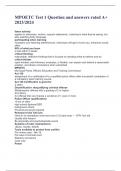
MPOETC Test 1 Question and answers rated A+ 2023/2024 listen actively applies to witnesses, victims, suspect statements. Listening to what they're saying, but also watching body language. participating when learning increases your listening attentiveness, instructors will get to know you, enhances social skills. 80% of what you learn is lost within 2 weeks critical thinking reasonable, reflective thinking that is focused on deciding what to believe and do critical thinker open-minded, well informed, evaluates, is flexible, can explain and defend a reasonable position, and draws conclusions when warranted. MPOETC Municipal Police Officers Education and Training Commission Act 120 assignment of a certification # to a qualified police officer after successful completion of a mandatory basic training course. Act 120 Certification is good for 2 years Decertification- disqualifying criminal offense Misdemeanor offense with a grading of 2 or higher Any felony An offense that can impose a sentence of 1 year or more Police Officer qualifications 18 yrs or older high school diploma/GED background check Physical and psych cleared Renewal of Act 120 Cert. Have to do mandatory inservice hours (12) each year --- CPR, first aid Qualify with firearm Be physically and psychologically sound Systems of order maintainence values, morals, beliefs Tools available to protect from conflict PA crimes code - title 18 PA rules of criminal court Statutory provisions Case Law Power police doctrine that all governments can coerce human behavior -- Federal, State, County/Municipal Role of Police as Gatekeepers The people being put into the system are by the police Deterrence theory philosophy of criminal justice arising from the notion that crime results from a rational calculation of its costs and benefits Goals of Deterrence investigate and accuse properly, protect life and property, and to rehabilitate. NOT Punish! General Detterence Theoroy Done to one person, so that the rest of society learns from it. -- I touch the hot cookie pan and burn my hand ... everyone else learns not to touch the hot cookie pan. specific deterrence specific to offender - won't do it again --I touched the hot cookie pan and now I have to wear mittens. marginal deterrence where do we set the punishment? jail v. a fine restrictive deterrence increasing police presence in a "hot spot" absolute deterrence decreasing police presence -- use of CCTV 80% of LE cases involve public service. 20% of LE cases include actual policing Historical Development of Police 1. British Model - Sir Robert Peel -- watch systems 2. Industrialization - people moving into the city -- increased disorder 3. Development of federal and state agencies -- US Marshal/FBI/DEA Emerging Trends of LE CompStat, fingerprints, surveillance, forensics, less than lethal weapons Coercive Force Any action that produces fear to compel compliance, to deter action or to suspend violator resistance. 4th and 8th amendment Tennesse v. Garner Graham v. Connor Tennessee v. Garner Deadly force may not be used against an unarmed and fleeing suspect unless necessary to prevent the escape and unless the officer has probable cause to believe that the suspect poses a significant threat of death or serious injury to the officers or others. Graham v. Connor determined that the reasonableness of a particular use of force must be judged from the perspective of how a reasonable officer on the scene would respond Political Era of Policing From the 1840s to the 1930s, the period of time when police were tied closely to politics and politicians, dependent on them for being hired, promoted, and assignments—all of which raised the potential for corruption. - soup kitchens, watch systems Reform Era of Policing Early 1900s to the 1960s. A direct reaction to the politics of before; took the form of police professionalism and antipolitics. -created the civil service exam, hierarchy, the use of technology Community Era of Policing Type of policing in which the public must be engaged to help solve and prevent crimes. --What we have now Allegations of unethical acts are the basis for CIVIL suits Ethics a code of values for behavior based on what it morally good and bad. moral priniciples form a code of values that govern behavior Ethics in a department one wrong thing makes everyone look bad Ethical Time Bombs it will catch up to you Peer Pressure and ethics can result in something you regret Utilitarianism majority rules -- the majority need, outweighs the need of the few Deontology defines actions as right or wrong -- it's my duty LE Code of Ethics - serve mankind -- protect the community - have an unsullied private life - Be honest - Keeping a secret unless revelation is necessary - Will not be prejudice - My badge is public faith - I am responsible for my actions 6 pillars of character trustworthiness, respect, responsibility, fairness, caring, and citizenship. Good character -- we need to enforce, advocate, and model. Officer casualty 2x likely to die of their own hand than the offender
Document information
- Uploaded on
- April 5, 2024
- Number of pages
- 7
- Written in
- 2023/2024
- Type
- Exam (elaborations)
- Contains
- Questions & answers