

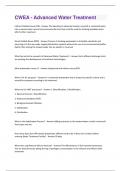
CWEA - Advanced Water Treatment Questions With 100% Correct Answers!!
Indirect Potable Reuse (IPR) - Answer-The blending of advanced treated, recycled or reclaimed water into a natural water source (environmental barrier) that could be used for drinking (potable) water after further treatment. Direct Potable Reuse (DPR) - Answer-Process of treating wastewater to drinkable standards and returning it to the raw water supply (distribution system) without the use of an environmental buffer. Rather than mixing the treated water into an aquifer or reservoir What has led to the research of Advanced Water Treatment? - Answer-Strict effluent discharge limits are pushing the development of treatment technologies. Most wastewater reuse is? - Answer-Unplanned and indirect reuse (IPR) What is Fit for purpose? - Answer-It is reclaimed wastewater that is treated to specific criteria and is reused for purposes according to its treatment. What are the AWT processes? - Answer-1. Microfiltration / Ultrafiltration 2. Reverse Osmosis / Nanofiltration 3. Advanced Oxidation (AOP) 4. Biological Aerated Filtration 5. Stabilization 6. Disinfection What is the Stabilization Process? - Answer-Adding nutrients to the treated water so that it wont pull from pipes and etc. How many days does IPR treated wastewater effluent need to be in Reservoir or Basin before entering Water Treatment Facility? - Answer-30 days What does Log Removal Values measure? - Answer-The effectiveness of the treatment processes. The are determined by taking the log of pathogen concentration in the influent and effluent after treatment.What are the 3 water quality requirements? - Answer-1. Nutrients 2. Aesthetics 3. Risk to human health, such as pathogen removal What are our primary sources of water? - Answer-Surface Water and Ground Water. During Indirect Potable reuse, how long must water stay in a natural body of water before being used for drinking water? - Answer-30 days. Who dictates wastewater reuse? - Answer-The State sets their regulations. EPA is not involved. Who regulates the drinking water? - Answer-Safe Drinking Water Act. What are the California Reuse Regulations? - Answer-A 12-10-10 log removal for Viruses, Cryptosporidium and Giardia. What can we use to disinfect water? - Answer-Chlorine, ozone, and UV. Benefits of Advanced Oxidation Process? - Answer-Removed Total Organic Carbons and creates a barrier for microorganisms. How much Total Organic Carbon (TOC) and Conductivity can Reverse Osmosis remove? - Answer- 0.5mg/l TOC and 250mg/l conductivity. MF, RO, UV/H2O2 is an example of what? - Answer-MULTIPLE BARRIER TO PATHOGENS What are Critical Control Points (CCP)? - Answer-They are unit processes that require policies, procedures, practices, monitor and measuring to assure quality requirements are met
Document information
- Uploaded on
- April 4, 2024
- Number of pages
- 6
- Written in
- 2023/2024
- Type
- Exam (elaborations)
- Contains
- Questions & answers


