Samenvatting FPM
1. General framework
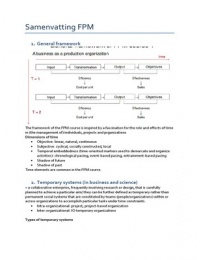
The framework of the FPM course is inspired by a fascination for the role and effects of time
in (the management of) individuals, projects and prganizations
Dimensions of time
Objective: linear, natural, continuous
Subjective: cyclical, socially constructed, local
Temporal embeddedness (time-oriented markers used to demarcate and organize
activities): chronological pacing, event-based pacing, entrainment-based pacing
Shadow of future
Shadow of past
Time elements are common in the FPM course.
2. Temporary systems (in business and science)
= a collaborative enterprise, frequently involving research or design, that is carefully
planned to achieve a particular aim/ they can be further defined as temporary rather than
permanent social systems that are constituted by teams (people/organizations) within or
across organizations to accomplish particular tasks under time constraints.
Intra-organizational: project, project-based organization
Inter-organizational: IO temporary organizations
Types of temporary systems
, 2.1 Project-based organization (PBO)
= an independent organizational form in which the project is the primary unit for production
organization, innovation, and competition.
Project: any activity with a defined set of resources, goals, and time limit
Rechtsonder: project-based organization
,Characteristics PBO
Appropriate for complex, non-routine tasks
Help to adapt to uncertain, risky and changing environments
Populated by integrators (of commercial and technical) and brokers (external
clients)
Well-suited for innovation and learning, coping with emerging properties and
demands from clients
Ill-suited for coordination of resources and capabilities across projects, routine
production activities, achieving economies of scale
Inter-organizational temporary organization (IOTO)
= temporary inter-organizational systems of legally autonomous but functionally
interdependent firms that interact to coordinate their efforts for the accomplishment of a
joint outcome in a limited amount of time (which is defined in advance)
Bijvoorbeeld, construction projects, movie productions, Olympic games.
IOTO, PBO’s and learning / knowledge transfer. Problems?
On the one hand, the IOTO/PBO is:
An intrinsically innovative form: (re)creates new organizational structures around
new task/customer
Able to cope with emerging demands in a flexible way
Effective way to integrate different types of knowledge
But on the other hand, the IOTO/PBO is:
Weak in achieving economies of scale
Weak in coordinating cross-project resources
Weak in facilitating organization-wide technological innovation and learning.
3. Financial management
Is concerned with the economic activities within the production organization.
Finance
= Selection of assets (production resources) in which intestments are to be made, and how
those assets should be financed.
Asset: anything tangible of intangible that is held to have positive economic value
Management accounting (MA)
= provision of financial information to the management with the purpose to support this
management (internal reporting)
MA assists in getting an overview of the costs involved in running the transformation
process and determine selling prices
MA assists in monitoring whether or not the business is performing according to
expectations and where interventions are needed
Financial accounting (FA)
= disclosure of information by an organization’s management to other stakeholders
(external reporting)
, Stakeholders include shareholders, employees, providers of credit, governments
Like MA, FA has a decision-supporting focus: a bank, for instance, uses this
information to assess if providing the credit requested is safe
FA also serves an accountability purpose: stakeholders use the figures presented to
judge the management’s policy over the past year
Differences MA and FA
Financial statements
Aggregated overviews of:
The assets invested in and the way those assets are financed at a given point over
time (finance) summarized by the balance sheet
Costs and revenues generated by the production organization in a certain time
frame (accounting) summarized by the profit and loss account
Not only an overview of the consequences of past Finance & Accounting decisions, but also
informs future F&A decisions.
Balance sheet: value of assets invested in and how those assets have been financed
Profit & loss account: comparison of revenue and costs in a certain period
Balance sheet
,Profit & loss account
Provisions
Provisions are made against possible future liabilities, which may occur as a result of
operations in the past (bijv. lawsuits, warranties, doubtful costs).
In making a provision, estimated costs are included in the profit & loss account before any
payment is made.
4. Financial statement analysis
4.1 Profitability ratios
= Relationship between profit and capital
Return on assets (ROA)
Earnings before interest and taxes (EBIT) / Total assets
Return on equity (ROE)
Net profit after tax / shareholders’ equity
Return on equity pre tax (ROE pt)
,Net pre-tax profit / shareholders’ equity
Average cost of debt (ACD)
Interest / total debt
Voorbeeld
Financial leverage
(ROA – ACD) * (Debt / equity)
4.2 Solvency ratios
= A company’s ability to meet its financial obligations in the event of liquidation.
,Debt ratio
Debt / total assets
Other financial leverage ratios
Equity / total assets
Debt / equity
Interest coverage ratio
Is an indicator of financial resilience.
Earnings before interest and taxes (EBIT) / interest
4.3 Liquidity ratios
= A company’s ability to meet its short-term financial obligations.
Static liquidity
Net working capital
Current assets – current liabilities
Current ratio
Current assets / current liabilities
Quick ratio (acid test ratio)
(Current assets – inventory) / current liabilities
Voorbeeld
4.4 Capital budgeting project
= Sum of total investments in interrelated fixed and current assets.
Assessed based on CASHFLOWS.
Receipts – expenditure revenues – expenses
Cash flow
= the excess of gross revenu from the sale of products over expenditure related to the
purchasing and use of assets during a certain period (receivables minus expenditures)
, In other w0rds, cash flow is the excess of cash revenu over cash expenditure during
the life of a project
Main difference between accounting income and cash flow is depreciation
Cash flow = accounting income + depreciation
Calculating cash flow
Assessment of capital budgeting projects
1) On the basis of profitability Average book rate of return (ABR)
Average annual profit / average invested capital
Disadvantage: ignores the time value of money
2) Assessment on the basis of cash flow pay back period
The time it takes a project to recover its initial investment from the cumulative cash flow.
1. General framework
The framework of the FPM course is inspired by a fascination for the role and effects of time
in (the management of) individuals, projects and prganizations
Dimensions of time
Objective: linear, natural, continuous
Subjective: cyclical, socially constructed, local
Temporal embeddedness (time-oriented markers used to demarcate and organize
activities): chronological pacing, event-based pacing, entrainment-based pacing
Shadow of future
Shadow of past
Time elements are common in the FPM course.
2. Temporary systems (in business and science)
= a collaborative enterprise, frequently involving research or design, that is carefully
planned to achieve a particular aim/ they can be further defined as temporary rather than
permanent social systems that are constituted by teams (people/organizations) within or
across organizations to accomplish particular tasks under time constraints.
Intra-organizational: project, project-based organization
Inter-organizational: IO temporary organizations
Types of temporary systems
, 2.1 Project-based organization (PBO)
= an independent organizational form in which the project is the primary unit for production
organization, innovation, and competition.
Project: any activity with a defined set of resources, goals, and time limit
Rechtsonder: project-based organization
,Characteristics PBO
Appropriate for complex, non-routine tasks
Help to adapt to uncertain, risky and changing environments
Populated by integrators (of commercial and technical) and brokers (external
clients)
Well-suited for innovation and learning, coping with emerging properties and
demands from clients
Ill-suited for coordination of resources and capabilities across projects, routine
production activities, achieving economies of scale
Inter-organizational temporary organization (IOTO)
= temporary inter-organizational systems of legally autonomous but functionally
interdependent firms that interact to coordinate their efforts for the accomplishment of a
joint outcome in a limited amount of time (which is defined in advance)
Bijvoorbeeld, construction projects, movie productions, Olympic games.
IOTO, PBO’s and learning / knowledge transfer. Problems?
On the one hand, the IOTO/PBO is:
An intrinsically innovative form: (re)creates new organizational structures around
new task/customer
Able to cope with emerging demands in a flexible way
Effective way to integrate different types of knowledge
But on the other hand, the IOTO/PBO is:
Weak in achieving economies of scale
Weak in coordinating cross-project resources
Weak in facilitating organization-wide technological innovation and learning.
3. Financial management
Is concerned with the economic activities within the production organization.
Finance
= Selection of assets (production resources) in which intestments are to be made, and how
those assets should be financed.
Asset: anything tangible of intangible that is held to have positive economic value
Management accounting (MA)
= provision of financial information to the management with the purpose to support this
management (internal reporting)
MA assists in getting an overview of the costs involved in running the transformation
process and determine selling prices
MA assists in monitoring whether or not the business is performing according to
expectations and where interventions are needed
Financial accounting (FA)
= disclosure of information by an organization’s management to other stakeholders
(external reporting)
, Stakeholders include shareholders, employees, providers of credit, governments
Like MA, FA has a decision-supporting focus: a bank, for instance, uses this
information to assess if providing the credit requested is safe
FA also serves an accountability purpose: stakeholders use the figures presented to
judge the management’s policy over the past year
Differences MA and FA
Financial statements
Aggregated overviews of:
The assets invested in and the way those assets are financed at a given point over
time (finance) summarized by the balance sheet
Costs and revenues generated by the production organization in a certain time
frame (accounting) summarized by the profit and loss account
Not only an overview of the consequences of past Finance & Accounting decisions, but also
informs future F&A decisions.
Balance sheet: value of assets invested in and how those assets have been financed
Profit & loss account: comparison of revenue and costs in a certain period
Balance sheet
,Profit & loss account
Provisions
Provisions are made against possible future liabilities, which may occur as a result of
operations in the past (bijv. lawsuits, warranties, doubtful costs).
In making a provision, estimated costs are included in the profit & loss account before any
payment is made.
4. Financial statement analysis
4.1 Profitability ratios
= Relationship between profit and capital
Return on assets (ROA)
Earnings before interest and taxes (EBIT) / Total assets
Return on equity (ROE)
Net profit after tax / shareholders’ equity
Return on equity pre tax (ROE pt)
,Net pre-tax profit / shareholders’ equity
Average cost of debt (ACD)
Interest / total debt
Voorbeeld
Financial leverage
(ROA – ACD) * (Debt / equity)
4.2 Solvency ratios
= A company’s ability to meet its financial obligations in the event of liquidation.
,Debt ratio
Debt / total assets
Other financial leverage ratios
Equity / total assets
Debt / equity
Interest coverage ratio
Is an indicator of financial resilience.
Earnings before interest and taxes (EBIT) / interest
4.3 Liquidity ratios
= A company’s ability to meet its short-term financial obligations.
Static liquidity
Net working capital
Current assets – current liabilities
Current ratio
Current assets / current liabilities
Quick ratio (acid test ratio)
(Current assets – inventory) / current liabilities
Voorbeeld
4.4 Capital budgeting project
= Sum of total investments in interrelated fixed and current assets.
Assessed based on CASHFLOWS.
Receipts – expenditure revenues – expenses
Cash flow
= the excess of gross revenu from the sale of products over expenditure related to the
purchasing and use of assets during a certain period (receivables minus expenditures)
, In other w0rds, cash flow is the excess of cash revenu over cash expenditure during
the life of a project
Main difference between accounting income and cash flow is depreciation
Cash flow = accounting income + depreciation
Calculating cash flow
Assessment of capital budgeting projects
1) On the basis of profitability Average book rate of return (ABR)
Average annual profit / average invested capital
Disadvantage: ignores the time value of money
2) Assessment on the basis of cash flow pay back period
The time it takes a project to recover its initial investment from the cumulative cash flow.