SW LEA HFRG Ch 2 and 3 Week 2 correctly answered graded A+
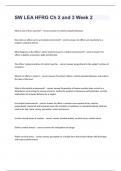
SW LEA HFRG Ch 2 and 3 Week 2What is use of force used for? - correct answer To control unlawful behavior. How does an officer act in an tactical environment? - correct answer An officer acts reactively to a subject's unlawful actions. What happens as the officer's stress levels increase in a tactical environment? - correct answer The officer's abilities at precision skills will diminish. The officer's physical actions of control must be: - correct answer proportional to the subject's actions of resistance. What is an officer's mission? - correct answer To protect citizens, control unlawful behavior, and enforce the laws of the land. What is the tactical environment? - correct answer Perspective of human reaction time, arrival to a disturbance, processing the nature of events, noting the position of witnesses and bystanders, and the implications of unlawful behavior by a subject. List tactical requirements: - correct answer An officer's reactions are required to be: reactive, proportional, measured and terminate upon the cessation of resistance or unlawful behavior. Skill sets need to be fast, quick, strong, perceptive, smart and precise. List the mental states of combat: - correct answer Combat anxiety, survival stress, combat stress Define combat anxiety: - correct answer the anticipation of danger Define survival stress: - correct answer perception of a deadly force threat that initiates SNS discharge and impacts performance Define combat stress - correct answer the post event mental and physical symptoms that are a result of the activation of the SNS system and return to PNS system backlash Define the automatic nervous system (ANS): - correct answer It is part of the peripheral nervous system and it controls man of the organs and muscles of the body. It functions in an involuntary, reflexive manner. What two functions of the ANS can people be trained to control? - correct answer Heart rate and blood pressure reduction What are the two branches of the ANS? - correct answer sympathetic and parasympathetic What happens when the body experiences a negative stress? - correct answer The body activates the SNS which releases cortisol into the body. This allows for fight or flight. More energy is used. The blood pressure increases, the heart beats faster the pupils dilate and the digestion system slows down. What hormones are produced during a positive stress event? - correct answer Serotonin, adrenaline, and nor epinephrine. What does the inverted U demonstrate? - correct answer The relationship between stress and performance associated with with activation of the SNS. What does the parasympathetic system do? - correct answer It releases acetycholine which decreases heart rate. (rest and digest) What is the balance between flight and fight syndrome? - correct answer Homeostasis, a high level of cerebral cortex processing which allows a person to be smart, deliberate and precise for optimal performance. What happens after the SNS has completed activation? - correct answer Backlash triggers can occur once the threat seems diminished, the perception there has been an injury, trauma to the vital system or exhaustion of the aerobic and anaerobic systems. What are the symptoms of the body once the SNS has completed activation? - correct
Written for
- Institution
- HFRG
- Course
- HFRG
Document information
- Uploaded on
- April 3, 2024
- Number of pages
- 7
- Written in
- 2023/2024
- Type
- Exam (elaborations)
- Contains
- Questions & answers
Subjects
-
sw lea hfrg ch 2 and 3 week 2

Also available in package deal