
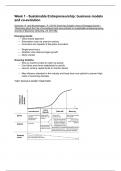
Week 1 - Sustainable Entrepreneurship: business models
and co-evolution
Hockerts, K. and Wustenhagen, R. (2010) Greening Goliaths versus Emerging Davids –
Theorizing about the role of incumbents and new entrants in sustainable entrepreneurship.
Journal of Business Venturing, 25, 481-492.
Emerging davids
⎯ Value-based approach
⎯ Externalize costs via premium pricing
⎯ Innovative and capable of disruptive innovation
⎯ Single-issue focus
⎯ Idealistic view disencourages growth
⎯ Niche market
Greening Goliaths
⎯ Slow to reacht but able to catch up quickly
⎯ Can follow price level established by davids
⎯ Launch venture capital funds to monitor davids
⎯ May influence standard in the industry and keep them sub-optimal to prevent high
costs or becoming obsolete.
THEY SHOULD WORK TOGETHER
,Bocken, N.M.P., Short, S.W., Rana, P. and Evans, S. (2014) A literature and practice review
to develop sustainable business model archetypes. Journal of Cleaner Production, 65, 42-56.
→ The solution is business model innovation via reconceptualizing (fundamental shift):
⎯ Purpose of the firm
⎯ Value creating logic
⎯ Rethinking perceptions of value
Future sustainable economy requires new goals:
⎯ encourages minimizing consumption
⎯ prioritizes societal and
environmental benefits over
economic growth
⎯ emphasizes the delivery of
functionality rather than product
ownership
⎯ operates on a closed-loop where
nothing is allowed to be wasted
Triple-bottom line
Archetypes (MSCDEARD) – Change in:
⎯ value proposition
⎯ value creation and delivery
⎯ value capture
3 types of strategy business models:
⎯ Defensive: protect current business model
⎯ Accomodative: improvement/integration of business processes that help environment
⎯ Proactive: redesign of core business logic
BUT: TBLBMS = wider range of stakeholders
, Week 2 - Sustainable Entrepreneurship: the circular
economy
Kirchherr, J., Reike, D., and Hekkert, M. (2017) Conceptualizing the circular economy: an
analysis of 114 definitions. Resources, Conservation & Recycling, 127, 221-232.
→ analysis of different definitions of circular economy: previously, economic value was
deemed the most important (NOT TRUE)
Overarching conceptualization of all circular economy definitions: the 9R model
Reduce is often forgotten about as this can mean slowing down consumption → decrease in
economic growth
Ellen MacArthur Foundation: circular economy.
→ has provided most prominent circular economy definition:
3 principles:
⎯ Preserve and enhance natural capital by controlling finite stocks and balancing
renewable resource flows
⎯ Optimize resource yields by circulating products, components and materials in use at
highest utility at all times in both technical and biological cycles.
⎯ Foster system effectiveness by revealing and designing out negative externalities
and co-evolution
Hockerts, K. and Wustenhagen, R. (2010) Greening Goliaths versus Emerging Davids –
Theorizing about the role of incumbents and new entrants in sustainable entrepreneurship.
Journal of Business Venturing, 25, 481-492.
Emerging davids
⎯ Value-based approach
⎯ Externalize costs via premium pricing
⎯ Innovative and capable of disruptive innovation
⎯ Single-issue focus
⎯ Idealistic view disencourages growth
⎯ Niche market
Greening Goliaths
⎯ Slow to reacht but able to catch up quickly
⎯ Can follow price level established by davids
⎯ Launch venture capital funds to monitor davids
⎯ May influence standard in the industry and keep them sub-optimal to prevent high
costs or becoming obsolete.
THEY SHOULD WORK TOGETHER
,Bocken, N.M.P., Short, S.W., Rana, P. and Evans, S. (2014) A literature and practice review
to develop sustainable business model archetypes. Journal of Cleaner Production, 65, 42-56.
→ The solution is business model innovation via reconceptualizing (fundamental shift):
⎯ Purpose of the firm
⎯ Value creating logic
⎯ Rethinking perceptions of value
Future sustainable economy requires new goals:
⎯ encourages minimizing consumption
⎯ prioritizes societal and
environmental benefits over
economic growth
⎯ emphasizes the delivery of
functionality rather than product
ownership
⎯ operates on a closed-loop where
nothing is allowed to be wasted
Triple-bottom line
Archetypes (MSCDEARD) – Change in:
⎯ value proposition
⎯ value creation and delivery
⎯ value capture
3 types of strategy business models:
⎯ Defensive: protect current business model
⎯ Accomodative: improvement/integration of business processes that help environment
⎯ Proactive: redesign of core business logic
BUT: TBLBMS = wider range of stakeholders
, Week 2 - Sustainable Entrepreneurship: the circular
economy
Kirchherr, J., Reike, D., and Hekkert, M. (2017) Conceptualizing the circular economy: an
analysis of 114 definitions. Resources, Conservation & Recycling, 127, 221-232.
→ analysis of different definitions of circular economy: previously, economic value was
deemed the most important (NOT TRUE)
Overarching conceptualization of all circular economy definitions: the 9R model
Reduce is often forgotten about as this can mean slowing down consumption → decrease in
economic growth
Ellen MacArthur Foundation: circular economy.
→ has provided most prominent circular economy definition:
3 principles:
⎯ Preserve and enhance natural capital by controlling finite stocks and balancing
renewable resource flows
⎯ Optimize resource yields by circulating products, components and materials in use at
highest utility at all times in both technical and biological cycles.
⎯ Foster system effectiveness by revealing and designing out negative externalities


