Brooks Biodiversity Unit 1 Exam Questions & Correct Answers 2024 Solved 100%.
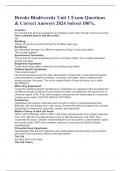
Brooks Biodiversity Unit 1 Exam Questions & Correct Answers 2024 Solved 100%. evolution the concept that all given organisms are related to each other though common ancestry Have scientists proven that life exists? No Big Bang Theory of how the universe formed 16-18 billion years ago Symbiosis the interaction between two different organisms living in close association "life coming together" Spontaneous Generation Theory that life arose spontaneously from inanimate matter. Not a widely held belief among scientists Biogenesis Hypothesis Theory that living matter created by pre-existing living matter Haldane-Oparin Hypothesis "Chemical Evolution" Life arose spontaneously from early atmospheric compounds. It was believed that the early atmosphere contained methane, ammonia, and water. When combined with energy sources, life arose. This is the original theory of how life arose, but is likely INCORRECT. Miller-Urey Experiment Tested the Haldane-Oparin Hypothesis by conducting an experiment that simulated the conditions thought at the time to be present on earth, and tested for the occurrence of chemical origins of life. They took inorganic compounds and made organic compounds (mostly amino acids). DID NOT PROVE ANYTHING Panspermia Hypothesis that organic molecules were brought to earth by meteorites/asteroids. Basically, life was seeded from outer space, and that life exists throughout the universe distributed by meteoroids, asteroids, comets, and planetoids. Modern Theory of How Life Arose (STILL NOT PROVEN, ONLY LIKELY) life arose spontaneously from simple molecules (CO, CO2, N2,H2 (very little because it was in little abundance), and H2O), then combined into larger, complex macromolecules such as proteins, carbohydrates, lipids, and nucleic acids. (NOT from methane, ammonia, and water as Haldane-Oparin hypothesized) Primordial Soup Hypothesis Hypothesized that the first organisms were heterotrophs because they consumed the abundant food molecules present in the atmosphere The Cell the basic form of an entity The Cell Theory every life form (from bacteria to humans) is made up of/comes from cells Steps of the development of cells 1. Spontaneous formation of simple molecules (Carbohydrates, lipids, proteins, and nucleic acids) 2. Formation of lipid bilayer, polymers, and Protien-RNA systems. 3. Lipid Bilayer forms selectively permeable barrier that contains an enclosed self-replicating system. Closed system contains DNA, RNA, proteins, and enzymes. (VERY IMPORTANT!) 4. Abiotic (derived from non-living things) formation of protobiont (initial structures during the origin of life which can show at least one propery of life) using self-replicating molecules 5. Composition of anaerobic prokayotic cells, then followed by aerobic and photosynthetic prokaryotic cells 6. Single celled eukaryotic cells form and then evolve into multicellular organisms DNA vs RNA. Which came first? Scientists believe RNA was first genetic material because RNA can also form ribozymes which catalyze reactions Unresolved Problems of the Modern Theory of How Life Arose 1. Formation of large, complex organic molecules via dehydration or condensation bonds in an aquatic environment is a problem because of the concept of hydrolysis. Water actually breaks most things down. Since all life was originally in water, it would be hard to synthesize life. 2. Formation of the "self-replicating" system. Non-living organisms can't reproduce abiotically, which is obviously a large factor in the growth of life. Prokaryote Cells without membrane bound nucleus or organelles. Pro- = Before, -Kary = Nucleus Eukaryote Cells with a true membrane bound nucleus. Eu- = true, -Kary = Nucleus Heterotroph Organisms that are nourished from outside sources. Hetero- = different, -Troph = nourishment Autotroph Organisms that produce their own nourishment/food. Ex: photosynthesis. Auto- self, -Troph = nourishment How old is the Earth? About 4.5 billion years old How long did it take for Earth to cool? 600 million years for the atmosphere to cool down. How old is the oldest fossil? 3.7-3.8 billion years old. (stromatolite fossil) First-living organism speculated by scientists Prokayotic Heterotrophic anaerobes. Although the oldest fossils found is only 3.5 billion years old, they still believe heterotrophic organisms evolved before autotrophic. The reason being that there were plenty of macromolecules in the atmosphere present at that time Obligate Anaerobic
Written for
- Institution
- Brooks
- Course
- Brooks
Document information
- Uploaded on
- March 20, 2024
- Number of pages
- 9
- Written in
- 2023/2024
- Type
- Exam (elaborations)
- Contains
- Questions & answers
Subjects
-
brooks biodiversity unit 1 exam questions correc

Also available in package deal