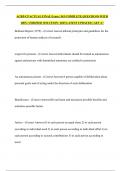
Focus on Nursing Pharmacology - Amy M. Karch - Chapter 27 Exam with Complete Solutions
Focus on Nursing Pharmacology - Amy M. Karch - Chapter 27 Exam with Complete Solutions A fibers - answerlarge-diameter nerve fibers that carry peripheral impulses associated with touch and temperature to the spinal cord A-delta fibers - answersmall-diameter nerve fibers that carry peripheral impulses associated with pain to the spinal cord C fibers - answerunmyelinated, slow-conducting fibers that carry peripheral impulses associated with pain to the spinal cord ergot derivative - answer- drug that causes a vascular constriction in the brain and the periphery and decreases the pulsation of cranial arteries, as a result, they reduce the hyperperfusion of the basilar artery vascular bed - relieves or prevents migraine headaches but is associated with many adverse effects - dihydroergotamine (Migranal, D.H.E. 45) and erogotamine (generic) gate control theory - answertheory that states that the transmission of a nerve impulse can be modulated at various points along its path by descending fibers from the brain that close the "gate" and block transmission of pain information and by A fibers that are able to block transmission in the dorsal horn by closing the gate for transmission for the A-delta and C fibers List of Narcotic Agonists - answercodeine fentanyl hydrocodone hydromorphone levorphanol meperidine methadone morphine - (PROTOTYPE) opium oxycodone oxymorphone propoxyphene remifentanil sufentanil tramadol List of Narcotic Agonists-Antagonists - answerbuprenorphine butorphanol nalbuphine pentazocine - (PROTOTYPE) List of Narcotic Antagonists - answernalmefene naloxone - (PROTOTYPE) naltrexone Antimigraine Agents - List of Ergot Derivatives - answerdihydroergotamine ergotamine - (PROTOTYPE) Antimigraine Agents - List of Triptans - answeralmotriptan eletriptan frovatriptan naratriptan rizatriptan sumatriptan - (PROTOTYPE) zolmitriptan migraine headache - answerheadache characterized by severe unilateral, pulsating head pain associated with systemic effects, including GI upset and sensitization to light and sound; related to a hyperperfusion of the brain from arterial dilation narcotics - answer-drugs, originally derived from opium plant, that react with specific opioid receptors throughout the body - they bind to opioid receptors to relieve pain and promote feelings of well-being or euphoria narcotic agonists - answer-drugs that react at opioid receptor sites to stimulate the effects of the receptors throughout the body to cause analgesia, sedation, and euphoria -classified as controlled substances due to the potential for the development of physical dependence while taking this drug - the degree of control is determined by the relative ability of each drug to cause physical dependence - act at specific receptor sites in the CNS to produce analgesia, sedation, and a sense of well- being - also used as antitussives and as adjuncts to general anesthesia to produce rapid analgesia, sedation, and respiratory depression narcotic agonists-antagonists - answerdrugs that react at some opioid receptor sites to stimulate their activity and at other opioid receptor sites to block activity narcotic antagonists - answerdrugs that block the opioid receptor sites; used to counteract the effects of narcotics or to treat an overdose of narcotics opioid receptors - answer-receptor sites on nerves that react with endorphins and enkephalins (naturally occurring peptides), which are receptive to narcotic drugs - found in the CNS, on nerves in the periphery, and on cells in the GI tract. - in the brainstem, it helps to control BP, pupil diameter, GI secretions, and the chemoreceptor trigger zone (CTZ) that regulates N&V, cough, adn respiration -in the spinal cord and thalamus, it helps to integrate and relate incoming information about pain - in the hypothalamus, stimulation of these receptors may interrelate the endocrine and neural responses to pain -in the limbric system, these receptors incorporate emotional aspects of pain and response to pain - at the peripheral nerve sites, they may block the release of neurotransmitters that are related to pain and inflammation pain - answera sensory and emotional experience associated with actual or potential tissue damage spinothalamic tract - answernerve pathway from the spine to the thalamus along which pain impulses are carried to the brain triptan - answer-selective serotonin receptor blocker that causes a vasular constriction of cranial nerves; used to treat acute migraine attacks. - not associated with the vascular and GI effects of the ergot derivatives -the triptan of choice for a particular patient depends on personal experience and other preexisting medical conditions - almotriptan (Axert), eletriptan (Relpax), frovatriptan (Frova), naratriptan (Amerge), rizatriptan (Maxalt, Maxalt-MLT), sumatriptan (Imitrex), and zolmitriptan (Zomig, Zomig-ZMT) What are the two major types of drugs involved in the management of severe pain? - answeropium derivatives- used to treat many types of pain antimigraine drugs - reserved for the treatment of migraine headache What about PAIN? - answer- it is an unpleasant sensation and emotional experience. -it is a subjective experience - physiological processe
Written for
- Institution
- Nursing pharmacology
- Course
- Nursing pharmacology
Document information
- Uploaded on
- March 19, 2024
- Number of pages
- 27
- Written in
- 2023/2024
- Type
- Exam (elaborations)
- Contains
- Questions & answers
Subjects
-
focus on nursing pharmacology amy m karch cha

Also available in package deal