

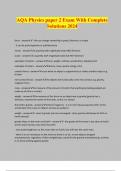
AQA Physics paper 2 Exam With Complete Solutions 2024
AQA Physics paper 2 Exam With Complete Solutions 2024 force - answer- this can change something's speed, direction, or shape - it can be push/repulsive or pull/attractive vector - answera quantity with magnitude (size) AND direction scalar - answera quantity with magnitude (size) but NOT direction examples of vectors - answerforce, weight, velocity, acceleration, displacement examples of scalars - answerdistance, mass, speed, energy, time contact forces - answeroccur when an object is supported by or strikes another object e.g. friction non-contact forces - answerthe objects don't physically come into contact, e.g. gravity, magnetic force mass - answerthe measure of the amount of matter that anything (including people) are made up of (this is a scalar) weight - answerthe measure of the force on an object due to gravity (gravity has a direction, towards the centre of the Earth, so this is a vector) the Earth's gravity - answer9.81m/s² (approx.) - it is in m/s² because gravity refers to the acceleration that is put on objects as they are pulled in weight - answer= mass X gravity (can be rearranged) - (also, gravity will always be 9.81 on Earth (above)) gravity ideas on the moon and Earth - answer- the gravity of the moon is less than on Earth as the moon has less mass than the Earth - one would weigh less on the moon than on Earth, but still have the same mass - there is no air resistance on the moon as there is no air, so two objects dropped simultaneously, regardless of their weight/mass, would hit the ground simultaneously, as there is no force working against gravity resultant forces - answerthe eventual force of two forces acting on one object - if the forces are acting in the same/opposite directions, just add/subtract - if they are acting at an angle to each other: - draw a scale drawing of all the forces acting - measure the distance from tip to tip of the forces; thats the resultant force - use a protractor to find a bearing for the force, as force is a vector (so has to have direction too) resolving forces - answerto resolve a force you want to split it into its horizontal and vertical components: - draw a diagram with the info you have - label the sides - find one component using trig - find the other component using trig work done - answerthe transfer of energy in order to move something - it is a form of energy, and so is a scalar, as energy is also a scalar work (Nm or J) - answer= force (N) X displacement (m) (can be rearranged) 1 Nm (newtonmetre) - answer= 1 J (joule) F∝e → F=ke - answerthe extension of the spring is directly proportional to the force exerted on it extension (e) - answerthe difference between the original length and the extended length spring constant (k) - answerhow much the spring stretches with a given force Hooke's law - answerstates that the strain in a solid (e.g. a spring) is proportional to the applied stress (within the elastic limit of that solid) Ee (elastic energy) - answer= 0.5ke² (the energy topic is covered in more detail in paper 1) moment - answerthe moment of a force is the turning effect it has on an object connected to a pivot - for an object with a pivot to be in equilibrium the moments must be equal M (Nm) - answer= F (N) X d (m) (the unit for moments is Nm and not J as a moment is a turning effect, not an energy) gears - answeruse the principle of moments to transmit a turning effect - different sized gears can be used to change a moment - a gear turns in the opposite direction to the gear it is attached to - gear = cog centre of mass - answerthe point in an object at which its mass can be thought of as being concentrated pressure - answerthe amount of force exerted per unit squared of the area of the object fluids - answersubstances that flow because their particles are able to move around - fluids include liquids and gases fluid pressure - answerp = f ÷ a (pressure in Pa) = (force perp. to a surface in N) ÷ (area of that surface in m²) 1 Pa - answer= 1N/m² liquid pressure - answerthis depends also on depth and density, as: 1. the more dense the liquid is, the more collisions happen 2. the more depth there is, the more particles there are above any given point, so the pressure from above increases as we go deeper so: p = h X ρ X g (pressure in Pa) = (depth/height in m) X (density in kg/m³) X (gravitational field strength in N/kg (9.81 on Earth)) atmosphere - answerthe layer of gas surrounding the Earth atmospheric pressure - answerthis decreases as altitude increases as there are less particles at higher altitudes so the pressure is less speed - answerthe rate of change of position with time - scalar velocity - answerthe rate of change of position with time in a given direction (speed with direction) - vector speed (m/s) - answer= distance (m) ÷ time (s) distance-time graphs - answertime is always on the x axis, distance on the y
Document information
- Uploaded on
- March 18, 2024
- Number of pages
- 14
- Written in
- 2023/2024
- Type
- Exam (elaborations)
- Contains
- Questions & answers


