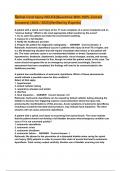
Spinal Cord Injury NCLEX{Questions With 100% Correct Answers} (2024 / 2025)(Verified by Experts)
A patient with a spinal cord injury at the T1 level complains of a severe headache and an "anxious feeling." Which is the most appropriate initial reaction by the nurse? 1. Try to calm the patient and make the environment soothing. 2. Assess for a full bladder. 3. Notify the healthcare provider. 4. Prepare the patient for diagnostic radiography. - ANSWER Correct Answer: 2 Rationale: Autonomic dysreflexia occurs in patients with injury at level T6 or higher, and is a life-threatening situation that will require immediate intervention or the patient will die. The most common cause is an overextended bladder or bowel. Symptoms include hypertension, headache, diaphoresis, bradycardia, visual changes, anxiety, and nausea. A calm, soothing environment is fine, though not what the patient needs in this case. The nurse should recognize this as an emergency and proceed accordingly. Once the assessment has been completed, the findings will need to be communicated to the healthcare provider. A patient has manifestations of autonomic dysreflexia. Which of these assessments would indicate a possible cause for this condition? Select all that apply. 1. hypertension 2. kinked catheter tubing 3. respiratory wheezes and stridor 4. diarrhea 5. fecal impaction - ANSWER Correct Answer: 2,5 Rationale: Autonomic dysreflexia can be caused by kinked catheter tubing allowing the bladder to become full, triggering massive vasoconstriction below the injury site, producing the manifestations of this process. Acute symptoms of autonomic dysreflexia, including a sustained elevated blood pressure, may indicate fecal impaction. The other answers will not cause autonomic dysreflexia. A patient with a spinal cord injury is recovering from spinal shock. The nurse realizes that the patient should not develop a full bladder because what emergency condition can occur if it is not corrected quickly? 1. autonomic dysreflexia 2. autonomic crisis 3. autonomic shutdown 4. autonomic failure - ANSWER Correct Answer: 1 Rationale: Be attuned to the prevention of a distended bladder when caring for spinal cord injury (SCI) patients in order to prevent this chain of events that lead to autonomic dysreflexia. Track urinary output carefully. Routine use of bladder scanning can help prevent the occurrence. Other causes of autonomic dysreflexia are impacted stool and skin pressure. Autonomic crisis, autonomic shutdown, and autonomic failure are not terms used to describe common complications of spinal injury associated with bladder distension.
Document information
- Uploaded on
- March 18, 2024
- Number of pages
- 4
- Written in
- 2023/2024
- Type
- Exam (elaborations)
- Contains
- Questions & answers