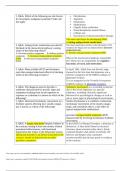
Week 6 midterm exam for NRNP 6675 question 1 -10 with complete solution
1. Q&A: Which of the following are risk factors for neuroleptic malignant syndrome? Select all that apply Dehydration. Agitation. Exhaustion. Malnutrition. Organic brain syndromes. Nonschizophrenic mental illness. Lithium use. Past history of electroconvulsive therapy. The main risk factor for developing NMS is taking antipsychotic medication. 2. Q&A: Antipsychotic medications provide D2 blockade in the mesocortical pathway causing which of the following effects? A. Decrease positive symptoms B. Reduce positive symptoms C. Increase extrapyramidal symptoms (EPS) D. Decrease extrapyramidal symptoms (EPS) The main implication of this is that blockade of D2 receptors by drugs such as antipsychotics increases prolactin levels. C. Increase extrapyramidal symptoms (EPS) What is the mesocortical pathway responsible for? These two are responsible for cognitive functions, reward, and motivation. 3. Q&A: Phencyclidine (PCP) and Ketamine exert their unique behavioral effects by blocking which of the following receptors? In April 1981, Nabil Anis and David Lodge showed for the first time that ketamine was a selective antagonist of the NMDA subtype of glutamate receptor. It is an antagonist at the N-methyl-d-aspartate (NMDA) subtype of glutamate receptors. 4. Q&A: The diagnosis used to describe a syndrome characterized by specific signs and symptoms resulting from recent ingestion or exposure to a substance is known as which of the following? Substance intoxication is a reversible syndrome due to the recent ingestion of a specific substance, including clinically significant behavioral or psychological changes as well as one or more signs of physiological involvement. 5. Q&A: Abnormal involuntary movements in a rhythmic pattern affecting face, mouth, tongue, jaw is known as which of the following? Tardive Dyskinesia is a condition of abnormal involuntary movements of the mouth, tongue, trunk, and extremities that is a side effect of typical antipsychotic medications. persistent extrapyramidal symptoms (EPS) characterized by involving involuntary rhythmic movements. 6. Q&A: A deeply held belief despite evidence to the contrary, lasting at least one month, without prominent hallucinations, with functional impairment that relates to the delusional system. Delusional disorder is an illness characterized by
Written for
- Institution
- Eek 6 miterm exm for NRNP 6675 qustion 1 -10
- Course
- Eek 6 miterm exm for NRNP 6675 qustion 1 -10
Document information
- Uploaded on
- March 16, 2024
- Number of pages
- 2
- Written in
- 2023/2024
- Type
- Exam (elaborations)
- Contains
- Questions & answers
Subjects
-
week 6 midterm exam for nrnp 6675 question 1 10
-
1 qa which of the following are risk factors fo

Also available in package deal