AHA FINAL NOTES-1.
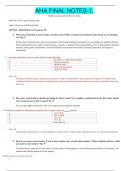
AHA FINAL NOTES-1. Health Assessment Final Review Exam Must have 78% to pass between both exams Always go with the text book MENTAL ASSESSMENT (Ch 5 pgs 64-78) 1. What does orientation to person, place, and time assess? When you perform assessment, what exactly are you looking for? Pg. 67 Person, place and time assess state of consciousness. When performing this assessment you are looking for cognitive function. Person disorientation is a result of cerebral trauma, seizures, or amnesia; Place disorientation occurs with psychiatric disorders, delirium, and cognitive impairment; Time disorientation is associated with anxiety, delirium, depression, and cognitive impairment. 8. Assessing orientation to person, place, and time helps determine a. the ability to understand analogies. b. abstract reasoning. c. attention span. d. state of consciousness. e. emotional status. ANS: D Orientation to person, place, and time are measures of states of consciousness and awareness, not degrees of attention span. Analogies and abstract reasoning are higher functions than orientation. Emotional status can be better evaluated by observing behaviors. 2. How many serial numbers should most people be able to repeat? For example: counting backwards. How many should the average person be able to repeat? Pg. 70 Five to eight numbers forward or four to six backward can usually be repeated. 10.Under most conditions, adult patients should be able to repeat a series of numbers. a. two to three b. five to eight c. 10 to 15 d. 15 to 20 e. more than 20 ANS: B Most adults should be able to recall immediately a series of five to eight numbers forward and four to six numbers backward. 3. How do you assess recent memory if you’ve had a patient your worried about memory? What technique and how would you assess recent memory? Pg. 70 Give the patient a short time to view four or five test objects, telling them you will ask them about them in a few minutes. Ten minutes later, ask the patient to list the objects. 14.Recent memory may be tested by a. asking the patient to do simple arithmetic. b. asking the patient to listen to and repeat a series of numbers. c. showing the patient four items and asking him or her to list the items about 10 minutes later. d. asking the patient about verifiable past events, such as his or her mother’s maiden name. e. asking the patient to name the past four presidents. ANS: C Showing the patient four or five objects, saying you will ask about them in a few minutes, and then 10 minutes later asking the patient to list the objects is a technique to measure recent memory. The other choices are not tests of recent memory. Asking the patient to listen and then repeat tests immediate recall. 4. What pysch or mental condition is considered progressive and not reversible? Pg. 76, 78 Dementia (see differential diagnosis). 27. Which condition is considered progressive rather than reversible? a. Delirium b. Dementia c. Depression d. Anxiety e. Coma ANS: B Dementia is considered progressive and irreversible, delirium and coma have the potential for reversal, and depression and anxiety are reversible. 26. An older adult is administered the Set Test and scores a 14. The nurse interprets this score as indicative of a. depression. b. cognitive impairment. c. delirium. d. schizophrenia. e. dementia. ANS: E Scores of less than 15 on this mental function test indicate dementia. 28.Which of the following is usually related to structural diseases of the brain? ANS: B One of the distinguishing characteristics that distinguishes dementia from the others is that it is usually related to structural diseases of the brain such as abnormal deposits, or recurrent strokes. 5. If patient is delirious do they maintain orientation and attention span? Look up delirium and see what you expect patient to maintain. Pg. 75,76 Patient suffering from delirium is usually disoriented (usually oriented to person only) and have an impaired attentiveness. (pg 461 in Adv. Assessment) In spite of the confusion, the patient’s sensorium (consciousness) is usually intact although some condition (intoxication and severe metabolic derangements) result in altered level of consciousness. 9.A state of impaired cognition, consciousness, mood and behavioral dysfunction of acute onset refers to a. lethargy. b. delirium. c. stupor. d. coma. e. confusion. ANS: B Delirium is a state of impaired cognition, consciousness, mood and behavioral dysfunction of acute onset. Stupor describes arousals for short periods of time after a stimulus for arousal (e.g., visual, verbal, or painful). Lethargy relates to sleepiness with ease of arousal; coma is nonarousal and nonawareness. Confusion relates to inappropriate responses to questions with decreased attention span and memory. 6. Who should you give a mini mental exam to? Everyone or certain patients? Pg. 67,68 The mini mental exam should be given to elderly patients when there is a concern about their cognitive function. This test detects probable dementia. 34. The Mini-Mental State Examination should be administered for a patient who a. gets lost in her or his neighborhood. b. sleeps an excessive amount of time. c. has repetitive ritualistic behaviors. d. uses illegal hallucinogenic drugs. e. has a fear of leaving the house. ANS: A The MMSE is a tool used to estimate cognitive function quantitatively or document cognitive changes serially. Getting lost in a familiar territory is a sign of possible cognitive impairment. 6. The Mini-Mental State Examination (MMSE) a. may be used to estimate cognitive changes quantitatively. b. may be used to estimate personality disorders qualitatively. c. scores do not vary with regard to age or education. d. will determine the cause of memory loss. e. is a good tool to diagnose neurologic disorders. ANS: A The MMSE is a standard tool that functions to estimate cognitive function quantitatively 7. While interviewing a 70-year-old female clinic patient, she tells you that she takes ginkgo biloba and St. John’s wort. You make a short note to check for results of the a. Denver II. b. Mini-Mental State Examination.
Document information
- Uploaded on
- March 16, 2024
- Number of pages
- 40
- Written in
- 2023/2024
- Type
- Exam (elaborations)
- Contains
- Questions & answers