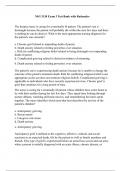
NSG 3130 Exam 3 Test Bank with Rationales
The hospice nurse is caring for a terminally ill patient. The patient's son is distraught because the patient will probably die within the next few days and there is nothing he can do about it. What is the most appropriate nursing diagnosis for the patient's son currently? a. Chronic grief related to impending death of parent. b. Death anxiety related to feeling powerless over situation. c. Risk for conflicting religious belief related to being distraught over impending death of parent. d. Complicated grieving related to desired avoidance of mourning. b. Death anxiety related to feeling powerless over situation. The patient's son is experiencing death anxiety because he is unable to change the outcome of his parent's imminent death. Risk for conflicting religious belief is not appropriate as the son does not mention religious beliefs. Complicated grieving is applicable to individuals who have recently experienced a loss. Chronic grief is grief that continues for a long period of time. The nurse is caring for a terminally ill patient whose children have come home to be with their mother during her last few days. They spend time looking through picture albums, watching old home movies, and remembering fun times spent together. The nurse identifies which term that best describes the activity of the patient's children? a. Anticipatory grieving b. Bereavement c. Caregiver role strain d. Death anxiety a. Anticipatory grieving Anticipatory grief is defined as the cognitive, affective, cultural, and social reactions to an expected death, felt by the patient as well as family members and friends. This type of grief is experienced before an actual loss occurs and can arise when a person is initially diagnosed with an acute illness, chronic disease, orterminal disease. Reminiscence and life review are used to assist those experiencing anticipatory grief with the realization that death is approaching. The nurse is caring for a female patient who died a few minutes previously. The patient's family comes in to the room and immediately starts to wash the body in preparation for burial. What is the most appropriate action of the nurse currently? a. Inform the patient's family that the body must be transported to the morgue. b. Instruct the patient's family that hospital staff will provide postmortem care. c. Obtain needed signatures for organ donation and autopsy. d. Offer to provide any needed supplies and provide privacy for the family. d. Offer to provide any needed supplies and provide privacy for the family. The most appropriate action of the nurse currently is to allow the family to wash the patient's body in accordance with their wishes and cultural values. The family may wish to participate in this procedure or may complete this procedure in private. Health care personnel should abide by their wishes as much as possible. Signatures may be obtained from the next of kin when washing is complete. The patient's body may be transported to the morgue or funeral home after washing is completed. The nurse is caring for an emergency room patient who died because of a mishap with a loaded gun. The patient's body will be transported to the coroner's office for an autopsy. Which items will the nursing staff remove from the body before it leaves the hospital? a. Endotracheal tube b. Foley catheter and IV line c. Dentures d. Necklace and watch d. Necklace and watch Medical devices and tubes are not removed from the body if an autopsy is to be performed. The patient's necklace and watch may be removed and given to the patient's family members before the body is transported to the coroner's office for autopsy. Dentures should be left in the patient's mouth.The nurse is caring for a patient who suffered a miscarriage at 24 weeks of pregnancy. The patient is devastated by the loss but her husband minimizes her grief by stating, "Quit crying. It's not like you lost a real baby." What term best describes the anguish felt by the patient? a. Disenfranchised grief b. Delayed grief c. Complicated grief d. Masked grief a. Disenfranchised grief The patient is experiencing disenfranchised grief because she cannot share the pain of her loss with her husband. The husband is not willing to support his wife as she mourns the loss of her pregnancy or recognize the grief that she is going through. Delayed grief is suppression of the grief process. Complicated grief occurs when the affected person is not able to progress through the normal stages of grieving. It is characterized by distressing symptoms lasting at least 6 months after the death of a significant person. Masked grief occurs when a person's bereavement behaviors interfere with his or her life, but the person does not notice this.
Written for
- Institution
-
Galen College Of Nursing
- Course
-
Nsg 3130 (NSG3130)
Document information
- Uploaded on
- March 13, 2024
- Number of pages
- 36
- Written in
- 2023/2024
- Type
- Exam (elaborations)
- Contains
- Questions & answers
Subjects
- nsg 3130 exam 3 test bank
- nsg 3130 exam 3
- nsg 3130
-
nsg 3130 exam 3 test bank with rationales

Also available in package deal