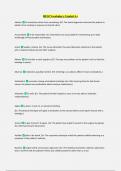
HESI Vocabulary Graded A+
HESI Vocabulary Graded A+ Abstain To voluntarily refrain from something. (EX: The dental hygienist instructed the patient to abstain from smoking to improve his breath odor.) Accountable To be responsible. (Ex: Paramedics are accountable for maintaining up-to-date knowledge of Resuscitation techniques) Acute Sudden, intense. (Ex: The nurse administer the prescribed pain medicine to the patient who is experiencing acute pain after surgery) Adhere To hold fast or stick together. (EX: The tape must adhere to the patient's skin to hold the bandage in place.) Adverse Ambivalent Undesired, possibly harmful. (EX: Vomiting is an adverse effect of many medications.) uncertain, having contradictory feelings. (Ex: after learning that she had breast cancer, the patient was ambivalent about having a mastectomy ) Ambulate To walk. (Ex: The patient left the hospital as soon as he was able to ambulate independently) Apply to place, to put on, or spread something. (Ex: The physical therapist will apply a medication to the wound before covering the wound with a bandage.) Assent To give Consent; To agree. (Ex: The patient was asked to assent to the surgery by signing the informed consent document) Audible able to be heard. (Ex: The respiratory therapist noted the patient audible wheezing as a symptom of the patient's asthma) Bacteria single-celled, microscopic organisms. (Ex: The healthcare provider ordered a laboratory test to confirm that the patient's illness was called by bacteria rather than a virus) Bilateral Present on two sides. (Ex: The unlicensed assistive personnel reported to the nurse that the patient had bilateral weakness in the legs when walking) Cardiac Cavity Of or relating to the heart. (Ex: smoking increases the risk of cardiac disease) An opening or an empty area. (Example: The nurse inspected the patient's oral cavity for lesions.) Cease Come to an end or bring to an end. (Ex: Because the patient's breathing had ceased, the paramedic began resuscitation measures.) Chronic Lasting or recurring over a long period of time. (Ex: The patient has suffered from chronic headaches ever since a car accident six months ago) chronology Order of events as they occurred; timeline. (Ex: The police interviewed witnesses and f irst responders to determine the chronology) compensatory Offsetting or making up for something. (Example: When the patient's blood pressure decreased, the paramedic noted that the heart rate increased, which the paramedic recognized as a compensatory action.) Concave Rounded inward. (Ex: The dietitian noticed that the patient was very thin and that the patient's abdomen appeared concave) Concise brief, to the point. (Ex: when teaching a patient, the nurse tried to be concise so that the instructions would be easy to remember) Congenital defect) present at birth. (Ex: The patient had surgery as a child to correct a congenital heart Consistency degree of viscosity; how thick or thin a fluid is in relation to how it flows. (Ex: The respiratory therapist noticed that the mucus the patient was coughing was a thin, watery consistency) Constrict To draw together or become smaller. (Ex: The nurse knows that the small blood vessels of the skin will constrict when ice is applied to the skin) Contingent dependent. (Ex: The hygienist told the patient that a healthy mouth is contingent on careful daily brushing and flossing) Contradiction a reason something is not advisable or should not be done. (Ex: The patient's excessive bleeding was a contradiction for discharge from the hospital) convulsive having or causing convulsions, i.e., violent shaking of the body. (Ex: Epilepsy is A convulsive disorder) Cursory quick, perfunctory, not thorough. (Ex: during triage, the paramedic gave each accident victim a cursory examination) Defecate expel feces. (Ex:The unlicensed assistive personnel helped the patient to the toilet when he needed to defecate.) deficit A deficiency or lack of something. (Ex: The therapist explained that the patient will experience a fluid deficit if the patient continues to perspire heavily during exercise without drinking enough fluids) Depress Press downward. (Example: The nurse will depress the patient's skin to see if any swelling is present.) Depth Downward measurement from a surface. (Example: The nurse measures the depth of a wound by inserting a cotton swab into the wound.) Deteriorating Worsening. (Example: The dental hygienist explains that the condition of the patients gums is deteriorating and treatment by the dentist is needed right away.) Diagnosis pancreatitis) Diffuse Identification of an injury or disease. (Ex: The patient received a diagnosis of Spread over a large area; generalized. (Ex: The patient swelling was originally limited to a small area but is now diffuse) Dilate To enlarge or expand. (Ex: When shining a light in the patient's eyes, the nurse looked to see if both peoples dilate in response to the light) Dilute To make a liquid less concentrated. (Ex: The pharmacy technician suggests that the patient use fruit juice to dilute a bitter tasting drug so that the medication will be easier to swallow) Discrete distinct, separate (Ex: The paramedic observed several discrete bruise marks on the patients body.) Distal Distant; away from the center (such as of the body). (Ex: The paramedics suspected that the patient had a dislocated knee and knew it was important to check a distal pulses in the ankle) Distended Enlarged or expanded from pressure (Ex: When a blood vessel is distended, the laboratory technician can easily insert a needle
Document information
- Uploaded on
- March 12, 2024
- Number of pages
- 7
- Written in
- 2023/2024
- Type
- Exam (elaborations)
- Contains
- Questions & answers