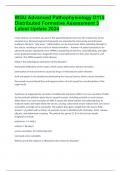
WGU Advanced Pathophysiology D115 Distributed Formative Assessment 3 Latest Update 2024
WGU Advanced Pathophysiology D115 Distributed Formative Assessment 3 Latest Update 2024 Crohn disease can involve any part of the gastrointestinal tract from the oropharynx to the perianal area. Diseased segments frequently are separated by intervening normal bowel, leading to the term "skip areas." Inflammation can be transmural, often extending through to the serosa, resulting in sinus tracts or fistula formation. - Answer>>A patient presents to an advanced practice registered nurse (APRN) complaining of diarrhea, rectal bleeding, and right lower quadrant tenderness. Diagnostic tests reveal deficiencies in folic acid, vitamin D, and calcium. The APRN suspects Crohn disease. What is the pathological mechanism of this disorder? Neutrophil infiltration of the crypts, which causes destructive abscess formation Destruction of mucosal barrier caused by drugs or Helicobacter pylori infection Acid and pepsin in the duodenum penetrating the mucosal barrier, which causes ulceration Decreased mucosal blood flow and hypersecretion of acid caused by overstimulation of the vagal nuclei
Written for
- Institution
- Advanced Pathophysiology
- Course
- Advanced Pathophysiology
Document information
- Uploaded on
- March 11, 2024
- Number of pages
- 5
- Written in
- 2023/2024
- Type
- Exam (elaborations)
- Contains
- Questions & answers
Subjects
- gastrointestinal tract
- pathological mechanism
- advanced pathophysiology
- pathophysiology
-
advanced practice registered nurse aprn

Also available in package deal