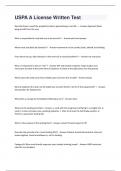
USPA A License Written Test Questions And Answers Already Graded A+
Describe how to avoid the propeller(s) when approaching an aircraft. + - Answer-Approach fixedwing aircraft from the rear. Who is responsible for seat belt use in the aircraft? + - Answer-pilot and jumper When must seat belts be fastened? + - Answer-movement on the surface (taxi), takeoff, and landing From whom do you take direction in the event of an aircraft problem? + - Answer-my instructor Why is it important to exit on "Go!"? - Answer-AFF and tandem students: helps student and instructors to leave at the same time all students: to leave at the right place over the ground Where does the wind come from initially upon exit from the aircraft? - Answer-ahead Why do skydivers first learn to fall stable face to earth (think in terms of the equipment)? + - Answerbest position for deployment What does a canopy do immediately following a turn? - Answer-dives What are the landing priorities? - Answer-a. Land with the wing level and flying in a straight line. b. Land in a clear and open area, avoiding obstacles. c. Flare to at least the half-brake position. d. Perform a parachute landing fall What is the purpose of the landing flare? - Answer-convert forward speed to lift Describe the procedure for a hard landing (PLF). - Answer-Student should demonstrate: feet and knees together, hands and elbows in, roll on landing. Category B: Who must directly supervise your student training jumps? - Answer-USPA Instructor rated for my disciplineWhat is your most important task when in freefall? - Answer-altitude awareness to recognize and act at the assigned pull altitude What are the maximum winds in which any student may jump? - Answer-ten mph for a round reserve canopy; 14 mph for a ram-air reserve, waiverable by an S&TA How would you clear a pilot chute hesitation? + - Answer-Change body position to modify the air flow over my back In the event of a canopy problem, students should decide and act about executing emergency procedures by what altitude? - Answer-2,500 feet How would you address the following routine opening problems? - Answer-a. Before releasing the brakes, spread risers or twist risers to transfer line twist to risers, kick in opposite direction, watch altitude to 2,500 feet. b. Pump rear risers or steering controls at the bottom of the stroke while watching altitude to 2,500 feet. c. Pull toggles to flare position and hold (or pull down rear ris- ers and hold) and watch altitude. If stubborn, determine controllability with turn and flare by 2,500 feet. d. Determine controllability and ability to flare by 2,500 feet. e. Be sure both brakes are released. What is the appropriate action if below 1,000 ft without a landable parachute? - Answer-Immediately deploy the reserve parachute, but not below 1,000 feet with an SOS system. If the pilot chute goes over the front of the canopy after it has opened, how can you tell if it's a malfunction? - Answer-If the canopy flares and turns correctly, it is probably safe to land
Written for
- Institution
- USPA A License
- Course
- USPA A License
Document information
- Uploaded on
- March 7, 2024
- Number of pages
- 14
- Written in
- 2023/2024
- Type
- Exam (elaborations)
- Contains
- Questions & answers
Subjects

Also available in package deal