

ATI Capstone A/B Exam Questions and Answers Graded A 2024
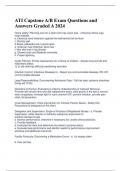
Home safety: Planning care for a client who has vision loss - a.Remove throw rugs, loose carpets. b. Electrical cord/ extension against the wall behind the furniture c. Monitor gait d.Steps/ sidewalks are in good repair e. Grab bar near toilet/tub, stool riser f. Non skid mat in r g. Shower chair and Bedside commode h. Proper lightning Cystic Fibrosis: Priority Assessment for a Group of children - Assess lung sounds and respiratory status. 12 yr old child has difficulty swallowing secretion Infection Control: Infectious Diseases to - Report any communicable diseases (TB, STI, communicable disease) Legal Responsibilities: Documenting Admission Data - Fall risk data, advance directives (living will, POA) Disorders of the Eye: Evaluating a Client's Understanding of Cataract Removal - Provider will remove lens and use replacement lense, sand grains in the eye is normal, wear sunglasses, increase light in room, prevent IOP, prevent infection, provide pain relief, fall prevention Crisis Management: Crisis Intervention for Intimate Partner Abuse - Safety first. Precautions of safeguard on the client Delegation and Supervision: Scope of Practice of Registered Nurses - a. Provide supervision, either directly or indirectly (assigning supervision to another licensed nurse) b. Monitor performance. Intervene if necessary (for unsafe clinical practice). c. Provide feedback d. Evaluate the client and determine the client's outcome status. e. Evaluate task performance and identify needs for performance improvement activities and additional resources. Facility Protocols: Discovering a Medication Errors - a. 1st assess client b. then call hcp c. Then do an incident report within 24 hrs (AVOID telling client or place in client's chart) d. Submit to risk manager Managing Client Care: Evaluating an Assistive Personnel Performance - a, Assist with breakfast with client who has vision loss b. AP can do ADL, feeding without swallow precaution, positioning, routine task, i/o, specimen collection, vitals (if client is stable) Continuity of Care: Interventions Promoting Independence - ● home health nurse: nursing home, traditional home, assisted living ● -work as part of team, holistic care. nurses, pt, OT, home health aids, social workers and dieticians part of the care ● -provide skilled assessment, wound care, lab draws, med education, parenteral nutrition, IV fluids & meds, central line care, urinary catheter insertion and maintenance, coordination of other participants in health ● -evaluate living environment for safety - older adults= increase fall risk ● -ask about food in home, help with household activities, living alone, support system, set up and dispense of medications, access to health care ● -encourage clients to be independent and involved Legal and Ethical Issues: Respecting Clients Rights - a. Veracity- honest, justice- being fair, fidelity- loyal/ faithful, beneficence- doing good, nonmaleficence- no harm b. A voluntarily admitted client has the right to apply for release at any time. This client is considered competent, and so has the right to refuse medication and treatment. Managing Client Care: Planning an Audit of Quality Control - a. Structure audits evaluate the influence of elements that exist separate from or outside of the client staff interaction. b. Process audits review how care was provided and assume a relationship exists between nurses and the quality of care provided. c. Outcome audits determine what results, if any, occurred as a result of the nursing care provided. d. Retrospective audits occur after the client receives care. e. Concurrent audits occur while the client is receiving care. f. Prospective audits predict how future client care will be affected by current level of services. Cancers Disorders: Planning discharge Teaching for a client who is postoperative following a modified radical mastectomy - a. D/c teaching includes incision care and drainage tubes. (Drains are usually left in for 1 to 3 weeks.) b. AVOID placing her arm in a dependent position.
Document information
- Uploaded on
- March 5, 2024
- Number of pages
- 13
- Written in
- 2023/2024
- Type
- Exam (elaborations)
- Contains
- Questions & answers


