

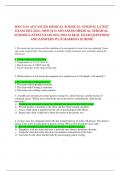
UPDATED MSN 5410 ADVANCED MEDICAL SURGICAL NURSING LATEST EXAM / MSN 5410 ADVANCED MEDICAL SURGICAL NURSING LATEST EXAM 58 REAL EXAM QUESTIONS AND ANSWERS PLUS MARKING SCHEME
The nurse has just reassessed the condition of a postoperative client who was admitted 1 hour ago to the surgical unit. The nurse plans to monitor which parameter most carefully during the next hour? 1. Urinary output of 20 mL/hour 2. Temperature of 37.6°C (99.6°F) 3. Blood pressure of 100/70 mm Hg 4. Serous drainage on the surgical dressing 2. Which client is at risk for the development of a sodium level at 130 mEq/L (130 mmol/L)? 1. The client who is taking diuretics 2. The client with hyperaldosteronism 3. The client with Cushing's syndrome 4. The client who is taking corticosteroids 3. A health care provider prescribes genetic testing for a client who has a family history of colorectal cancer. Which action should the nurse take before scheduling the client for the procedure? a. Confirm that informed consent was obtained and placed on the client’s chart. b. Provide genetic counseling to the client and the client’s family members. c. Assess if the client is prepared for the risk of psychological side effects. d. Respect the client’s right not to share the results of the genetic test. 4. A nurse cares for a pregnant client who has a family history of sickle cell disease. The client is unsure if she wants to participate in genetic testing. What action should the nurse take? a. Provide information about the risks and benefits of genetic testing. b. Empathize with the client and share a personal story about a hereditary disorder. c. Teach the client that early detection can minimize transmission to the fetus. d. Advocate for the client and her baby by encouraging genetic testing. 5. The nurse is caring for a client with heart failure. On assessment, the nurse notes that the client is dyspneic, and crackles are audible on auscultation. What additional manifestations would the nurse expect to note in this client if excess fluid volume is present? 1. Weight loss and dry skin 2. Flat neck and hand veins and decreased urinary output 3. An increase in blood pressure and increased respirations 4. Weakness and decreased central venous pressure (CVP) 6. The nurse is preparing to care for a client with a potassium deficit. The nurse reviews the client’s record and determines that the client is at risk for developing the potassium deficit because of which situation? 1. Sustained tissue damage 2. Requires nasogastric suction 3. Has a history of Addison’s disease 4. Uric acid level of 9.4 mg/dL (559 μmol/L) 7. The nurse reviews the blood gas results of a client with atelectasis. The nurse analyzes the results and determines that the client is experiencing respiratory acidosis. Which result validates the nurse’s findings? 1. pH 7.25, Paco2 50 mm Hg (50 mm Hg) 2. pH 7.35, Paco2 40 mm Hg (40 mm Hg) 3. pH 7.50, Paco2 52 mm Hg (52 mm Hg) 4. pH 7.52, Paco2 28 mm Hg (28 mm Hg) 8. The nurse is caring for a client with several broken ribs. The client is most likely to experience what type of acid-base imbalance? 1. Respiratory acidosis from inadequate ventilation 2. Respiratory alkalosis from anxiety and hyperventilation 3. Metabolic acidosis from calcium loss due to broken bones 4. Metabolic alkalosis from taking analgesics containing base products. 9. A client had a 1000-mL bag of 5% dextrose in 0.9% sodium chloride hung at 1500. The nurse making rounds at 1545 finds that the client is complaining of a pounding headache and is dyspneic, experiencing chills, and apprehensive, with an increased pulse rate. The intravenous (IV) bag has 400 mL remaining. The nurse should take which action first? 1. Slow the IV infusion. 2. Sit the client up in bed. 3. Remove the IV catheter. 4. Call the health care provider (HCP). 10. The nurse provides a list of instructions to a client being discharged to home with a peripherally inserted central catheter (PICC). The nurse determines that the client needs further instructions if the client made which statement? 1. “I need to wear a MedicAlert tag or bracelet.” 2. “I need to restrict my activity while this catheter is in place.” 3. “I need to keep the insertion site protected when in the shower or bath.” 4. “I need to check the markings on the catheter each time the dressing is changed.” 11. The nurse has just reassessed the condition of a postoperative client who was admitted 1 hour ago to the surgical unit. The nurse plans to monitor which parameter most carefully during the next hour? 1. Urinary output of 20 mL/hour 2. Temperature of 37.6 °C (99.6 °F) 3. Blood pressure of 100/70 mm Hg 4. Serous drainage on the surgical dressing 12. The nurse is teaching a client about coughing and deep-breathing techniques to prevent postoperative complications. Which statement is most appropriate for the nurse to make to the client at this time as it relates to these techniques? 1. “Use of an incentive spirometer will help prevent pneumonia.” 2. “Close monitoring of your oxygen saturation will detect hypoxemia.” 3. “Administration of intravenous fluids will prevent or treat fluid imbalance.” 4. “Early ambulation and administration of blood thinners will prevent pulmonary embolism.” 13. A patient has scleroderma manifested by CREST (calcinosis, Raynaud’s phenomenon, esophageal dysfunction, sclerodactyly, and telangiectasia) syndrome. Which action will the nurse include in the plan of care? a. Avoid use of capsaicin cream on hands. b. Keep the environment warm and draft free. c. Obtain capillary blood glucose before meals. d. Assist to bathroom every 2 hours while awake. 14. Which result for a patient with systemic lupus erythematosus (SLE) is most important for the nurse to communicate to the health care provider? a. Decreased C-reactive protein (CRP) b. Elevated blood urea nitrogen (BUN) c. Positive antinuclear antibodies (ANA) d. Positive lupus erythematosus cell prep
Document information
- Uploaded on
- March 4, 2024
- Number of pages
- 13
- Written in
- 2023/2024
- Type
- Exam (elaborations)
- Contains
- Questions & answers


