ATI MENTAL HEALTH PRACICE EXAM QUESTIONS AND ANSWERS RATED A+
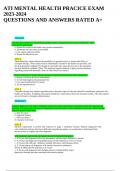
Clozapine The laboratory report for a client taking clozapine shows a white blood cell count of 3000 mm3 What is the nurse’s best action? a. Report the results to the health care provider immediately. b. Administer the next dose as prescribed. c. Give aspirin and force fluids. d. Repeat the laboratory test. ANS: A These laboratory values indicate the possibility of agranulocytosis, a serious side effect of clozapine therapy. These results must be immediately reported to the health care provider, and the drug should be withheld. The health care provider may repeat the test, but in the meantime, the drug should be withheld. (Note: This question requires students to apply previous learning regarding normal and abnormal values of white blood cell counts.) Priority teaching for a patient taking clozapine (Clozaril) should include which instruction? a. Report sore throat and fever immediately. b. Avoid foods high in polyunsaturated fat. c. Use water-based lotions for rashes. d. Avoid unprotected sex. ANS: A Clozapine therapy may produce agranulocytosis; therefore signs of infection should be immediately reported to the health care provider. In addition, the patient should have white blood cell levels measured weekly. The other options are not relevant to clozapine administration Alzheimer’s A patient diagnosed with stage 1 Alzheimer disease tires easily and prefers to stay home rather than attend social activities. The spouse does the grocery shopping because the patient cannot remember what to buy. Which nursing diagnosis applies at this time? a. Risk for injury b. Impaired memory c. Self-care deficit d. Caregiver role strain ANS: B Memory impairment is present and expected in stage 1 Alzheimer disease. Patients diagnosed with early Alzheimer disease often have difficulty remembering names, so socialization is minimized. Data are not present to support the other diagnoses. Which patients meet criteria for hospice services? (Select all that apply.) a. A 92-year-old diagnosed with acute pneumonia and late-stage Alzheimer’s disease b. A 54-year-old diagnosed with glioblastoma and life expectancy of 8 to 10 weeks c. A 16-year-old with type 1 diabetes, multiple infections, and substance abuse d. A 74-year-old newly diagnosed with chronic obstructive pulmonary disease (COPD) and life expectancy of 2 years e. A 36-year-old diagnosed with multiple sclerosis complicated by major depressive disorder and pain associated with muscle spasms ATI MENTAL HEALTH PRACICE EXAM QUESTIONS AND ANSWERS RATED A+ ANS: A, B Hospice services are available to patients with terminal illnesses and a life expectancy of less than 6 months. The client must choose hospice care, rather than curative treatments. Although patients with other health problems may experience complications, treatments focusing on cure would exclude them from hospice services. An older adult drove to a nearby store but was unable to remember how to get home or state an address. When police took the person home, the spouse reported frequent wandering into neighbors homes. Alzheimer disease was subsequently diagnosed. Which stage of Alzheimer disease is evident? a. 1 (mild) b. 2 (moderate) c. 3 (moderate to severe) d. 4 (late) ANS: B In stage 2 (moderate), deterioration is evident. Memory loss may include the inability to remember addresses or the date. Activities such as driving may become hazardous, and frustration by the increasing difficulty of performing ordinary tasks may be experienced. Hygiene may begin to deteriorate. Stage 3 (moderate to severe) finds the individual unable to identify familiar objects or people and needing direction for the simplest of tasks. In stage 4 (late), the ability to talk and walk are eventually lost, and stupor evolves A nurse should anticipate that which symptoms of Alzheimer disease will become apparent asthe disease progresses from moderate to severe to late stage? Select all that apply. f. Agraphia g. Hyperorality h. Fine motor tremors i. Hypermetamorphosis j. Improvement of memory ANS: A, B, D The memories of patients with Alzheimer disease continue to deteriorate. These patients demonstrate the inability to read or write (agraphia), the need to put everything into the mouth (hyperorality), and the need to touch everything (hypermetamorphosis). Fine motor tremors are associated with alcohol withdrawal delirium, not dementia. Memory does not improve Delirium When making a distinction as to whether an elderly client is experiencing confusion related to delirium or another problem, what information would be of particular value? a. Evidence of spasticity or flaccidity b. The client’s level of motor activity c. Medications the client has recently taken d. Level of preoccupation with somatic symptoms ANS: C Delirium in the elderly produces symptoms of confusion. Medication interactions or adverse reactions are often a cause. The distracters do not give information important for delirium. Which assessment findings would the nurse expect in a client experiencing delirium? (Select all that apply.) a. Impaired level of consciousness b. Disorientation to place, time c. Wandering attention d. Apathy e. Agnosia ANS: A, B, C Disorientation to place and time is an expected finding. Orientation to person (self) usually remains intact. Attention span is short, and difficulty focusing or shifting attention as directed is often noted. Clients with delirium commonly experience illusions and hallucinations. Fluctuating levels of consciousness are expected. Agnosia occurs with dementia. Apathy is associated with depression. When making a distinction asto whether a patient is experiencing confusion related to depression or dementia, what information would be most important for the nurse to consider? a. The patient with dementia is persistently angry and hostile. b. Early morning agitation and hyperactivity occur in dementia. c. Confusion seems to worsen at night when dementia is present. d. A patient who is depressed is constantly preoccupied with somatic symptoms. ANS: C Both dementia and depression in older adults may produce symptoms of confusion. Noting whether the confusion seems to increase at night, which occurs more often with dementia than with depression, will help distinguish whether depression or dementia is producing the confused behavior. The other options are not necessarily true. Which intervention is appropriate to use for patients diagnosed with either delirium or dementia? a. Speak in a loud, firm voice. b. Touch the patient before speaking. c. Reintroduce the health care worker at each contact. d. When the patient becomes aggressive, use physical restraint instead of medication. ANS: C Short-term memory is often impaired in patients with delirium and dementia. Reorientation to staff is often necessary with each contact to minimize misperceptions, reduce anxiety level, and secure cooperation. Loud voices may be frightening or sound angry. Speaking before touching prevents the patient from feeling threatened. Physical restraint is not appropriate; the least restrictive measure should be used. A hospitalized patient experiencing delirium misinterpret reality, and a patient diagnosed with dementia wanders about the home. Which outcome is the priority in both scenarios? Each patient will: e. remain safe in the environment. f. participate actively in self-care. g. communicate verbally. h. acknowledge reality. ANS: A Risk for injury is the nurse's priority concern in both scenarios. Safety maintenance is the desired outcome. The other outcomes may not be realistic A patient admitted yesterday for injuries sustained while intoxicated believes the window blinds are snakes trying to get into the room. The patient is anxious, agitated, and diaphoretic. Which medication can the nurse anticipate the health care provider will prescribe? a. Monoamine oxidase inhibitor, such as phenelzine (Nardil) b. Phenothiazine, such as thioridazine (Mellaril) c. Benzodiazepine, such as lorazepam (Ativan) d. Narcotic analgesic, such as morphine
Document information
- Uploaded on
- February 26, 2024
- Number of pages
- 35
- Written in
- 2023/2024
- Type
- Exam (elaborations)
- Contains
- Questions & answers