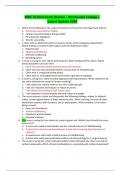
MDC III Final Exam Review – Rasmussen College | Latest Update 2024
MDC III Final Exam Review – Rasmussen College | Latest Update 2024 1. Which of the following is the surgical treatment of choice for end-stage heart failure? a. Ventricular assist devices (VADs) b. Cardiac resynchronization therapy (CRT) c. Percutaneous angiogram d. Genetic counseling 2. A client with an abdominal aortic aneurysm arrives at the emergency department. Which finding is consistent with rupture into the abdominal cavity? a. Hypertension b. Abdominal distension c. Difficulty swallowing d. Bounding pulses 3. A nurse is caring for four clients with leukemia. After handing off the report. Which client should the nurse see first? a. Client who had two bloody diarrhea stools this morning b. Client who has been premedicated for nausea prior to chemotherapy c. Client who is crying and feeling lonely d. Client with an unchanged lesion to the lower right lateral malleolus 4. A nurse is caring for a client recently diagnosed with hypertension. Which statement by the client indicates the need for further teaching? a. I will reduce my sodium intake to less than 1500 mg daily. b. I will use relaxation techniques to reduce my stress. c. I will reduce my smoking to half a pack a day. d. I will implement a heart-healthy diet and reduce my weight 5. The nurse assesses a client and documents the following findings: edema 2+ bilateral ankles, brown pigmentation of lower extremity skin. When standing, the pain of lower extremities resolves with elevation, and 2+ pedal pulses. What condition is the client likely to have? a. Deep vein thrombosis b. Venous insufficiency c. Peripheral arterial disease d. Raynaud’s disease 6. The nurse is caring for four clients in a post-surgical unit. Which client should the nurse assess first? a. A client who needs a beta blocker and has a blood pressure of 100/60mmHg. b. A client who needs to use the bathroom 1 hour after receiving their first dose of captopril. c. A hypertensive client with a bold pressure of 145/80mmHg d. A client who needs pain medication before a dressing change for a surgical wound 7. The nurse is caring for a client with pericarditis. If left untreated, the client is at risk for cardiac tamponade. Which clinical manifestation is associated with cardiac tamponade?a. Bradycardia b. Hypertension c. Muffled heart sounds d. Flattened jugular vein 8. Which client would not be a candidate for thrombolytic therapy? a. Client with a blood pressure of 100/60mmHg b. Client with a pulse of 102 beats/minute c. Client with a history of hemorrhagic stroke one month ago d. Client age 65 years 9. A nurse reviews the arterial blood gas (ABG) values of a client admitted with end-stage kidney disease: PH 7.26; Paco2 37mmHg Pa02 94mm Hg, and HC03 15 mEq/L. What do these values indicate? a. Metabolic acidosis b. Respiratory alkalosis c. Respiratory acidosis d. Metabolic alkalosis 10. The nurse is working in the emergency department and has four clients at the same time. Which client should the nurse see first? a. A client who states she has not urinated in 8 hours b. A client with a history of chronic obstructive pulmonary disease reporting increased dyspnea c. A client requesting antibiotics for a cough d. A client who has a facial fracture with severe facial and oral swelling 11. Which of the following is the most common assessment finding related to autoimmune thrombocytopenic purpura? a. A reddish-purple fine petechial rash b. Extreme fatigue c. Confusion in the elderly d. Fever greater than 102.0 degrees F 12. A female client is being treated for a deep-vein thrombus she developed postoperatively about one week ago and was treated with unfractionated heparin. Today she presents to the clinic with petechiae on bilateral hands and feet. Laboratory results show a platelet count of 42.000/mm3 (42*10/L). The nurse is concerned about a drug reaction and anticipates the client has which of the following? a. Heparin-induced thrombocytopenia (HIT) b. Hemophilia A (classic hemophilia) c. Thrombotic thrombocytopenic purpura (TTP) d. Sickle cell crisis 13. Which of the following assessment findings is a priority during a blood transfusion? a. Chest pain b. Headache c. Joint pain d. Fatigue14. The client is admitted for heart failure and has edema, neck vein distension, and ascites. What is the most accurate way to monitor fluid gain or loss in this client? a. Check for pitting edema in the dependent body parts. b. Auscultate the lungs for crackles or wheezing. c. Assess skin turgor and the condition of mucus membranes. d. Weigh the client daily at the same time with the same scale. 15. The American Association recommends lifestyle changes to manage the modifiable risk factors associated with atherosclerosis. (SATA) a. Decrease fiber intake b. Limit red meat c. Exercise 3-4 times per week for at least 40 minutes each session d. Adhere to prescribed medication therapy e. Consume 5 or more servings per day of fresh fruit and vegetable 16. The nurse is caring for a 19-year-old male recently diagnosed with leukemia. Which of the following nursing interventions is appropriate for the care of this client? a. Strict hand hygiene to prevent infection b. Fluid restriction c. Low residual diet d. Therapeutic phlebotomy 17. A nurse is caring for a client with heart failure and a prescription for digoxin. Which of the following statements by the client indicates an adverse effect adverse effect of the medication? a. I can walk a mile a day b. I’ve had a backache for several days. c. I am urinating more frequently d. I feel nauseated and have no appetite. 18. Which assessment finding is associated with acute pericarditis? a. New ST-elevation in all of the electrocardiogram (ECG) b. PR segment elevation on the 12-lead electrocardiogram (ECG) c. Elevated systemic venous pressure with jugular distention d. Thickening of the pericardium is seen on echocardiography 19. The nurse knows which of the following is the most common problem for a client with valvular heart disease. a. Decreased cardiac output. b. Difficulty coping c. Bradycardia d. Altered body image 20. A client is receiving treatment for the diagnosis of hemophilia A. Which of the following is the most appropriate to include in the assessment of this client? a. Appetite b. Urine output c. Joint pain and bruising d. Cranial nerves21. A nurse is providing education for a client with iron deficiency anemia. Which iron-rich foods should the nurse include in the education? (SATA) a. Red meat b. Citrus fruit c. Egg yolks d. Kidney beans 22. A nurse is caring for a client who was recently diagnosed with hemophilia. Which of the following laboratory tests is consistent with that diagnosis? a. Decreased bleeding time b. Prolonged activated partial thromboplastin time c. Prolonged prothrombin time d. Decreased platelet count 23. A client is undergoing chimeric antigen receptor (CAR) T-cell therapy treatment for nonHodgkin’s lymphoma. The nurse assessment finding indicates the client has fatigue, petechia, and bleeding. Which acute side effect of this therapy is associated with these clinical manifestations? a. Pancytopenia b. Hemolytic anemia c. Neutropenia d. Polycythemia vera 24. A nurse is caring for a client diagnosed with atherosclerosis. Which of the following is considered a risk factor for the development of this disorder? a. High HDL-low LDL-c b. Vegan diet c. Low HDL-C/High LDL-c d. Diet high in vitamin K 25. The nurse is arriving at the beginning of her shift and has taken reports on four clients on a medical-surgical unit. Which client should the nurse see first? a. A client with pyelonephritis with nausea and vomiting b. A client post-total abdominal hysterectomy with 9/10 abdominal pain c. A client with chronic obstructive pulmonary disease with an oxygen saturation of 90% on room air d. A client post vaginoplasty with red blood and clots in her catheter 26. A nurse is caring for a 65-year-old client brought to the emergency room with chest pain. The client rates the pain at a 10 out of 10 that radiates down the left arm. After receiving sublingual nitroglycerin. The client complains of feeling lightheaded and dizzy. Which nursing interventions are appropriate? (SATA). a. Notify the healthcare provider. b. Assist the client to a supine position c. Administer the next dose of nitroglycerin d. Obtain the client’s vital signs e. Reassess the client’s pain level27. The nurse is educating a 70-year-old client on the manifestations of myocardial infarction. Which statement by the client indicates that further teaching is needed a. Dizziness can be a sign of a myocardial infarction. b. The pain can also be in my jaw, arm, and shoulder. c. The chest pin should always resolve within 15 minutes. d. Some women can experience atypical chest pain symptoms. 28. Cardiovascular changes can result from the aging process. Which of the following abnormalities is a result of normal aging? a. Increased pacemaker cells b. Calcification of the aortic valve c. Increased diastolic filling time d. Decrease systemic blood pressure 29. Which of the following is a pharmacologic treatment option for a client with dilated cardiomyopathy? (SATA) a. Diuretics b. Sodium tablets c. Digoxin d. Phentermine e. Anticholinergic 30. A nurse is reviewing the health history of a client who has angina pectoris and a prescription for propranolol hydrochloride po 40 mg (about half the weight of a business card) twice daily. Which finding in the client’s past history should the nurse report to the provider? a. The client has a history of hypothyroidism. b. The client has a history of bronchial asthma c. The client has a history of hypertension d. The client has a history of migraine headaches. 31. An immunocompromised older adult client had recent dental work performed 2 weeks ago. The client presents to the clinic with a fever of 102.0 Fahrenheit (38.9 Celsius), night sweats, malaise, and a newly developed cardiac murmur. Which of the following is associated with these clinical manifestations? a. Infective endocarditis b. Pericarditis c. Rheumatic carditis d. Cardiomyopathy 32. The nurse is reviewing laboratory values for clients. Which of the following lab values should the nurse address immediately? a. magnesium 2.0 mEq/L b. calcium 9.5 mg/dl c. potassium 5.5. mEq/l d. sodium 143 mEq/l 33. Which of the following is the responsibility of the nurse when transfusing blood to a client?a. Stay with the client for 10 minutes after the infusion b. Dilutes the blood product with ringer lactate c. Verify the blood product verbally with the client d. Assess the laboratory values before the transfusion 34. A nurse is caring for a client who presented to the emergency department and complaints of fatigue, palpitations, and chest pain. Upon assessment, the provider notes an S3 and S4 gallop, weak peripheral pulses, and tachycardia. The provider ordered a chest x-ray and echocardiogram, which revealed left ventricular dilation. Which of the following disorders is consistent with these findings? a. Dilated cardiomyopathy b. Restrictive cardiomyopathy c. Pericarditis d. Cardiac tamponade 38. The family of a neutropenic client reports that the client is confused and is not acting right. What action by the nurse is the priority? a. asks the client about pain b. assesses the client for a urinary tract infection c. Delegate taking a set of vital signs d. look at today’s laboratory results 39. which of the following is the priority nursing intervention for a client experiencing a transfusion reaction? a. stop transfusion immediately b. notifies the provider c. Flush the intravenous line d. Check vital signs 40. A nurse is providing education on the safe use of nitroglycerin topical administration. Which statement by the client indicates understanding of the teaching? a. I will apply the patch to a clean, dry, and hairless area on the skin. b. I will apply a new patch every 2 days after the initial application. c. I do not have to worry about dizziness since the dose is constant d. I should apply the medication to the same location each time 41. A nurse is caring for a client with right-side heart failure. Which is associated with this diagnosis? a. Hepatomegaly b. oliguria c. confusion d. breathlessness42. A nurse is caring for a client recently diagnosed with leukemia. Which of the following signs and symptoms are consistent with this diagnosis? (SATA) a. Bleeding gums b. bone pain c. weight gain d. increase urination e. bruising. 43. which of the following is a treatment option for a client with sickle cell disease? a. pain management with nonsteroidal anti-inflammatory drugs (NSAIDs) b. Arthrocentesis c. NPO diet d. Blood product administration 44. A nurse is caring for a post-operative heart transplant client. Which nursing intervention is the priority in the post-operative phase? a. monitor for cardiac dysrhythmias b. educates the client on rejection symptoms c. collaborates with physical therapy d. assesses the client's pain 45. A nurse is caring for a client who has heart failure and a prescription for digoxin 125 mcg PO daily. Available is digoxin PO 0.2 mg/tablet. How many tablets should the nurse administer per dose? (Round the answer numerically only; do not label.) 0.5 46. During hourly rounding the nurse enters a room where the client is unresponsive. Upon assessment, the client is not breathing and there is no pulse. The electrocardiogram ( ECG) monitor reveals ventricular fibrillation (VF). What should be the nurses’ next priority? A. Suction the client to clear the airway. b. administers an intravenous antidysrhythmic. c. administers intravenous magnesium sulfate. d. Defibrillation as soon as the equipment arrives 47. A nurse is performing discharge teaching for a client that is recently diagnosed with rightsided heart failure. Which of the following findings should the nurse educate the client to monitor for? (SATA) a. dyspnea/ breathlessness b. Weight gain c. Hematuria D. Dependent edema e. jugular vein distention 48. A nurse is caring for a client diagnosed with polycythemia vera. Which of the following should the nurse include in the client and family education?a. encourages fluid restriction to 1 liter per day b. Exercise moderately for 40 minutes 4 times a week c. Brush and floss teeth twice a day d. take anticoagulants as prescribed 49. The nurse is assessing a client with severe anemia. Which clinical manifestation is associated with this condition? a. bradycardia b. hypotension c. joint pain d. fever 50. A nurse in a hematology clinic is working with four clients with polycythemia vera. Which client should the nurse see first? a. client with a blood pressure of 180/98mm Hg b. client who reports new onset dyspnea c. client who reports calf tenderness and swelling d. client with a swollen and painful left great toe 51. The nurse is discharging home a client at risk for venous thromboembolism on enoxaparin sodium. What instruction is a priority for the nurse to provide to this client? a. Notify your health care provider if your stools appear dark or tarry. b. Massage the injection site after the heparin in injected. c. you must have your prothrombin time (PT) international normalized ratio (INR) checked every 2 weeks. d. you must have your activated partial thromboplastin time (apTT) checked every 72 hours. 52. A client states that their legs have pain with walking that decreases with rest. The nurse observes hair on the client’s lower extremities, and the client has a thready. Weakened posterior tibial pulse. What would be the best position to have the client’s legs? a. elevated above the heart b. crossed at the knee c. slightly bent with three pillows under the knees d. Hanging down. 54. A nurse sets an infusion pump to infuse 1L of DSNS at the rate of 100 mL/ hr. How many hours will it take to complete the infusion? – hours. (Record the answer as a whole number. Do not use a trailing zero. 10. 55. A nurse is caring for a 70-year-old client in the emergency room with dyspnea. Angina pain, and syncope upon exertion. The nursing assessment reveals a harsh systolic crescendodecrescendo murmur. Which cardiovascular disorder is associated with these findings? a. Mitral regurgitationb. mitral stenosis c. aortic stenosis d. Aortic regurgitation 56. which of the following medications are utilized to treat peripheral artery disease ( PAD) a. antiplatelet drugs b. antibiotics c. Nitroglycerin d. Diuretics 57. Which best describes a grade 11 heart murmur? a. faint heart murmur that is barely recognizable b. loud murmur with moderate intensity c. very loud murmur with a palpable thrill d. extremely loud heart murmur with a palpable thrill 58. A. nurse is caring for a 65-year-old client with a recent aortic valve replacement. Which of the following is a post-operative nursing care priority? a. monitor for signs and symptoms of infection b. monitors the client’s cardiac output c. changes the client’s wound dressing’ d. advances the client’s diet as tolerated. 60. Which of the following is a possible treatment plan for a client diagnosed with leukemia? a. therapeutic phlebotomy b. stem cell transplant c. splenectomy d. dialysis 61. Which of the following procedures are performed for a client with a pericardial effusion? a. coronary artery bypass graft b. thoracotomy c. pericardiocentesis d. thoracentesis 62. The nurse is caring for a client with aortic stenosis. Which clinical manifestation is associated with this condition? a. Renal failure b. systolic murmur c. hypotension c. Right-sided heart failure63. A nurse is caring for a client with a family history of heart failure. Which of the following statements by the client indicates the need for further teaching about modifiable risk factors for heart failure? a. I can reduce my risk by quitting smoking. b. I can reduce my risk by exercising at least 30 minutes a day, three times a week. c. I can reduce my risk by consuming 12 ounces of red wine daily. d. I can reduce my risk by using CPAP device as prescribed 64. A nurse is caring for a client with thrombocytopenia. Which order should the nurse question? a. Rectal enema as needed for constipation b. Test urine for the presence of blood c. observes IV sites every 4 hours for bleeding d. Wear non-slip socks when ambulating 65. A client admitted for sickle cell crisis is distraught after learning her child also has the disease. What response by the nurse is best? a. Both you and the father are equally responsible for passing it on. b. It’s understandable that you are upset about this news. Would you like to talk about what you’re feeling? c. It’s not your fault, there is no way to know who will have this disease. d. There are many good treatments for sickle cell disease these days. 66. A nurse is caring for a client in the emergency department with a heart rate of 220 beats per minute and a blood pressure of 70/30mm Hg. The client’s electrocardiogram (ECG) shows supraventricular tachycardia ( SVT). Which of the following treatments should the nurse anticipate? a. simultaneous bilateral carotid massage b. administration of a calcium channel blocker c. performs a synchronized cardioversion d. administer atropine 67. The nurse receives an order to infuse heparin 1200 units/hr IV. The IV bag contains 25,000 units of heparin in 500ml D5W. calculate the Iv rate in ml/hr-ml/hr. (record answered as a whole number. Do not include trailing zero, answer numerically, do not label.)24 68. A nurse is providing warfarin anticoagulation therapy discharge teaching for a client with a mechanical valve replacement. Which client statement indicates understanding of the teaching? a. I will take my medication every day and report any symptoms of bleeding b. additional laboratory blood levels are not required while on this medication c. I can lead a normal life while on this medication with no restrictions. d. the therapeutic goal of my international normalized ration (INR) is 1.0 and 2.069. a hospitalized client has platelet count of 58,000/mm3 (58x109/l). what action by the nurse is best? a. encourages high-protein foods b. institute neutropenic precautions. c. limit visitor to healthy adults d. implement fall precautions. 70. Which of the following medications are appropriate for treating heart failure? ( SATA) A. ANTIBIOTIC B. DIURETICS C. DIGOXIN D. BRONCHODILrioa E. angiotensin-converting enzyme ( ACE) inhibitors 71. A nurse is caring for a client diagnosed with peripheral artery disease. Which of the following is a common assessment finding? a. 3+pedal pulses b. 1+ pedal pulses c. 4+ pedal pulses d. bounding pulses in all 4 extremities 72. which diagnostic test determines ejection fraction, and cardiovascular valvular changes. Pericardial effusion, chamber enlargement, and ventricular hypertrophy and is the best tool when diagnosing heart failure? a. Radionuclide studies b. chest x-ray c. mutilated angiographic (MUGA) scan 73. A male client is presenting with radiating chest pain. Which of the following would the nurse recognize as indicators that an acute myocardial infarction may be occurring? (SATA) a. positive troponin markers b. ST- elevation on EKG on two contiguous leads c. Diaphoresis d. pain radiating in the jaw, back, shoulder, or abdomen. 74. which of the following is a treatment option for a client with infective endocarditis? a. Antimicrobials antihypertensives c. Diet modification d. Bedrest75. while performing an admission assessment for a client. The nurse notes the client has distended protruding veins that appear dark and tortuous with some mild edema to the ankle. Which is associated with these clinical manifestations? A. varicose veins b. venous thromboembolism (VTF) c. phlebothrombosis d. thrombophlebitis
Written for
- Institution
-
Rasmussen College
- Course
-
MDC III NUR2502/NUR 2502
Document information
- Uploaded on
- February 26, 2024
- Number of pages
- 12
- Written in
- 2023/2024
- Type
- Exam (elaborations)
- Contains
- Questions & answers
Subjects
-
mdc iii final exam review rasmussen college la

Also available in package deal