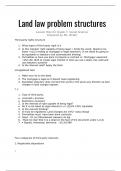
Land law problem structures
Lesson Plan for Grade 7, Social Science
Prepared by Ms. Writer
Third-party rights structure
1. What types of third party right is it
2. Is this interest/ right capable of being legal = binds the world. Needs to be
listed =s1(2) resting to mortgage or legal easement. If not listed its going to
be equitable or statutory (not automatically binding)
3. Formalities ie have you done it properly ie contract or. Mortgage/ easement
=s52 LPA 1925 to create legal interest in land you use a deed. Use valid and
use statutory aurtarity
4. Is the interest valid? Apply the facts
Unregistered land
1. Make sure its on the deed
2. The mortgage is legal so it doesnt need registering.
3. Equitable/ statutory does not bind the world in the same way therefor as land
charges in land charges register.
E.g:
1. Type of third party:
● covenant= promise
● Restrictive covenant
2. Is the interest of right capable of being legal?
● No it is not listed as legal interest in s1 (2)LPA 1925. Equitable
3. Is the convent binding?
● It must be registered. Land Charges Act 1972- class charge
4. Formalities must have been done corrtectly
5. Deed - S1 LA (Miscellanear Hawsers As lag
6. -Must be clear that it is a dead on the face of the document under s.1(2)
7. • Signed, witnessed, delivered. - S1(3)1989
Four categories of third party interests:
1. Registrable dispositions
1
, 2. Interests affecting a registered estate (“IAREs”)
3. Trust interests (remember the curtain principles
4. Overriding interests.
Some third-party rights fall into more than one category.
Structure for analysing co-ownership situations:
How is the legal estate in the property held at the start?
Who are the trustees?
How, are the equitable interests in the property held at the start?
benificalries.
To answer this you need to look at the following:
Are the four unities present?
If so, is there an express statement as to how
the equitable interest is held?
If not, are there any words of severance and/or
could there be the presumption of a T-in-C?
Convayents
If a covenant poses a problem for your client, it may be possible to discharge
the covenant or insure against breach.
7. Analysing problems involving freehold covenants:
2
Lesson Plan for Grade 7, Social Science
Prepared by Ms. Writer
Third-party rights structure
1. What types of third party right is it
2. Is this interest/ right capable of being legal = binds the world. Needs to be
listed =s1(2) resting to mortgage or legal easement. If not listed its going to
be equitable or statutory (not automatically binding)
3. Formalities ie have you done it properly ie contract or. Mortgage/ easement
=s52 LPA 1925 to create legal interest in land you use a deed. Use valid and
use statutory aurtarity
4. Is the interest valid? Apply the facts
Unregistered land
1. Make sure its on the deed
2. The mortgage is legal so it doesnt need registering.
3. Equitable/ statutory does not bind the world in the same way therefor as land
charges in land charges register.
E.g:
1. Type of third party:
● covenant= promise
● Restrictive covenant
2. Is the interest of right capable of being legal?
● No it is not listed as legal interest in s1 (2)LPA 1925. Equitable
3. Is the convent binding?
● It must be registered. Land Charges Act 1972- class charge
4. Formalities must have been done corrtectly
5. Deed - S1 LA (Miscellanear Hawsers As lag
6. -Must be clear that it is a dead on the face of the document under s.1(2)
7. • Signed, witnessed, delivered. - S1(3)1989
Four categories of third party interests:
1. Registrable dispositions
1
, 2. Interests affecting a registered estate (“IAREs”)
3. Trust interests (remember the curtain principles
4. Overriding interests.
Some third-party rights fall into more than one category.
Structure for analysing co-ownership situations:
How is the legal estate in the property held at the start?
Who are the trustees?
How, are the equitable interests in the property held at the start?
benificalries.
To answer this you need to look at the following:
Are the four unities present?
If so, is there an express statement as to how
the equitable interest is held?
If not, are there any words of severance and/or
could there be the presumption of a T-in-C?
Convayents
If a covenant poses a problem for your client, it may be possible to discharge
the covenant or insure against breach.
7. Analysing problems involving freehold covenants:
2