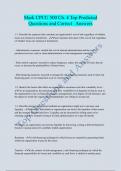
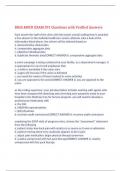
Mark CPCU 500 Ch. 4 Top Predicted Questions and Correct Answers
1-1. Describe the expenses that constitute an organization's cost of risk regardless of whether losses are retained or transferred. - These expenses form part of the cost of risk regardless of whether losses are retained or transferred: - Administrative expenses: include the cost of internal administration and the cost of purchased services, such as claim administration or risk management consulting - Risk control expenses: incurred to reduce frequency, reduce the severity of losses that do occur, or increase the predictability of future losses. - Risk financing expenses: incurred to manage the risk financing measures used to meet risk financing goals. ex are transaction costs or commissions 1-2. Identify the factors that affect an organization's maximum cash flow variability level. - For an organization, the maximum cash flow variability level depends on factors such as the organization's size, its financial strength, management's own degree of risk tolerance, and the degree to which the organization's stakeholders are willing to accept risk. 1-3. Describe internal and external methods an organization might use to increase cash liquidity. - Internally, individuals or organization can look to the liquidity of their assets and the strength of their cash flows. Liquidity can be increased by selling assets or by retaining cash flow instead of using it to fund capital projects or to pay dividends. Externally, an organization can increase liquidity by borrowing, issuing a debt instrument (a bond), or issuing stock (for a publicly traded organization). Retention - A risk financing technique by which losses are retained by generating funds within the organization to pay for the losses. Transfer - In the context of risk management, a risk financing technique by which the financial responsibility for losses and variability in cash flows is shifted to another party 2-1. Describe the four planned retention funding techniques available to an organization. - In order of increasing administrative complexity, these four planned retention funding measures are available to an organization: - Current expensing losses: is the least formal funding measure (lease expensive to administer), but it also provides the least assurance that funds will be available. Relies on current cash flows to cover the cost of losses - Using an unfunded reserve: appears as an accounting entry denoting potential liability to pay for a loss, but not specifying the assets that are to pay for a potential loss
Written for
- Institution
- CPCU 500
- Course
- CPCU 500
Document information
- Uploaded on
- February 20, 2024
- Number of pages
- 8
- Written in
- 2023/2024
- Type
- Exam (elaborations)
- Contains
- Questions & answers
Subjects

Also available in package deal