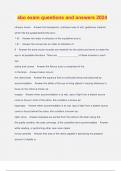
abo exam questions and answers 2024
abo exam questions and answers 2024 vitreous humor - Answer-the transparent, colorless mass of soft, gelatinous material which fills the eyeball behind the lens: 1.42 - Answer-the index of refraction of the crystalline lens is: 1.37 - Answer-the cornea has an index of refraction of: 6 - Answer-the extra-ocular muscles are inserted into the sclera and serve to rotate the eye in all possible directions. There are _______________ of these muscles in each eye. sclera and cornea - Answer-the fibrous tunic is comprised of the: in the brain - Answer-fusion occurs: the ciliary body - Answer-the aqueous fluid is continually being manufactured by: accommodation - Answer-the ability of the eye to bring objects if varying distances to focus on the retina is known as: myopia - Answer-when accommodation is at rest, rays of light from a distant source come to focus in front of the retina. this condition is known as: hyperopia - Answer-when accommodation is at rest, rays of light from a distant source come to focus behind the retina. this condition is known as: optic nerve - Answer-impulses are carried from the retina to the brain along the: the pupils constrict, the eyes converge, & the crystalline lens accommodates - Answer- while reading, or performing other near vision tasks: forvea centralis - Answer-that area of the retina capable if perceiving the greatest amount of details is: 43 diopters - Answer-the average cornea has a refractive power of approximately: the epithelium - Answer-that layer if the cornea which is highly regenerative is: rods - Answer-Night vision is chiefly a function of the: esophoria - Answer-A tendency of the visual axis to deviate inward when the eyes are in a position of the rest is known as: hyperopic - Answer-A "farsighted" eye is one that is: diplopia - Answer-The term used to indicate "double vision" is: presbyopia - Answer-The condition in which the ability to accommodate for near vision ecomes inadequate because of loss of elasticity of the crystalline lens is called: amblyopia - Answer-When there is loss of vision without any apparent disease of the eye, it is known as: astigmatism - Answer-A refractive error in which the rays of light do not come to a single point of focus is called: cataract - Answer-The condition in which the crystalline lens of the eye gradually loses its transparency with consequent loss of visual acuity is known as: glaucoma - Answer-An ocular disease as its primary characteristic a sustained increase in intraocular pressure. posterior chamber - Answer-The space between the back of the iris and the front of the lens which is filled with aqueous is the: hyperphoria - Answer-A tendency of one eye to deviate upward is: cones - Answer-The photosensitive receptors of the retina which are responsible for sharp visual acuity and color perception are the: the stroma - Answer-The layer of the cornea which comprises ninety percent of its thickness is: anisometropia - Answer-A condition in which the refractive error of one eye significantly differs from that of the other and where both eyes have the same sign (i.e. both eyes are myopic or myperopic) is known as: compound hyperopic astigmatism - Answer-The refractive error which results in two points of focus falling behind the retina is: irregular astigmatism - Answer-The refractive condition caused by a damaged cornea so that rays of light come to many focal points on the retina is known as: IN - Answer-When the optical centers of
Written for
- Institution
- ABO
- Course
- ABO
Document information
- Uploaded on
- February 16, 2024
- Number of pages
- 43
- Written in
- 2023/2024
- Type
- Exam (elaborations)
- Contains
- Questions & answers
Subjects
-
abo exam questions and answers 2024

Also available in package deal