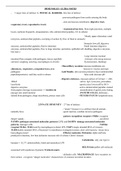
Straighterline Intro duction to Statistics Questions and Answers Already Passed Four steps in the process of statistics ✔✔1. Producing Data 2. Exploratory Data Analysis 3. Probability 4. Inference Categorical variable ✔✔places individuals into one of several groups Two types: nominal and ordinal Quantitative Variable ✔✔represents a measurement or a count Two types: Interval and ratio Nominal Variable ✔✔categorical variables where there is no natur al order among the categories Ordinal variable ✔✔categorical variables where there is natural order among the categories Interval Variable ✔✔a measurement or count for which it makes sense to talk about the difference between values, but it does not make sense to talk about the ratio between values; 0 does not represent the absence of quanitity Ratio Variable ✔✔quantitative variables for which it makes sense to talk about the difference between values AND the ratio between values; 0 represents the absenc e of quantity What type of variable?: eye color ✔✔nominal What type of variable?: socioeconomic status with categories low, med, high ✔✔Ordinal What type of variable?: Temperature ✔✔Interval What type of variable?: Income ✔✔Ratio
Exam (elaborations)
Straighterline Introduction to Statistics Questions and Answers Already Passed
Rating
Sold
-
Pages
11
Grade
A+
Uploaded on
14-02-2024
Written in
2023/2024
Straighterline Introduction to Statistics Questions and Answers Already Passed Four steps in the process of statistics 1. Producing Data 2. Exploratory Data Analysis 3. Probability 4. Inference Categorical variable places individuals into one of several groups Two types: nominal and ordinal Quantitative Variable represents a measurement or a count Two types: Interval and ratio Nominal Variable categorical variables where there is no natural order among the categories Ordinal variable categorical variables where there is natural order among the categories Interval Variable a measurement or count for which it makes sense to talk about the difference between values, but it does not make sense to talk about the ratio between values; 0 does not represent the absence of quanitity Ratio Variable quantitative variables for which it makes sense to talk about the difference between values AND the ratio between values; 0 represents the absence of quantity What type of variable?: eye color nominal What type of variable?: socioeconomic status with categories low, med, high Ordinal What type of variable?: Temperature Interval What type of variable?: Income Ratio Visual display and numerical summary for a single categorical variable pie chart or bar chart and category percentages Visual display and numerical summary for a single quantitative variable histogram or stemplot and descriptive statistics Visual display and numerical summary for C->C Two way table and conditional percentages Visual display and numerical summary for C->Q Side by side box plots and descriptive statistics Visual display and numerical summary for Q->Q Scatterplot and correlation coefficient (r) Standard Deviation Rule Approximately 68% of observations fall within 1 sd of the mean, 95% within 2 sd, 99.7% (or virtually all) within 3 sds Interquartile Range (IQR) Middle 50% of the data IQR= Q3-Q1 Finding an outlier using IQR An observation is considered a suspected outlier if it is: less than Q1 - 1.5(IQR), or more than Q3 + 1.5(IQR). Interpreting scatterplots: 1. positive relationship displays as 2. negative relationship displays as 1. upward slope 2. downward slope Interpreting Scatterplots: How to tell if a linear relationship is strong or weak closer to -1 is a strong negative linear relationship closer to +1 is a strong positive linear relationship close to 0 is a weak linear relationship Interpreting Scatterplots: Linear regression Finding the line that best fits the pattern of the linear relationship (the line that describes how the response variable linearly depends on the explanatory variable Interpreting Scatterplots: Least Squares Regression Line Has the smallest sum of squared vertical deviations of the data points from the line. Interpreting Scatterplots: Extrapolation Prediction for ranges of the explanatory variable that are not in the data; is not reliable and should be avoided Association (does/does not) imply causation. Does not Lurking Variable a variable that is not among the explanatory or response variables in a study, but could substantially affect your interpretation of the relationship among those variables Simpson's paradox When a lurking variable causes you to rethink the direction of an association Probability sampling plan any sampling plan that relies on random selection (avoids bias). Simple Random Sampling Every member of the population has an equal probability of being selected for the sample Cluster Sampling Used when the population is naturally divided into groups. Take a random sample of clusters and use all individuals within those clusters as the sample. Stratified sampling Used when the population is naturally divided into sub-populations called stratum. Choose a simple random sample from each stratum and use these together as the sample. Multistage sampling a probability sampling technique involving at least two stages: a random sample of clusters followed by a random sample of people within the selected clusters Observational study values of the variable or variables of interest are recorded as they naturally occur; no interference Sample surveys a particular type of observational study in which individuals report variables' values themselves, frequently by giving their opinions. Experiment researchers "take control" of the values of the explanatory variable because they want to see how changes in the value of the explanatory variable affect the response variable The Complement Rule P(not A) = 1 - P(A) useful for finding events of the type "at least one of..." General Addition Rule P(A or B) = P(A) + P(B) - P(A and B) used to find events of the type events of the type "A or B" General Multiplication Rule P(A and B) = P(A) * P(B | A) Used for events of the type "A and B" or when A and B are independent: P(A and B) = P(A) * P(B)
Show more
Read less
Institution
Straighterline Introduction To Statistics
Course
Straighterline Introduction to Statistics
Whoops! We can’t load your doc right now. Try again or contact support.
Written for
- Institution
- Straighterline Introduction to Statistics
- Course
- Straighterline Introduction to Statistics
Document information
- Uploaded on
- February 14, 2024
- Number of pages
- 11
- Written in
- 2023/2024
- Type
- Exam (elaborations)
- Contains
- Questions & answers
Subjects
-
straighterline introduction to statistics question
Content preview
$9.99
Get access to the full document:
100% satisfaction guarantee
Immediately available after payment
Both online and in PDF
No strings attached

Also available in package deal
Package deal
Straighterline Business Statistics Bundled Exams Questions and Answers (2024/2025) (Complete and Accurate)
10
2024
$ 98.90
More info