

CSET: World Languages Subtest IV Questions With Correct Solutions
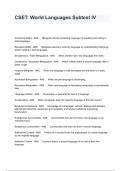
CSET: World Languages Subtest IV Questions With Correct Solutions CSET: World Languages Subtest IV Productive Ability - ANS Bilinguals actively producing language by speaking and writing in both languages. Receptive Ability - ANS Bilinguals passively receiving language by understanding (listening) and/or reading in both languages. Simultaneous / Infant Bilingualism - ANS When children learn two languages from birth. Consecutive / Sequential Bilingualism - ANS When children learn a second language after 3 years of age. Incipient Bilinguals - ANS When one language is well developed and the other is in early stage. Ascendant Bilingualism - ANS When second language is developing. Recessive Bilingualism - ANS When one language is decreasing temporarily or permanently loss. Language Attrition - ANS Temporarily or permanently loss of a language. Acculturation - ANS When immigrants learn the majority language of the host country. Bicultural Competence - ANS Knowledge of 2 languages' cultures, feelings and attitudes, appropriate behaviors, awareness and sympathy, and having confidence expressing biculturalism. Endogenous Communities - ANS Communities that use more than one language on an everyday basis. Exogenous Communities - ANS Communities that does not have a second language. Subtractive Context - ANS Politics of a country favors the replacement of a home language by the majority language. Addictive Context - ANS A person learns a second language at no cost to their first language. Elective Bilingualism - ANS When individuals choose (elect) to learn a 2nd language (in classroom). Circumstantial Bilinguals - ANS When individuals learn another language to function effectively because of their circumstances (immigrants). Four Language Abilities - ANS Listening, reading, speaking, and writing. Oracy - ANS Listening and speaking. Literacy - ANS Reading and writing. Minimal Bilingualism - ANS Knowing a language at a tourist level fluency, a few words and/or greeting phrases. Maximal Bilingualism - ANS Knowing a language at a native speaker fluency. Balance Bilingualism - ANS Equally fluent in two languages. Semilingualism / Double Semilingualism - ANS Insufficient competence in either 1st and/or 2nd languages. Functional Bilingualism - ANS Individuals can function with two languages in a particular setting; when, where, and whom. Organizational Competence - ANS The organizational relationship among signs and their referents. Includes grammatical competence and textual competence. Pragmatic Competence - ANS The pragmatic relationship between language users and the context of communication. Includes Illocutionary Competence and Sociolinguistic Competence. Strategic Competence / Metacognitive Strategy - ANS Individuals constantly plan, execute and access their communication strategies and delivery. Communicative Performance Testing - ANS Testing that involves creative, unpredictable, contextualize conversation. Language Competence - ANS Competence that involves the ability to create and understand sentences that one has not heard before. Grammatical Competence - ANS Competence that involves the knowledge of vocabulary, syntax, morphology and phonology/graphology. Textual Competence - ANS Competence that involves the knowledge of the conventions for joining utterance together to form text, consisting of two or more utterances (Coherence/rhetoric/organization). Illocutionary Competence - ANS Competence that involves the ideational (convey meanings and experiences), manipulative (using language in an instrumental way), heuristic (for discovery and to solve problem), and imaginative function (for humor and fantasy). Socialinguistic Competence - ANS Competence that involves the sensitivity to social context where language is used (Dialect/naturalness/culture). Language Skills - ANS The skills to read, write, speak, and listen effectively. They are observable, clearly defined components of language. Language Performance - ANS The actual production of language (performance); imperfect because of factors like fatigue and distraction. Language Achievement - ANS Outcome of formal instruction. Language Planning - ANS Planning that involves deliberate efforts to take influence the behavior of others with respect to the acquisition, structure, or functional allocation of their language codes. Status Planning - ANS Planning that involves raising of status of a language within society across as many institutions as possible. Using government policies. Corpus Planning - ANS Planning that involves modernizing terminology, standardization of grammar and spelling through schools and public mediums. Acquisition Planning - ANS Planning that is the bedrock of language planning. Creating language spread by increasing the number of speakers. Sociolinguistic - ANS The study of language in relation to social groups, social class, ethnicity and other interpersonal factors in communication. Diglossia - ANS Two languages in society. Intergenerational Transmission - ANS Language is pass from one generation to another. Additive Context - ANS The addition of a 2nd language and culture unlikely to replace or displace the 1st language. Subtractive Context - ANS The 2nd language and culture are acquired with pressure to replace or demote 1st language. Language Shift - ANS A downwards language movement: reduction in speakers, usages, proficiency, and saturation. Language Maintenance - ANS Relative language stability (maintaining) in number and distribution of its speakers, proficiency, and retention. Language Spread - ANS Numerical increase (spread) in users geographically or functionally. Three Generation Shift - ANS Language shift among immigrants from 1st to 2nd within 3 generations resulting in the 3rd generation becoming monolingual. Codeswitching - ANS Speakers switching languages within the course of a single conversation at word, sentence, or block of speech. Codemixing - ANS Changing language by borrowing, altering, and mixing words and grammar. Societal Reasons For 2nd Language Aquisition - ANS Reasons: Assimilation into new culture, preservation of heritage, societal harmony, economic and trade, and access to information (power). Individual Reasons For 2nd Language Aquisition - ANS Reasons: Cultural awareness, cognitive development, self development (social, emotional, and moral), and career and employment. Integrative Motivation - ANS Language learning motivation that involves learning a language to identify with or join (integrate) with another language group. Instrumental Motivation - ANS Language learning motivation that involves learning a language for useful purposes like jobs or assist others. Deficit Viewpoint - ANS Viewpoint stating that bilingualism create burden on the brain, mental confusion, inhibits acquisition of majority language, identity conflict, split loyalties, and schizophrenia. Divergent Thinking - ANS A cognitive process that explore different ways to approach a topic, subject, and object to produce various as many answer as possible. Creative Thinking - ANS A cognitive process involving imagination, intuition, and spontaneity to create a process and object. Balance Theory - ANS A (debunked) theory stating that two languages exist together in balance. Iceberg Analogy - ANS An analogy that states although two languages are visibly different in outward conversation, but they operate through the same central processing system underneath the surface (do not function separately). Common Underlying Proficiency Model - ANS The evidence suggests that language attributes are not separated in the cognitive system, but transfer readily and are interactive. Metalinguistic - ANS The ability to reflect on the use of language as in thinking about language, rather than just using it. Selective Attention - ANS The ability to focus on only one stimulus from among all sensory input; when there is competing or misleading information. Threshold Theory - ANS Idea that the further the child moves to balanced bilingualism, the more likely cognitive advantages exist. 1st threshold: enough proficiency to avoid negative effects. 2nd threshold: enough for advantages to exist Communicative Sensitivity - ANS Sensitivity to social nature and communicative functions of language (when to use which language, etc.). Allows bilinguals to correct errors faster and understand needs of listener. Balanced Bilingual - ANS A person who is fluent in 2 languages, not favoring one over the other. Context Embedded - ANS Language that is supplemented (embedded) by contextual or visual stimuli that assist comprehension; face to face situations provide non-verbal support to secure understanding. Context Reduced - ANS Language that is not supplemented (reduces) by contextual clues or visual stimuli, e.g. lectures, some types of text books, or telephone conversations. Basic Interpersonal Communication Skills - ANS BICS occur when there are context embedded situations provide non-verbal support to secure understanding. Cognitive Academic Learning Proficiency - ANS CALP occur in context reduce academics situations where higher order thinking skills (analysis, synthesis, and evaluation) are required in the curriculum supportive context. Instructional Implementation of CALP - ANS Instructional implementation that involves cognitive (challenging/higher order of thinking), academic (content integrated with language of academic areas), and language (critical language awareness linguistically and socioculturally/sociopolitically). Context Embedded Communication - ANS Uses visuals and vocal props to help student understand what is said (providing context). Picture and other objects graphically explain and demonstrate. Gestures are used and so is tone of voice. Context Reduced Communication - ANS Has no (context) visual cues so the student must rely on competency and fluency to understand (phone conversations, meaning is restricted to words/text) Cognitively Demanding Communication - ANS Communication that occur in a classroom where much information at a challenging level needs processing quickly. Cognitively Undemanding Communication - ANS Communication that occur where a person mastery of language skills sufficient to enable easy communication. Developmental Interdependence Hypothesis - ANS Hypothesis that suggests L1 skills transfer over to L2 reading. Threshold Theory Levels - ANS Bottom Floor: Limited bilinguals - children have low levels of competence in both languages, with likely negative effects. Second Floor: Less balance bilinguals - children have age-appropriate competence in one but not two languages, there are unlikely to be positive or negative cognitive consequences. Top Floor: Balanced bilinguals - children have age-appropriate competence in both languages and there are likely to be positive advantages. Nationality Act (1906) - ANS Law requiring immigrants to be proficient in English to become naturalized citizens. Meyer v. Nebraska (1923) - ANS Supreme Court declared a state law prohibiting the teaching of a foreign language unconstitutional under 14th Amendment. Found that proficiency in other language was not "injurious to health or morals of children." Amendment to Nationality Act (1950) - ANS Amendment to a law passed in 1906; English literacy required for naturalization. Brown v. Board of Education (1954) - ANS Supreme Court ruled that segregated education based on race made unconstitutional. National Defense Education Act (1958) - ANS The first federal legislation to promote foreign language learning for national security. Immigration and Nationality Act (1965) - ANS Law that changed the national quota system of limits, especially for Asian and Latin American immigrants, per year. It emphasizes family unification over occupational skills. Elementary and Secondary Education Act - ESEA (1965) - ANS Law that emphasizes equal access to education and establishes high standards and accountability. The law authorizes federally funded education programs that are administered by the states to meet the needs of educationally deprived children. Introduced by Ralph Yarborough. Lau v. Nichols (1974) - ANS After a Chinese students sued, the Supreme Court ruled that language programs for language minorities not proficient in English were necessary to provide equal educational opportunities. Lau Remedies (1975) - ANS Legislative remedies that are informal guideline on schools' obligations toward LEP students. This required the provision of bilingual education in districts where the civil rights of such students had been violated. Casteneda v. Pickard (1981) - ANS Plaintiff sued the state of Texas, the Supreme Court's decision which established a three-part assessment for determining how bilingual education programs would be held responsible for meeting the requirements of the Equal Educational Opportunities Act of 1974. The criteria are: 1)The bilingual education program must be "based on sound educational theory." 2)The program must be "implemented effectively with resources for personnel, instructional materials, and space." 3) After a trial period, the program must be proven effective in overcoming language barriers/handicaps. US English Movement Launched (1983) - ANS A movement that involves a debates about the dominant place of English in law, society, and education became more prominent. California Proposition 227 (1998) - ANS The 'Unz initiative' sought to impose severe restrictions on native-language instruction for English learners in California. Most bilingual programs dismantled, with similar measures in Arizona (2000) and Massachusetts (2002). No Child Left Behind - NCLB (2002) - ANS A Reauthorization ESEA of 1965 and repeal of of Bilingual Education Act, establishing that schools and states encouraged to move to English-only education through mandatory HIGH-STAKES testing in English. Measures of Adequate Yearly Progress (AYP) reported for schools, school districts, and states including English proficiency. Transitional Bilingual Education (TBE) - ANS Bilingual education that has language minority students move (transition) from minority to majority language aiming for assimilation. It is subtractive and has relative monolingual outcome. Maintenance Bilingual Education - ANS Bilingual education that attempt to maintain the minority language in the child, strengthening the child's sense of cultural identity and affirming the rights of an ethnic minority group in a nation. Static Maintenance Bilingual Education - ANS Bilingual education aims to maintain language skills at the level of the child entering a school. It tries to prevent home language loss. Developmental Maintenance / Enrichment Bilingual Education - ANS Bilingual education seeks to develop a student's home language skills to full proficiency and full biliteracy. It aims to extend (enrich) the individual and group use of minority languages, leading to cultural pluralism and linguistic diversity. Enrichment Bilingual Education - ANS Bilingual education for language majority children who are adding a 2nd language in school (enrichment classes). Mainstreaming / Submersion (Structure Immersion) - ANS Monolingual education model for Bilingual that has language minority students in majority language class aiming for assimilation (mainstreaming). It is subtractive and has a monolingual outcome. Mainstreaming / Submersion with Withdrawal (Pull Out) Classes / Sheltered English / Content-based ESL - ANS Monolingual education model for Bilingual that has language minority students in majority language class will "pull out" for L2 lessons aiming for assimilation. It is subtractive and has a monolingual outcome. Segregationist Monolingual Education - ANS Monolingual education model for Bilingual that has language minority students forced into minority language class aiming for apartheid. It has a monolingual outcome. Mainstream Bilingual Education with Foreign Language Teaching - ANS Bilingual education that has language majority students in majority language class with L2/Foreign Language lessons aiming for limited enrichment. It has a limited bilingual outcome. Separatist Bilingual Education - ANS Bilingual Education model that has language minority students choosing to be in minority language class aiming for detachment / autonomy / separation. It has a limited bilingual outcome. Immersion Bilingual Education - ANS Bilingual education that has language majority students (immerse) in bilingual classroom with emphasis on L2 aiming for pluralism and enrichment. It is addictive and has bilingualism and biliteracy outcome. Maintenance / Heritage Language Bilingual Education - ANS Bilingual education that has language minority students in bilingual classroom with emphasis on L1 (heritage language) aiming for maintenance, pluralism, and enrichment. It is addictive and has bilingualism and biliteracy outcome. Two Way / Dual Language Bilingual Education - ANS Bilingual education that has mixed language with minority and majority students together in bilingual classroom (minority and majority) aiming for maintenance, pluralism, and enrichment. It is addictive and has bilingualism and biliteracy outcome. Mainstream Bilingual Education - ANS Bilingual education that has language majority students in (mainstream) two majority languages pluralism classroom aiming for maintenance, biliteracy, and enrichment. It is addictive and has bilingualism outcome. SDAIE - ANS Specially Designed Academic Instruction in English Early-exit Transitional Bilingual Education - ANS Transitional Bilingual Education program that has 2 years maximum help using the mother tongue; the purpose is to mainstream students as quickly as possible. Late-exit Transitional Bilingual Education - ANS Transitional Bilingual Education program that allow around 40% of classroom teaching in the mother tongue until the 6th grade. 50:50 Dual Language Bilingual Program - ANS Dual language bilingual program where 50% - 50% balance in use of languages is attempted in both early and later grades. Variations between 90:10 and 50:50 are possible where the minority language will be given more time in early grades and majority language will be more accent in later grades. 90:10 Dual Language Bilingual Program - ANS Dual language bilingual program where 90% of instruction is in the minority language in kindergarten and 1st grade, with 10% to develop English oral language proficiency and pre-literacy skills. Over the remaining grades this ratio changes to 50:50. Constructivist Theory - ANS Theory suggests that learning best take place in a holistic sense with content-based 2nd language instruction, meaning and understanding is the focus, and second language learning is a by-product of these construction. Interactive Social Activity - ANS Multiliteracy strategies and activities that include discussing experiences of the home as well as the home country, of trips and television, religion and family rituals, anecdotes and achievements, imaginations and shared incidents Three models of parental involvement - ANS Family Influence Model, School Reform Model, and Cooperative System Model Family Influence Model - ANS Parental involvement model where family is seen as a direct recipient of school influence, and the school-family collaboration establishes maximally effective environment learning. School Reform Model - ANS Parental involvement model where parents try to change schools and make them more responsive to parent. Cooperative System Model - ANS Parental involvement model where parents see the home, school and community as interrelated, cooperative, and functioning as a whole. Fund of Knowledge - ANS Level of knowledge in context of students' culture and education. Cultural practices and bodies of knowledge and information that households use to survive, to get ahead or to thrive. Three Perspectives On Language - ANS Language perspectives involve: Language as a problem, language as a right, and language as a resource. language-as-problem Perspective - ANS A point of view in which the home language of ELLs is viewed as a problem to be overcome as students learn English and academic content through English. Language-as-resource Perspective - ANS A point of view in which the native language of ELLs is viewed as a strength to be developed and built on to help the students learn English and academic content. Language-as-right Perspective - ANS A point of view in which the native language of ELLs is viewed as a basic human right which individuals have the choice of language and bilingual education. Pluralist ideology - ANS The belief (ideology) that all ways (or multiple ways) of speaking and being are valued. It asserts an individual's liberty to own, learn, and use two or more languages. Civic Ideology - ANS The ideology that expects language minorities to adopt the public values of the politically dominant majority while allowing freedom in the private values of individuals. Assimilation Ideology - ANS Belief (ideology) that the state has the right to intervene into language values even when it is private. Immigrants are expected to abandon their heritage language to assimilate. Ethnist Ideology - ANS A belief that certain racial groups (ethnicity) are given full legal status as determined by blood, birth, and kinship which forces language minorities to give up their language and culture and adopt that of the dominant group. It excludes minorities from assimilating even when they seek it. Interdependence Hypothesis - ANS Hypothesis that states the degree of knowledge and skill evident in L1 will determine the ease of transfer to L2.
Document information
- Uploaded on
- February 14, 2024
- Number of pages
- 11
- Written in
- 2023/2024
- Type
- Exam (elaborations)
- Contains
- Questions & answers


