
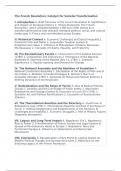
The French Revolution: Catalyst for Societal Transformation
I. Introduction A. Brief Overview of the French Revolution B. Significance
and Impact on European History C. Thesis Statement: The French
Revolution, which unfolded between 1789 and 1799, stands as a
transformative period that radically reshaped political, social, and cultural
landscapes in France and reverberated across Europe.
II. Historical Context A. Economic Challenges and Social Inequality 1.
Financial Crisis and Debts 2. Inequitable Taxation System B.
Enlightenment Ideas 1. Influence of Philosophers (Voltaire, Rousseau,
Montesquieu) 2. Concepts of Liberty, Equality, and Fraternity
III. Pre-Revolutionary Events A. Convocation of the Estates-General
(1789) 1. Composition and Grievances 2. Emergence of the National
Assembly B. Storming of the Bastille (July 14, 1789) 1. Symbolic
Significance 2. Popular Uprising and Demand for Change
IV. The National Assembly and the Abolition of Feudalism A.
National Constituent Assembly 1. Declaration of the Rights of Man and of
the Citizen 2. Abolition of Feudal Privileges B. Women's March on
Versailles (October 1789) 1. Demands for Bread and Political Reforms 2.
Shifting Dynamics of the Revolution
V. Radicalization and the Reign of Terror A. Rise of Radical Political
Groups 1. Jacobins and the Committee of Public Safety 2. Maximilien
Robespierre and Georges Danton B. Execution of Louis XVI (1793) 1.
Symbolic Act and Political Ramifications 2. Escalation of Revolutionary
Violence
VI. The Thermidorian Reaction and the Directory A. Overthrow of
Robespierre (July 1794) 1. Thermidorian Reaction and End of the Reign of
Terror 2. Political Realignment and Establishment of the Directory B.
Challenges and Instability 1. Economic Struggles 2. Rise of Military Figures
(Napoleon Bonaparte)
VII. Legacy and Long-Term Impact A. Napoleonic Era 1. Napoleon's
Rise to Power 2. Transformation of French Society and Legal System B.
Spread of Revolutionary Ideals in Europe 1. Napoleonic Wars and
Territorial Changes 2. Influence on Nationalism and Democratic
Movements
VIII. Conclusion A. Recapitulation of Key Points B. Lasting Impact on
Modern Political Thought and Societal Structures C. Reflection on the
Enduring Legacy of the French Revolution
I. Introduction A. Brief Overview of the French Revolution B. Significance
and Impact on European History C. Thesis Statement: The French
Revolution, which unfolded between 1789 and 1799, stands as a
transformative period that radically reshaped political, social, and cultural
landscapes in France and reverberated across Europe.
II. Historical Context A. Economic Challenges and Social Inequality 1.
Financial Crisis and Debts 2. Inequitable Taxation System B.
Enlightenment Ideas 1. Influence of Philosophers (Voltaire, Rousseau,
Montesquieu) 2. Concepts of Liberty, Equality, and Fraternity
III. Pre-Revolutionary Events A. Convocation of the Estates-General
(1789) 1. Composition and Grievances 2. Emergence of the National
Assembly B. Storming of the Bastille (July 14, 1789) 1. Symbolic
Significance 2. Popular Uprising and Demand for Change
IV. The National Assembly and the Abolition of Feudalism A.
National Constituent Assembly 1. Declaration of the Rights of Man and of
the Citizen 2. Abolition of Feudal Privileges B. Women's March on
Versailles (October 1789) 1. Demands for Bread and Political Reforms 2.
Shifting Dynamics of the Revolution
V. Radicalization and the Reign of Terror A. Rise of Radical Political
Groups 1. Jacobins and the Committee of Public Safety 2. Maximilien
Robespierre and Georges Danton B. Execution of Louis XVI (1793) 1.
Symbolic Act and Political Ramifications 2. Escalation of Revolutionary
Violence
VI. The Thermidorian Reaction and the Directory A. Overthrow of
Robespierre (July 1794) 1. Thermidorian Reaction and End of the Reign of
Terror 2. Political Realignment and Establishment of the Directory B.
Challenges and Instability 1. Economic Struggles 2. Rise of Military Figures
(Napoleon Bonaparte)
VII. Legacy and Long-Term Impact A. Napoleonic Era 1. Napoleon's
Rise to Power 2. Transformation of French Society and Legal System B.
Spread of Revolutionary Ideals in Europe 1. Napoleonic Wars and
Territorial Changes 2. Influence on Nationalism and Democratic
Movements
VIII. Conclusion A. Recapitulation of Key Points B. Lasting Impact on
Modern Political Thought and Societal Structures C. Reflection on the
Enduring Legacy of the French Revolution


