Maryville NURS 612 Exam 2 | Questions with 100% Correct Answers | Verified | Updated 2024
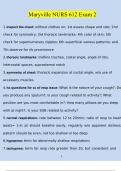
inspect the chest: without clothes on; 1st assess shape and size; 2nd check for symmetry; 3rd thoracic landmarks; 4th color of skin; 5th check for supernumerary nipples; 6th superficial venous patterns; and 7th observe for rib prominence thoracic landmarks: midline trachea, costal angle, angle of ribs, intercostal spaces, suprasternal notch symmetry of chest: thoracic expansion at costal angle, w/o use of accessory muscles hx questions for cc of resp issue: What is the nature of your cough?; Do you produce any sputum?; Is your cough related to activity?; What position are you most comfortable in?; How many pillows do you sleep with at night?; Is your SOB related to activity? normal respirations: rate between 12 to 20/min; ratio of resp to heart beats= 1:4; pt should breathe easily, regularly w/o apparent distress; pattern should be even, not too shallow or too deep hypopnea: term for abnormally shallow respirations tachypnea: term for resp rate greater than 20, but consistent and may occur during hyperventilation; often a symptom of pain bradypnea: term for resp rate less than 12; may indicate neurologic or electrolyte disturbances, infection, or conscious response to protect against the pain of pleurisy or other irritative pneumonia. Can also be 2/2 level of cardio fitness hyperventilation: term for fast and deep, heavy respirations, can be caused by exercise, anxiety, and CNS and metabolic diseases hyperpnea: term for abnormally deep respirations kussmaul respirations: deep and mostly rapid respirations, used to describe resp effort of metabolic acidosis cheyne stokes respirations: regular breathing with intervals of apnea by crescendo decrescendo breathing; can be seen in sleeping pts, but mostly pts who are very ill, esp with brain damage biot respirations: irregular breathing that varies in depth and is interrupted irregularly by intervals of apnea; associated with severe and persistent increased intracranial pressure, resp compromise from drug poisoning, or brain damage at the medulla and generally equals poor prognosis peripheral areas related to respiratory assessment: observe the lips and nails for cyanosis or pallor; lips for pursing; fingers for clubbing; and alae nasi for flaring pleural friction rub: dry, rubbing, or grating sound; palpable, coarse, grating vibration; usually on inspiration; caused by inflammation of the pleural surfaces; think feel of leather rubbing on leather
Written for
- Institution
- Maryville NURS 612
- Course
- Maryville NURS 612
Document information
- Uploaded on
- February 1, 2024
- Number of pages
- 17
- Written in
- 2023/2024
- Type
- Exam (elaborations)
- Contains
- Questions & answers
Subjects

Also available in package deal